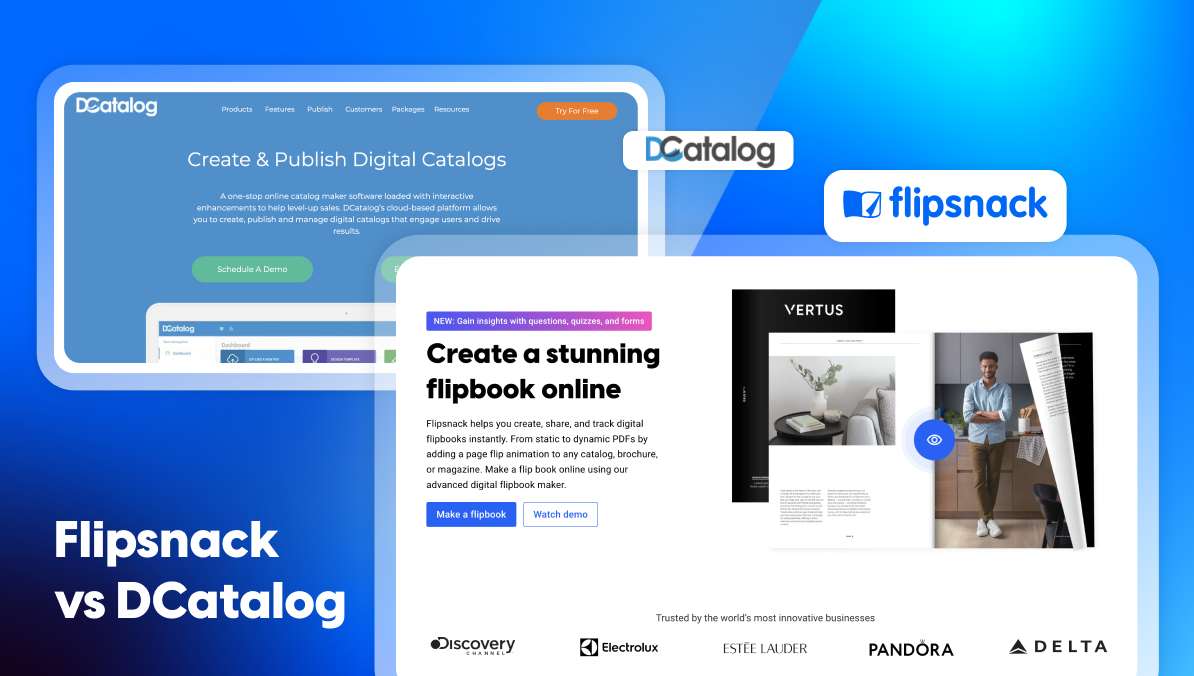
Flipsnack vs. DCatalog: Which Platform is Best for Product Catalogs?
Published on: 28 October 2025
Last updated: 17 September 2026
You’ve narrowed your shortlist to two names: Flipsnack and DCatalog. One call with sales already happened, or you’re about to book it, and you want the honest version before that conversation, not the sales deck version.
For companies managing large product inventories (manufacturers, wholesalers, retailers and service providers), traditional catalog creation is becoming time-consuming. Manual updates and static designs can’t keep up with modern buyers’ expectations or the pace of digital commerce.
These two platforms keep coming up as the fix.
What is DCatalog? DCatalog is a digital publishing platform that converts PDFs and structured product feeds into interactive online catalogs, built around data pulled from a PIM or ERP system and an embedded shopping cart for checkout inside the catalog itself.
What is Flipsnack? Flipsnack is a digital publishing platform that turns PDFs and product data into interactive, on-brand catalogs where buyers can shop and check out directly inside the page. It pairs a no-code design studio with product-feed automation and a Catalog API for PIM and ERP syncing, built for teams that want design control and real data automation.
Both platforms solve the same underlying problem from a different starting point. This comparison walks through interactivity, automation, collaboration, security, pricing, branding and what real users report on G2, so you can see which starting point actually matches how your team operates.
Table of contents
- Flipsnack vs DCatalog at a glance
- How do Flipsnack and DCatalog compare on interactive catalogs?
- How does each platform handle automation and real-time updates?
- How do Flipsnack and DCatalog compare on team collaboration?
- How do Flipsnack and DCatalog compare on security and compliance?
- How do Flipsnack and DCatalog compare on pricing?
- How do Flipsnack and DCatalog compare on branding control?
- Which platform has better reviews, Flipsnack or DCatalog?
- How do Flipsnack and DCatalog compare on support and onboarding?
- Final verdict: Flipsnack vs DCatalog
Flipsnack vs DCatalog at a glance
| Flipsnack | DCatalog | |
| Best for | Design-driven catalogs with product-feed automation and buyer-facing shopping built in | Data-driven catalogs generated from PIM, ERP or product feeds |
| Automation | Catalog API for PIM/ERP syncing, plus a Catalog Generator that builds catalogs from CSV, Sheets or a feed URL, with automatic SKU tagging | Catalog generation from structured PIM/ERP data, SKU tagging |
| Ecommerce | Shoppable links, built-in shopping cart, wishlist, Shopify checkout, WhatsApp checkout | Buy buttons, shopping windows, shopping cart, ecommerce integrations |
| G2 Reviews | 4.7 out of 412 G2 reviewers | 4.6 out of 33 G2 reviewers |
| Ease of use | 9.4 out of 377 G2 reviewers | 8.9 out of 30 G2 reviewers |
| Ease of setup | 9.5 out of 294 G2 reviewers | 8.9 out of 22 G2 reviewers |
How do Flipsnack and DCatalog compare on interactive catalogs?
The short answer: Flipsnack spreads interactivity across the whole catalog experience, video, links, product tags and multiple checkout paths, while DCatalog concentrates its interactivity on the shopping moment itself.
Buyers skim past a plain product grid today. They want proof an item performs before committing and a fast way to act once they’re convinced.
Flipsnack’s interactive elements build that moment into the catalog itself:
- Embedded videos, slideshows, GIFs and audio
- Product tags, shopping cart and buy buttons
- Living visuals that turn a still product photo into a video
- Lead forms and contact forms wired into HubSpot or Salesforce
- Clickable CTAs and hyperlinks that shorten the path from browse to reply
- Checkout by Shopify cart, WhatsApp, email or wishlist, whichever fits how they buy
DCatalog offers interactive elements too, links, popups, audio and video. The interactivity is there, but DCatalog focuses more on simplicity than on polish. Its lightboxes connect directly to Shopify, WooCommerce or Magento, so an item added inside the catalog lands straight in the site’s live cart.
Choose Flipsnack if brand storytelling and a catalog that feels professionally designed matter to you. Choose DCatalog if you want a simple, transaction-focused catalog and visual polish isn’t a priority.
How does each platform handle automation and real-time updates?
The short answer: Flipsnack connects to a spreadsheet, feed URL or a connected PIM/ERP system through its Catalog API, so catalogs update without a manual rebuild. DCatalog takes the same structured-data approach, generating catalogs directly from PIM, ERP, XML or CSV feeds.
For companies managing thousands of SKUs, automation is no longer optional. It’s the key to keeping catalogs accurate, fast and easy to update.
With Flipsnack, product data and design work together seamlessly. You can link a catalog directly to a spreadsheet, CSV or system export, so every price change, promotion or new product appears automatically, without rebuilding pages from scratch. This simple connection saves hours of manual work and helps you avoid costly mistakes caused by outdated information.
Automation in Flipsnack goes beyond updating data. It lets you build shoppable catalogs in whichever way fits your team. Generate a full catalog automatically from a product feed. Turn an existing PDF into a shoppable one through SKU tagging. Or drag and drop products straight into your layout when design control matters most. You can also:
- Update existing catalogs whenever your spreadsheet changes
- Automate multimedia elements, like product images, videos, pop-ups or links
- Make catalogs shoppable, combining automation with direct shopping from the catalog
- Request custom-branded Catalog Generator templates
Electrolux runs 345 interactive catalogs built this way across 17 countries, with 76,300 views and 8,800 downloads from partners and customers, proof this scales well past a single region or product line.
Flipsnack also integrates with Zapier, Google Analytics, Google Tag Manager, Adobe InDesign and more, so automation fits into a wider marketing workflow rather than living on its own.
DCatalog also handles large-scale automation, regenerating catalogs from PIM, ERP, XML or CSV feeds for enterprises managing complex inventories across multiple regions or divisions. Its process stays closer to a fixed feed-to-catalog pipeline, with less flexibility in how a catalog gets built. An automatic link recognition tool matches SKUs to their products as data changes, so catalogs stay accurate without manual tagging.
Out-of-the-box integrations run fewer than Flipsnack offers, though DCatalog provides custom integration support for enterprise needs.
How do Flipsnack and DCatalog compare on team collaboration?
The short answer: Flipsnack builds collaboration into the platform through multiple workspaces, custom roles and permission-based access, while DCatalog supports multi-user access too, but with lighter features for team management.
Cross-departmental catalog work (marketing drafting, design refining, sales approving) breaks down fast without shared tooling built for it. Flipsnack’s collaboration features cover:
- Multiple workspaces, so teams or regions can each manage their own projects in a separate environment
- User roles, each with fully customizable permissions
- Comments left directly on a publication inside Design Studio, instead of feedback scattered across emails
- A shared asset library for brand fonts, logos and templates, so every contributor pulls from the same approved set
- SSO for secure team access, plus user activity logs to track who changed what
One honest note: Flipsnack doesn’t support true simultaneous co-editing of a single document. Instead, it uses a “takeover” model, one person edits at a time, and a teammate can take over editing without losing the other person’s changes.
DCatalog’s collaboration tools run lighter by comparison. The platform doesn’t offer the same in-app commenting or granular role customization Flipsnack includes, and most review and approval work ends up happening outside the platform, over email or a separate project tool.
Choose Flipsnack if your team needs an efficient way to collaborate and organize their work through multiple workspaces, roles and SSO access. Choose DCatalog if collaboration tooling matters less than getting a catalog live fast, and your review process already lives somewhere else.
How do Flipsnack and DCatalog compare on security and compliance?
The short answer: Flipsnack and DCatalog both meet the standard security bar for enterprise software, audited controls, encrypted connections, single sign-on and AWS hosting. Flipsnack extends further with a broader set of ISO certifications, HIPAA-ready configurations and a dedicated privacy officer for GDPR. DCatalog’s edge is deployment flexibility.
Trust decides more catalog platform purchases than any single feature. Here’s what Flipsnack verifies:
- SOC 2 audited controls, ISO 27001, ISO 9001 and ISO 20000-1
- ADA, WCAG 2.1 AA and Section 508 compliance, with a published VPAT
- GDPR compliance across every plan, backed by a dedicated Data Protection Officer
- HIPAA-compliant configurations on Enterprise plans
- TLS encryption (A+ rated) in transit, data encrypted at rest
- SAML 2.0 single sign-on, plus two-factor authentication
Flipsnack helps us improve our internal digital communication. The features in Flipsnack make our collections and functionalities come alive and intriguing, helping us promote every level of detail and design concept, as well as material innovation, to our store staff globally. From the beginning, Flipsnack has understood our priority of IT safety first, and their internal developers have worked to meet our high requirements.
Therese H. Lindeløv, Creative Content Manager, Global Product
DCatalog covers the same core ground. Its site lists SOC 2, ADA, SSO/SAML, TLS 1.2+, MFA/2FA and AWS hosting as standard. Enterprise customers can also move to private cloud or fully in-house hosting.
Choose Flipsnack if you want the broadest certification set, including HIPAA and a formal GDPR program, inside a managed SaaS platform. Choose DCatalog if private cloud or on-premise hosting is a hard requirement your security team won’t waive.
How do Flipsnack and DCatalog compare on pricing?
The short answer: Flipsnack charges a flat monthly rate per plan, with extra users added at a fixed price. DCatalog charges per user and per active link on every paid tier. Below is what each plan actually includes.
| Plan | Price | Users | Key inclusions |
| Free | $0 | 1 | 5 flipbooks, 15 pages each, Flipsnack branding on links and embeds |
| Lite | $14/mo | 1 | 10 flipbooks, 30 pages each, no Flipsnack branding on links or embeds, link detection, 100 AI credits/mo |
| Pro | $38/mo | 1 | 50 flipbooks, 200 pages, video and slideshows, lead forms, full statistics, password-protected sharing, trackable links, 250 AI credits/mo |
| Business | $85/mo, 1 user included, +$25/mo per extra user up to 5 | Up to 5 | 100 flipbooks, custom domain, private sharing with expiring access, branded emails and bookshelves, quizzes and forms, HTML5 download, Zapier, 500 AI credits/mo |
| Enterprise | Custom | Custom | Roles, permissions and activity logs, SAML SSO, SOC 2 Type II, ISO 27001, HIPAA, catalog automation, API, priority support, guaranteed SLA |
DCatalog plans
| Plan | Price | Users | Key inclusions |
| SELECT | $29/mo, per active link | 1 | Interactive flipbooks, mobile and tablet optimization, cloud hosting, real-time updates, logo branding, templates, analytics integration |
| ELITE | $49/mo, per active link | 2 | Custom domains, white-label branding, QR code sharing, video and audio embedding, password protection, team management, statistics |
| Enterprise | Custom, per active link | Custom | Catalog automation, automated catalog generation, AI search, PIM/ERP/API integrations, team permissions, SSO, custom deployment |
Both companies reserve their deepest automation, PIM/ERP integration and AI features for a custom Enterprise quote.
How do Flipsnack and DCatalog compare on branding control?
The short answer: Flipsnack lets you replace its branding entirely, from the player to the domain. Locked templates keep that identity consistent across every asset, and branded emails and bookshelves carry it into your full catalog collection. DCatalog covers the same core ground, custom domains, branded templates and a branded player.
A catalog is not only a sales tool but also a reflection of your brand. Every color, font and layout shapes how customers see your products and your company. For most marketing and design teams, keeping that identity consistent across digital and printed catalogs is essential.
Flipsnack keeps teams on brand with:
- Your own domain for branded catalog links, with Flipsnack removed from URLs
- A branded player, your logo, custom background, accent color, preloader page and favicon
- Toolbar customization, controlling who can share or download your PDF, and what else appears
- A shared brand library for logos, fonts and colors, so every contributor pulls from the same approved set
- Locked templates that keep layouts and visual elements consistent across catalog editions
- Role-based permissions, so only approved users make changes
- Branded emails and bookshelves, so every viewer experiences your identity past the flipbook itself
DCatalog maintains brand identity through a different toolkit:
- Logo, design tools and a customized toolbar for building a branded catalog
- Branded templates to keep catalogs consistent
- Custom domains and a custom introduction page for an on-brand viewer
- Background image customization
Choose Flipsnack if brand consistency across a team, with a shared asset library and role-based control, matters as much as the catalog itself. Choose DCatalog if branding a single catalog covers what you need.
Which platform has better reviews, Flipsnack or DCatalog?
The short answer: On G2’s comparison page, Flipsnack scores higher across every satisfaction metric except one tie, 9.2 versus 9.0 on Meets Requirements, 9.4 versus 8.9 on Ease of Use, with roughly twelve times the review volume.
| Metric | Flipsnack | DCatalog |
| Star Rating | 4.7/5 (413 reviews) | 4.6/5 (33 reviews) |
| Meets Requirements | 9.2 (364 reviews) | 9.0 (29 reviews) |
| Ease of Use | 9.4 (377 reviews) | 8.9 (30 reviews) |
| Ease of Setup | 9.5 (294 reviews) | 8.8.9 (22 reviews) |
| Ease of Admin | 9.4 (150 reviews) | 9.1 (17 reviews) |
| Quality of Support | 9.6 (304 reviews) | 8.99.6 (30 reviews) |
| Good business partner | 9.6 (142 reviews) | 9.4 (17 reviews) |
| Product direction (% positive) | 9.3 (357 reviews) | 8.3 (28 reviews) |
Review volume matters almost as much as the score itself. DCatalog’s numbers rest on 17 to 33 reviews per metric. Flipsnack’s rest on 142 to 413, a gap worth weighing when either score looks close.
How do Flipsnack and DCatalog compare on support and onboarding?
The short answer: Both platforms score identically on G2 for support quality, 9.6 out of 10. Both also back paid support with self-serve resources open to every customer, a help center, guides and video training, available regardless of plan.
Adopting a new tool can feel overwhelming, especially when your team is already juggling tight deadlines, complex product data and existing workflows. Introducing new software and expecting everyone to make it work seamlessly right away is a real challenge.
That’s why Flipsnack offers guidance and support every step of the way. Every plan, including Free, includes live chat support, backed by a full help center and Flipsnack Academy, video walkthroughs covering the entire product from first upload to advanced automation.
Enterprise customers get more on top of that. Our specialists work alongside Enterprise customers to help set up data feeds, automate updates and create catalog templates that fit your brand and process. It’s no surprise that Flipsnack’s support is rated 9.6 out of 10 on G2, based on 304 reviews.
DCatalog scales support the same way, tier by tier. SELECT includes email support, ELITE adds phone support, and Enterprise adds a dedicated account manager with SLA-backed response times from a US-based team. Outside of paid support, DCatalog runs its own self-serve help center with a knowledge base, training videos and a blog. DCatalog’s support scores 9.6 out of 10 on G2 as well, based on 30 reviews.
In short, both platforms back an identical G2 support score with real self-serve resources at every tier.
Final verdict: Flipsnack vs DCatalog
Both platforms handle the fundamentals seriously: interactive catalogs, real automation, solid security and support.
Flipsnack pulls ahead on how a catalog fits your actual workflow. Brand consistency runs through every layer, from a shared asset library to a fully branded player. Collaboration lives natively inside the product, no bouncing feedback between email and a separate design tool. And catalog creation adapts to your team’s workflow, drag and drop automation, a Catalog Generator, or SKU tagging.
DCatalog still fits teams whose priority is a structured, transaction-focused catalog, especially where an embedded quote-request flow or off-cloud hosting matters.
For most teams building catalogs as an ongoing part of how they market and sell, Flipsnack keeps the brand tight and the process of creating catalogs easy.
A catalog nobody can update fast enough is a catalog quietly losing sales every day it stays outdated.