Why Aviation Companies Need a Digital Product Catalog (And How to Build One)
Published on: January 22, 2025
Aviation teams work with complex products, strict regulations, and constant change. Aircraft parts, certifications, approved alternatives, and service capabilities are updated frequently, yet the information that explains them often lives in long PDFs, spreadsheets, or someone’s inbox.
For OEMs, MRO organizations, and aviation service providers, this creates a familiar problem: customers rely on outdated catalogs, sales teams explain offerings differently, and important details are easy to miss. It is not uncommon to hear customers say, “I didn’t know you also did that,” even after years of working together.
This is where many aviation companies start to feel the limits of traditional catalogs and brochures. While PDFs are still useful, they are hard to update, difficult to control once shared, and impossible to track. A digital aviation product catalog keeps the same technical depth, but adds structure, accuracy, and visibility, making it easier for customers to understand what you offer and for teams to manage it with confidence. And this is exactly why aviation companies need a catalog or brochure, and why, today, that catalog should be digital.
Why aviation companies need a digital product catalog
1. Aviation products are spec‑heavy and safety‑critical
Aviation catalogs are not simple marketing brochures. They include:
- Aircraft parts and aerospace components
- Avionics, flight equipment, and accessories
- OEM and alternative part numbers
- Certifications (FAA, EASA), revision history, and compliance data
- Compatibility by aircraft model, configuration, or mission type
In aviation, a single incorrect part number or outdated specification can lead to costly delays or, worse, safety risks. Professionals trained through programs like UND’s aerospace engineering degree online often develop the technical problem-solving skills needed to navigate these challenges.
For spec-heavy industries like aviation, manual processes simply don’t scale when you have over 350 products that should be updated weekly or monthly.
2. A catalog makes your full offering visible
Aviation companies rarely sell just one product or service. OEMs offer variations, configurations, and approved alternatives. MROs specialize in certain systems. Service providers support multiple aircraft types and use cases.
Without a catalog, customers only see what sales happen to mention.
A digital aviation catalog ensures that:
- All products and services are visible in one place
- Cross-selling and upselling opportunities are not missed
- Buyers understand the full scope of your capabilities
This is especially important for aviation companies that serve multiple industries. In this way being much easier to differentiate.
3. Aviation catalogs support trust and compliance
In aviation, trust is built on clarity. Buyers expect:
- Certified and approved components
- Clear scope of services
- Transparent limitations and exclusions
- Traceable documentation and revision history
A well-structured aviation catalog reassures customers that they are dealing with a professional, compliant organization, before the first sales call even happens.

4. Static PDFs slow down sales and operations
Traditional aviation catalogs often look like long tables filled with part numbers, descriptions, and ALT references. A typical aircraft parts catalog may list hundreds of avionics, hydraulic, electrical, or engine components across multiple pages.
While this format is familiar across the aviation industry, it introduces real operational friction:
- Information is hard to search and navigate
- Updates require manual redesign and redistribution
- Once shared, usage and engagement are impossible to track
As aviation product portfolios grow and change more frequently, static PDFs become a bottleneck. Every new part, revision, or approved alternative forces teams back into repetitive, manual work.
Leading aviation organizations are moving away from static PDFs by automating how catalogs are built and maintained. Instead of rebuilding documents from scratch, structured product data can automatically generate and update catalogs, with product identifiers mapped directly to live data. When part numbers, specifications, or availability change, the catalog updates instantly, without manual edits, redesigns, or re-uploads.
This approach transforms a traditional aviation parts catalog online from a static reference document into a living digital asset, one that stays accurate, reduces operational overhead, and supports faster sales and maintenance workflows.
5. Global distribution requires consistency and speed
Aviation suppliers and OEMs operate globally. Sales teams, distributors, and MRO partners need fast access to the same product data, regardless of location.
A digital aviation product catalog ensures:
- Centralized updates across regions
- Easy sharing via secure links
- Consistent product information worldwide
How to create a digital aviation product catalog
A modern aviation catalog should work for both physical products and services, even when offerings are custom or pricing varies.
Below is a practical framework that you can use for your aviation product catalog with Flipsnack:
Decide what your catalog represents
For most aviation companies, the catalog already exists as a PDF. It doesn’t need to be rebuilt or turned into a fixed price list.
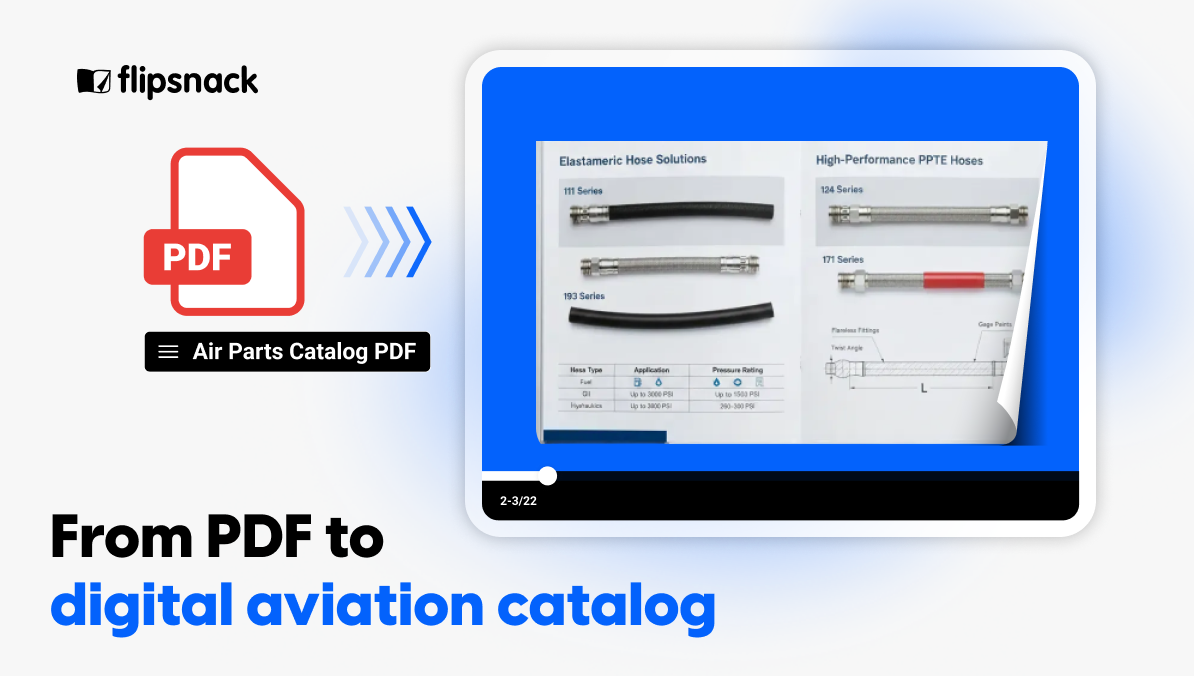
By uploading an existing aviation PDF into Flipsnack, it is automatically converted into a digital flipbook that can represent:
- Physical aircraft parts and components
- Service packages and operational capabilities
- Typical configurations and real-world use cases
- “Menu-style” offerings that support customization and quoting
Even when pricing and specifications are custom, a PDF-based flipbook catalog helps set expectations, clarify scope, and start better sales and procurement conversations.
For product-focused catalogs, include:
- Part numbers, SKUs, and ALT references
- Certifications and compatibility with aircraft or systems
- Typical use cases and operational benefits
- Interactive elements, search, and filters that help users quickly navigate between related parts, approved alternatives, or supporting documentation
For service-focused catalogs, include:
- What you do – and what you don’t do
- Aircraft types or systems supported
- Add-ons, upgrades, and related services
- Interactive links and searchable sections that guide users to relevant service scopes, request a quote, or move to the appropriate procurement or checkout flow
These interactions help buyers self-qualify, reduce back-and-forth clarification, and build confidence early, before a sales or maintenance conversation even begins.
Create and automate your aviation product catalog at scale
Once the scope and structure are clear, the next step is to automate how the catalog is built and maintained.
If an aviation catalog already exists as a PDF, it can be uploaded directly into Flipsnack and turned into a digital, searchable, and interactive catalog. Buyers and partners can quickly find specific part numbers, SKUs, systems, or services without scrolling through long documents.
When SKUs or part numbers are visible in the PDF, Flipsnack automatically detects part numbers and matches them with structured data from a spreadsheet or CSV file. These SKUs can then be linked to product detail pages, internal systems, request-for-quote workflows, or procurement and checkout portals. If SKUs are not visible, they can be added transparently during a small design update. This allows teams to control exactly where product links appear without changing the catalog’s visual layout.
For aviation companies without a finalized PDF or for those managing large and frequently changing inventories, the same automation can be applied directly to product data. By uploading a spreadsheet or product feed, Flipsnack automatically generates a complete digital aviation catalog.
Enable fast updates without rebuilding the catalog
Once a catalog is live, keeping it accurate over time becomes the real challenge.
But with Flipsnack, aviation companies can:
- Update product data without recreating the entire catalog
- Automate updates from spreadsheets or structured data sources
- Ensure partners always access the latest version
This approach ensures that sales teams, procurement managers, and MRO partners always access the most recent version through a single link. There is no need to resend files or confirm which PDF is current. Updates happen once and are immediately visible to everyone with access. For MRO teams in particular, this approach reduces the operational overhead of managing frequent revisions while helping maintain consistency, accuracy, and confidence across maintenance, repair, and overhaul workflows, without disrupting existing ERP or inventory processes.
Control access and sharing
Not all aviation product information should be public. Digital aviation catalogs made in Flipsnack will allow you to:
- Share catalogs via private or password‑protected links
- Control who can view, download, or share content
- Create different versions for internal teams, partners, or customers
For aviation companies, this means sensitive product and service information can be shared securely and confidently, while still enabling collaboration across sales, procurement, maintenance, and partner networks. Access control becomes part of the catalog workflow, not a separate process layered on top.
Use analytics to understand demand and intent
One of the biggest advantages of a digital aviation product catalog is visibility, not just into what buyers view, but into what they request, quote, and order.
With Flipsnack analytics, aviation companies can analyze:
- Which aircraft parts and aerospace components are viewed most often
- How long users spend on specific catalog sections
- Which systems (avionics, engines, hydraulics) attract the most attention
- How catalog interactions translate into quote requests and completed orders across different checkout or procurement flows
This insight is especially valuable in aviation, where pricing, availability, and fulfillment often vary by customer, configuration, or contract. By connecting catalog engagement with order and request data, commercial teams can prioritize high-intent accounts, speed up quoting, and optimize how buyers move from discovery to purchase.
For CCOs and sales leaders, this turns the aviation product catalog into a revenue and order intelligence tool, supporting more accurate forecasting and more informed sales and procurement decisions.
Security, privacy, and access control for aviation catalogs
When product data, technical documentation, and analytics are shared digitally, security and access control are critical, especially in aviation.
Flipsnack is built to support secure, compliant content sharing for regulated industries. All data is hosted on Amazon Web Services (AWS) and encrypted in transit using strong TLS/SSL protocols. Access to content can be restricted through private links, role-based permissions, single sign-on (SSO), and two-factor authentication.
Because Flipsnack’s security practices are audited and certified, including ISO 27001 for information security management, ISO 9001 for quality management, ISO 20000-1 for IT service management, and CSA STAR. Plus, the platform also operates in compliance with GDPR and follows a zero-trust security model internally.
For aviation companies, this means digital catalogs can be shared with customers, partners, and internal teams without compromising data privacy, control, or compliance expectations.
Why Flipsnack works for aviation catalogs and brochures
Flipsnack is built for companies that manage complex, regulated, and update-sensitive catalogs.
For aviation OEMs, suppliers, and MRO teams, Flipsnack enables:
- Digital and interactive aviation product catalogs optimized for technical content with built-in search and filters that help buyers and partners quickly find specific parts, systems, or services
- Automated updates for parts lists, ALT references, and revisions
- Secure sharing with access control for partners and customers
- Analytics and tracking to understand product interest
- Scalable catalogs that grow with aerospace inventories
Instead of distributing static PDFs, Flipsnack helps aviation companies deliver a searchable, compliant, and data-driven aircraft parts catalog.
Build a compliant digital aviation product catalog with Flipsnack
Aviation product catalogs are no longer just documentation. In a highly regulated, safety-critical industry, they act as sales enablement tools, compliance assets, and operational systems.
By moving from static PDFs to a digital aviation product catalog, companies can reduce the risk of errors caused by outdated or inconsistent information, support audits and regulatory traceability, speed up procurement, quoting, and maintenance workflows, and gain clear visibility into product interest and demand through analytics.