Wildlife Conservation Annual Reports: Moving Beyond the Unmeasurable PDF
Published on: February 27, 2026
Your wildlife conservation annual report takes months to produce. Your communications team coordinates with field researchers across three continents. Your designer spends weeks getting the species photography just right. Your executive director reviews every word of the impact summary before it goes out.
And then you send it as a PDF attachment. It gets downloaded 47 times. You have no idea who opened it, how far they read, or whether your major donor — the one whose renewal call is next Tuesday — ever saw the elephant corridor update on page twelve.
This is the quiet frustration at the heart of conservation communications. The work is extraordinary. The report that represents it is invisible.
The good news is that conservation organizations and other adventure-based tourism no longer have to choose between the structured, board-approved PDF format they rely on and a report that actually connects with donors. This shift happening across the sector is not about ditching the PDF. It is about enhancing it — adding the interactivity, the field footage, and the engagement data that a static file simply cannot provide.
In this article, we will walk through what that shift looks like in practice, why it matters for donor retention, and how your team can make it happen without rebuilding your entire annual report process from scratch.
Table of contents
- Why the wildlife conservation annual report matters more than most
- What goes into a wildlife conservation annual report
- The problem with sending a PDF to donors who care deeply
- PDF conservation annual report vs. interactive Flipsnack report
- What an interactive wildlife conservation annual report actually looks like
- How interactivity helps conservation organizations retain donors
- Sharing a conservation report that actually travels
- How to turn your existing conservation PDF into an interactive flipbook
- Your conservation work deserves a report that works as hard as you
Why the wildlife conservation annual report matters more than most
Every nonprofit produces an annual report. But wildlife conservation organizations face a communication challenge that most nonprofits do not.
Your work happens in places donors will never visit. The progress you make is measured in slow, complex metrics — species population trends, hectares of habitat protected, decades-long recovery programs.
Your researchers are in the field, not on stage at a gala. And the outcomes you are working toward — a stable lion population in the Serengeti, an intact migratory corridor in the Amazon — may not fully materialize within a single donor’s lifetime.
This makes the annual report one of the most important tools in your communications arsenal. It is often the one moment in the year when donors get direct, substantive evidence that their contribution did something real. Not a fundraising appeal. Not a social media post. A full, honest account of what happened in the field — what worked, what is still in progress, and what their support made possible.
That weight changes how you should think about the format. A report that gets downloaded and forgotten is not just a missed communications opportunity. It is a missed chance to deepen the donor relationships that fund the next season of fieldwork, the next research expedition, the next habitat acquisition.
The stakes for a wildlife conservation annual report are higher than they look. The format should reflect that.
What goes into a wildlife conservation annual report
Wildlife conservation annual reports follow a structure that reflects the complexity of the organizations producing them. Unlike a standard nonprofit report, a conservation annual report must communicate across multiple audiences simultaneously — major donors, grant funders, board members, government partners, and the general public — each with different levels of technical knowledge and different reasons for reading.
A well-structured wildlife conservation annual report typically includes:
- Field program updates — species population data, habitat restoration milestones, and progress against multi-year conservation targets
- Research highlights — findings from ongoing scientific studies, new species discoveries, or updated biodiversity assessments
- Geographic impact — a breakdown of where the organization operates, often spanning multiple countries or ecosystems
- Financial transparency — income sources, fund allocation, and program expenditure presented clearly for donors and grant funders
- Donor and partner acknowledgment — recognition of the individuals, foundations, and institutions whose support made the work possible
- Field photography and researcher spotlights — the human and ecological stories behind the data
Producing this document requires coordination across communications, finance, field operations, and senior leadership. It is one of the most resource-intensive communications outputs a conservation organization creates each year.
That investment deserves a format that reflects the quality of the work inside it.
The problem with sending a PDF to donors who care deeply
This is not an argument against the PDF. Conservation organizations will continue to produce PDF annual reports, and for good reason. The format is universally accessible, easy to archive, and straightforward to present to boards and grant committees.
The problem is not the PDF itself. The problem is what the PDF cannot do.
It cannot tell you whether your largest individual donor read the jaguar habitat section or closed the document on page three. It cannot carry the thirty-second field video your research team recorded in Sumatra. It cannot be shared on social media without appearing as a cumbersome file attachment. It cannot display the interactive species distribution map your GIS team spent two weeks building. And when a donor opens it on a mobile device, the carefully designed double-page spreads that looked striking in InDesign collapse into something barely legible.
Conservation communications managers already know this. The frustration is not with the PDF as a format. It is with the gap between the quality of the fieldwork being reported and the limitations of the document being used to report it.
A static PDF cannot close that gap. An interactive conservation report can.
PDF conservation annual report vs. interactive Flipsnack report
Producing a wildlife conservation annual report at this level of depth and coordination is a significant investment. The format it is published in should reflect that investment — and deliver measurable returns on it. Here is how a traditional PDF report compares to an interactive Flipsnack flipbook across the criteria that matter most to conservation communications teams.
| Criteria | PDF Conservation Annual Report | Interactive Flipsnack Report |
| Donor engagement | Donors read static text and photography. The depth of the fieldwork rarely comes through on the page. | Embed field video, photo galleries, and clickable species maps that put donors inside the conservation work. |
| Field storytelling | Written descriptions of habitat programs and species recovery data. Compelling, but limited by the format. | A ninety-second video recorded on location communicates what three paragraphs cannot. |
| Distribution | A large attachment that competes for attention in a crowded inbox — and rarely makes it to social media. | One shareable link for donor emails, your website, fundraising events, and social channels simultaneously. |
| Access control | One version for every audience. Board-level financials and public-facing impact data live in the same document. | Public links for donors and supporters, password-protected access for board members and grant funders. |
| Mobile experience | Double-page spreads designed in InDesign rarely survive a mobile screen intact. | Fully optimized for any device. Donors read the report the same way they read everything else — on their phones. |
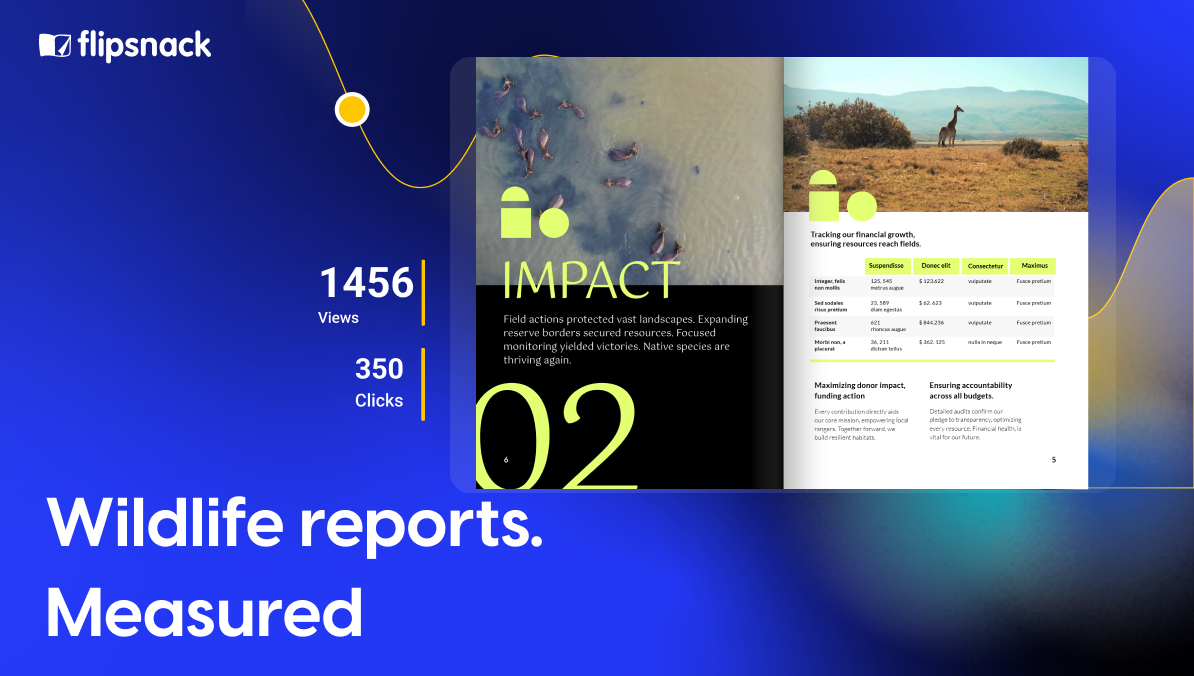
| Engagement data | No visibility into whether donors read the report, which sections they engaged with, or whether key funders opened it before a renewal call. | See which field program sections captured the most attention, which videos were played, and which pages were skipped. |
| Update process | Any correction or addition requires a redesign, a new export, and a fresh send to every stakeholder. | Edit once in Flipsnack and every existing link reflects the update instantly. |
What an interactive wildlife conservation annual report actually looks like
Most conservation communications managers have a clear picture of what their PDF annual report looks like. Fewer have seen what the same report looks like when the format is working as hard as the content inside it.
Here is what an interactive wildlife conservation annual report built in Flipsnack delivers.
A report that opens anywhere, instantly
A donor opens the report from a link in their renewal email. No download prompt. No compatibility issues. The cover loads directly in their browser, with full-bleed field photography and consistent branding from the first page.
Field footage that puts donors inside the work
Written descriptions of habitat monitoring programs only go so far. An embedded video recorded by the research team on location does something text cannot — it places the donor inside the fieldwork. To conclude, a ninety-second clip from the elephant corridor project communicates more than three paragraphs ever will.
Interactive maps that show geographic impact
A clickable species distribution map replaces the static regional breakdown. Each area surfaces its own key metrics:
- Hectares of habitat protected
- Species actively monitored
- Local and indigenous partners engaged
- Active research programs in the field
Financial data that is easy to understand
Fund allocation presented as an interactive chart is cleaner and more transparent than a static table. Donors see exactly where their contribution sits within the organization’s broader funding structure — without having to interpret dense financial formatting.
A page-flip experience that reflects the quality of the work
The page-flip effect gives the report the presence of a printed publication. Without the print costs, the distribution delays, or the inaccessibility of a physical mailing.
One link that travels anywhere
At the end of the report, a single shareable link means donors can forward it to a colleague, share it on social media, or revisit it on any device. No attachment. No file size limit. No version confusion.
This is not a redesign of the annual report. It is the same report, enhanced with the tools that make conservation impact visible, measurable, and shareable.
How interactivity helps conservation organizations retain donors
Donor retention is one of the most persistent challenges in conservation fundraising. Acquiring a new donor costs significantly more than retaining an existing one. And yet most conservation organizations invest heavily in the annual report as a production exercise and very little in measuring whether it actually strengthens donor relationships.
The connection between report format and donor retention is, in fact, more direct than it appears.
Donors who feel connected to the mission give again
Conservation donors are not giving to an abstract cause. They are giving to a specific place, a specific species, or a specific research program they believe in. The annual report is the primary opportunity to reinforce that connection between the donation and the outcome.
A PDF delivers information. An interactive conservation report delivers an experience. The difference matters when a donor is deciding whether to renew.
Engagement data changes how you manage donor relationships
With a static PDF, every donor looks the same. You sent it. You hope they read it. You make the renewal call without knowing whether they engaged with the report at all.
With a Flipsnack flipbook, that changes. You can see:
- Which donors opened the report and how long they spent inside it
- Which field program sections received the most time and attention
- Which embedded videos were played and how many times
- Which pages were skipped entirely — a signal worth acting on
This data does not just improve the next report. It changes how your development team prepares for renewal conversations. A major donor who spent twelve minutes on the species recovery section and played the field video twice is a very different conversation than one who opened the report for thirty seconds and closed it.
Shareable reports extend your reach beyond the existing donor base
A conservation impact report that lives on a shareable link does not stay in one inbox. Board members forward it to prospective donors. Field partners share it with government agencies. Supporters post it on social media. Each share is a potential new relationship that a PDF attachment would never have reached.
The annual report stops being a document you send once a year. It becomes a living representation of your organization’s impact — one that works for you long after the initial send.
Sharing a conservation report that actually travels
A wildlife conservation annual report serves multiple audiences at once. The same document needs to reach major donors, grant funders, board members, government partners, and the general public. Each of these audiences has different access needs and different reasons for reading.
A single PDF attachment cannot serve all of them well. A Flipsnack flipbook can.
Public sharing for maximum reach
For audiences you want to reach broadly, Flipsnack gives you flexible public sharing options:
- A shareable link — send it in donor renewal emails, embed it in your newsletter, or include it in grant applications
- Web embed — place the full interactive report directly on your organization’s website, where supporters can read it without leaving the page
- QR code — display it at fundraising events, on printed materials, or at field site visitor centers for instant mobile access
- Social media — share the link across your organization’s channels without the friction of a file attachment
Private sharing for sensitive content
Not everything in a conservation annual report is intended for public consumption. Board-level financials, internal program assessments, and funder-specific impact data require controlled access.
Flipsnack gives you the tools to manage that:
- Password protection — restrict access to board members and major funders without requiring a platform login
- Unlisted links — share privately with specific stakeholders without making the report publicly searchable
- SSO integration — secure access for staff and senior leadership across your organization
One report, every audience
The most practical advantage of publishing your conservation annual report in Flipsnack is that you maintain one master document. No separate versions for different audiences. No emailing updated attachments when the board requests a revision. One link that you control, update, and share — across every channel, to every stakeholder, simultaneously.
How to turn your existing conservation PDF into an interactive flipbook
Your existing PDF annual report is already the hard part. The content, the data, the field photography, the financial summaries — that work is done. Flipsnack does not ask you to start over. It asks you to upload what you already have and build from there.
Here is how the process works:
Step 1: Upload your conservation PDF
Upload your existing annual report directly to Flipsnack. The platform converts it into a page-flip flipbook automatically, preserving your layout, photography, and typography exactly as designed.
Step 2: Apply your organization’s branding
Set your logo, color palette, and fonts at the organization level. Every report you publish going forward inherits the same brand settings — consistent across annual reports, impact updates, and donor communications.
Step 3: Add field video and interactive elements
This is where the PDF becomes something more. Embed field footage from your research teams, add clickable species distribution maps, link financial charts to supporting data, and connect donor acknowledgment sections to your giving portal. Each addition is made directly in Flipsnack’s editor — no design software required.
Step 4: Set your sharing and access permissions
Decide who sees what before you publish. Set password protection for board-level content, create an unlisted link for major funders, and prepare a public link for your website and social channels.
Step 5: Publish and share
Hit publish and your interactive conservation report is live. Share the link in your donor renewal campaign, embed it on your website, and generate a QR code for your next fundraising event. Every stakeholder gets the same report — in the format that works best for them.
The production timeline does not change significantly. Most conservation communications teams complete the Flipsnack enhancement process in a single working day, once the PDF is finalized.
Your conservation work deserves a report that works as hard as you
Wildlife conservation organizations operate on tight budgets, lean communications teams, and the constant pressure to demonstrate impact to the people who fund the work. The annual report is the single most important document in that effort. It deserves a format that matches the quality of what is inside it.
The shift to an interactive conservation report is not a radical one. Your PDF workflow stays intact. Your design process stays the same. Your board approval process stays the same. What changes, however, is what the report can do once it leaves your hands — the field footage it can carry, the engagement data it generates, the donor relationships it strengthens, and the new audiences it reaches through a single shareable link.
Conservation communications managers who have made this shift consistently describe the same outcome: a report that finally feels proportionate to the work it represents.
Your donors are deeply invested in what you do. They deserve to experience it, not just read about it.
So if you want to see what your next wildlife conservation annual report could look like in Flipsnack, our team is ready to show you. Contact Flipsnack sales for a walkthrough tailored to your organization’s needs. Or, if you’d rather start on your own, begin a free trial and upload your existing PDF today — your first interactive conservation report is closer than you think.