Automate Your Real Estate Marketing Materials with AI
Published on: February 25, 2026
If you work in real estate, you already know that marketing isn’t the hard part of your job.
Selling is hard. Negotiating is hard. Winning listings in a competitive market is hard.
Marketing, on the other hand, should simply support those efforts. And yet, for many agents and brokers, marketing ends up consuming an unreasonable amount of time.
Not because it’s complex. But because it’s manual.
Every new listing sets off the same chain reaction. You log into MLS, gather property details, download photos, refine the description, and move everything into a brochure template. You adjust the layout, tweak the spacing, fix the image proportions, apply branding, export a PDF, and send it out. Then the listing price changes, or a detail needs to be updated, and the entire process starts again.
When you’re handling multiple listings at once, this workflow becomes exhausting. It feels productive, but it’s mostly repetitive production work. And production work doesn’t close deals.
This is exactly wherereal estate marketing automation powered by AI is meant to eliminate.

What real estate marketing automation actually means
Marketing automation in real estate isn’t about replacing the agent’s expertise. It’s about eliminating operational friction.
At its core, real estate marketing automation connects three things:
- Your listing data (MLS)
- Content generation (AI)
- Marketing output (brochures, digital materials, campaigns)
Instead of manually transferring data between systems and design files, automation tools integrate directly with your MLS and transform listing information into structured marketing assets.
In practical terms, it means your MLS listing can become a professional, branded property brochure in seconds, without copying, redesigning, or outsourcing.
Automation turns raw data into presentation-ready marketing.
Why manual marketing workflows don’t scale
Many agents accept manual workflows as “just part of the job.” But the hidden costs are significant.
First, there’s time. Even a modest brochure can take 1–3 hours to design properly. Multiply that across listings each month, and you’re losing days of productive time.
Second, there’s an error risk. Copy-pasting property details increases the chance of incorrect pricing, square footage, or amenities. Small errors damage credibility.
Third, there’s inconsistency. When different agents create brochures differently, branding becomes fragmented. Fonts, layouts, structure, and tone vary from one listing to the next.
Finally, there’s version chaos. A price update requires re-editing, re-exporting, and re-sending. Buyers often end up viewing outdated materials.
None of this directly contributes to selling. It’s operational overhead.
Automation removes that overhead.
Manual marketing vs. AI-powered marketing
The operational difference is clear when you compare workflows.
| Traditional Workflow | AI-Powered Workflow |
| Manually transfer MLS data | Automatically sync listing details |
| Rewrite and format descriptions | Generate structured, polished content |
| Rebuild layout for every listing | Apply pre-structured branded templates |
| Export static PDFs | Publish interactive, live digital brochures |
| Re-send updated versions | Update content without changing the link |
| No visibility into performance | Track engagement and collect leads |
Where AI fits into the real estate marketing process
AI supports real estate marketing in three essential areas: content, structure, and distribution. Many professionals now rely on an AI assistant for real estate to streamline these tasks, helping transform listing data into polished marketing materials while reducing the time spent on repetitive manual work.
1. Content creation and refinement
AI helps generate and rephrase listing descriptions so they remain clear, consistent, and professional. Inside Flipsnack, you can refine text directly in your flipbook, making adjustments without rewriting everything from scratch.
AI also improves accessibility by automatically generating page summaries and image descriptions, helping make your publications easier to navigate and more inclusive.
2. Data structuring
Instead of manually organizing property details, AI helps structure MLS information into clear sections such as property overview, amenities, and specifications. This creates a logical flow that makes listings easier to understand and more professional in presentation.
3. Design and distribution automation
AI-powered templates eliminate the need to design brochures from scratch. Content and visuals are placed automatically within a structured layout.
Flipsnack also allows you to translate entire flipbooks or selected text boxes with one click, helping you reach broader audiences without external tools. AI-generated statistics summaries further simplify performance tracking.
Together, these capabilities reduce friction across the entire marketing process from creation to sharing and analysis.
From MLS listing to professional brochure in seconds with Flipsnack
This is where solutions like MLS AI Brochure redefine the workflow.
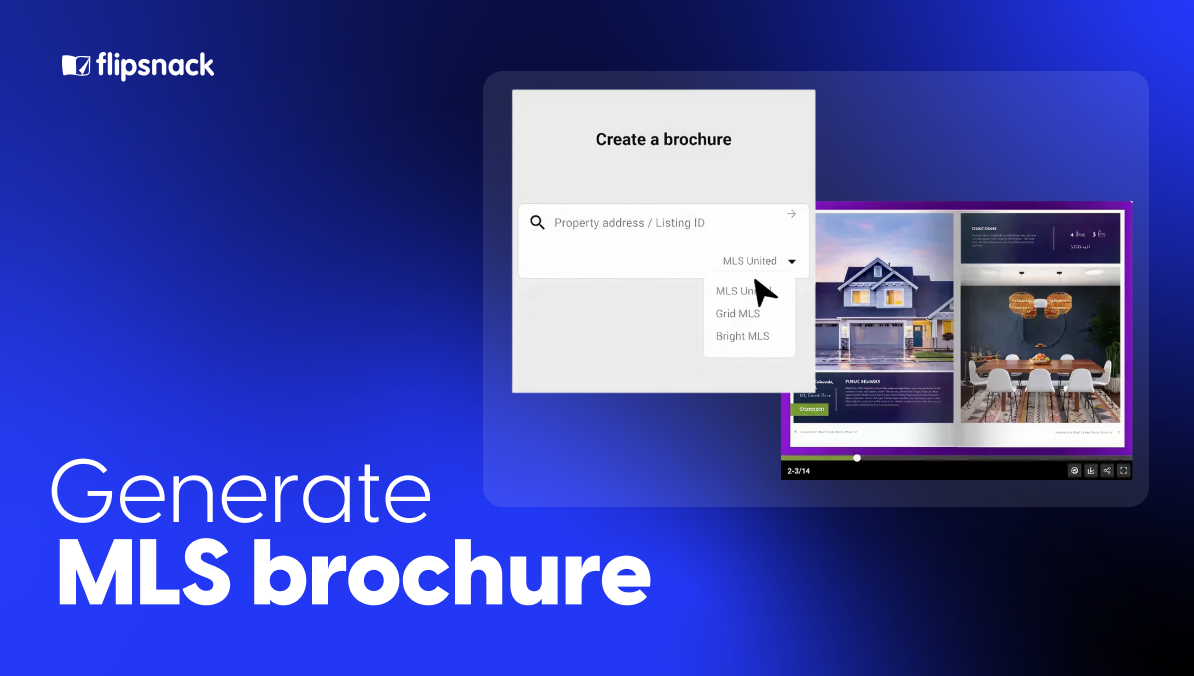
Instead of starting with a blank canvas, an agent selects a listing and allows the system to pull data directly from MLS. The AI then organizes the information into a professionally designed, interactive brochure format.
Inside Flipsnack, the process happens in three simple steps:
1. Connect your MLS
First, you connect your MLS account to Flipsnack. Once connected, your listing data becomes accessible inside your workspace. You’re no longer copying and pasting property details — the system can securely pull structured information directly from your MLS.
This step eliminates duplication before it even starts.
2. Select your listing
When you’re ready to create a brochure, you simply choose the property you want to promote. Flipsnack pulls in the available listing data — descriptions, specifications, pricing, and images and the AI organizes everything into a professionally designed brochure layout. And even add interactive elements where needed.
3. Customize and distribute
Once the brochure is generated, you can personalize it if needed. You can refine text, adjust branding, add your logo, embed virtual tours, or include a lead capture form.
Then you publish it as an interactive, page-flipping digital brochure.
You can share it via link, embed it on your website, or control visibility. And if listing details change later, you update the brochure without changing the shareable link.
More importantly, the result isn’t just faster, it’s consistent. Every listing follows a professional structure that reinforces brand credibility.
Why does this matter at different levels of your organization
For individual realtors
Automation reduces administrative burden. Instead of spending evenings formatting brochures, agents can focus on prospecting, showings, and negotiations.
Speed also matters. Faster marketing production means listings go live with full materials immediately.
For brokers and broker-owners
Brand consistency becomes manageable. When marketing materials follow structured templates, every listing reflects the brokerage’s standards. Brokers handling market valuations, property tax assessment appeals, and investment advisory can present all services seamlessly and professionally.
Automation also simplifies onboarding. New agents don’t need advanced design skills to produce professional materials.
For real estate team leads
Managing multiple listings across multiple agents becomes more efficient. Marketing quality stays high without constant supervision or design intervention.
As portfolio size increases, the operational impact of automation becomes more significant.
Beyond efficiency: Improving the buyer experience
But engagement is only the first step. With Flipsnack, you can turn your property brochures or catalogs into real sales tools. Instead of juggling spreadsheets, printed materials, and endless email threads, you can create interactive, shoppable brochures that simplify the entire selling process.
For real estate professionals, this means you can:
- Enable buyers to express interest or request details directly inside the brochure
- Collect inquiries through built-in lead forms
- Receive requests instantly via email or even WhatsApp
- Share brochures publicly, privately, or password-protected
- Update listing details under the same link without resending materials
You can even allow clients to build a shortlist of properties (similar to a wishlist) and submit it directly to you, making follow-ups faster and more structured.
Additionally, digital brochures provide powerful analytics. Understanding how long buyers engage with a listing, which pages they spend time on, and what elements they click on offers valuable insight for smarter follow-up conversations.
Smarter collaboration for listing documents
In many brokerages, contracts and listing agreements are shared back and forth as static PDFs. Small changes require re-exporting files, resending versions, and confirming everyone is working on the latest draft. This creates confusion and unnecessary friction.
With digital documents, teams can collaborate more efficiently. Contracts can be shared internally, reviewed, and updated without starting over. If adjustments are needed, the same document can be edited and republished without breaking the link or losing control over versions.
Instead of juggling multiple PDF attachments, everyone works from a centralized, up-to-date document.
For team leads and broker-owners, this creates clarity. For agents, it reduces administrative back-and-forth. And for clients, it ensures a smoother experience.
The real advantage of automating your real estate listing
Marketing quality influences seller decisions more than most agents realize. When you present a streamlined, AI-powered marketing process, you demonstrate professionalism, speed, and control. Sellers want to know their property will be marketed quickly, presented professionally, shared widely, and kept up to date.
Automating your real estate marketing delivers exactly that. It reduces time-to-market, ensures consistent branding across listings, and keeps materials accurate without constant manual updates. Internally, it simplifies workflows. Externally, it elevates perception.
Most importantly, it gives you back time, time to build relationships, follow up with buyers, and close deals.
Real estate marketing automation isn’t about adding more tools. It’s about removing the repetitive work that slows you down and turning your MLS data into professional, interactive marketing assets in seconds.
That’s where the real advantage lies.