Corporate Training Trends 2026: AI, Skills, ROI
Published on: February 24, 2026
Table of contents
- Introduction: Why 2026 Is a Turning Point for Corporate Training
- The state of corporate training in 2026
- The 12 corporate training trends shaping 2026
- 1. Skills-based organizations replace role-based structures
- 2. AI-powered content creation and adaptive learning
- 3. Measurable learning ROI is non-negotiable
- 4. Business-aligned training strategy
- 5. Soft skills become power skills
- 6. Continuous learning in the flow of work
- 7. Blended and hybrid learning models
- 8. Interactive content replaces static documents
- 9. Built-in assessment and knowledge validation
- 10. Centralized and secure knowledge hosting
- 11. Training technology stack evolution
- 12. Inclusive and multigenerational learning design
- Large company data insights: what the numbers show
- Technology adoption and the shift toward modern training materials
- How to modernize corporate training in 5 steps
- Quantified large company case study: Pandora
- Quantified large company case study: Estée Lauder
- Defining Flipsnack in the corporate training ecosystem
- Static documents vs. interactive flipbooks
- LMS vs. Flipsnack: strategic positioning
- Practical comparison: LMS vs. Flipsnack
- ROI framework for training leaders
- From training provider to strategic business driver
- Building a future-ready corporate training strategy
- Presenting corporate training strategy to the board
- Common mistakes in 2026
- The future of corporate training beyond 2026
- FAQ
Introduction: Why 2026 Is a Turning Point for Corporate Training
Today, corporate training is no longer just an HR task. It builds skills, strengthens performance, and directly supports business growth. In 2026, AI adoption is on the rise. Skills are changing rapidly. Remote and hybrid work add complexity. Executives demand measurable outcomes and clear ROI from corporate training programs.
As a result, Learning and Development (L&D) teams must demonstrate business impact across corporate training and workforce development initiatives. Completion rates and satisfaction scores are no longer sufficient. Leaders expect proof that employee training improves performance, increases revenue, reduces errors, and strengthens retention.
This guide outlines the key corporate training trends shaping 2026. It also provides practical recommendations for creating, sharing, and tracking interactive training materials without complex systems. If you want hands-on ideas, you can explore detailed examples ofhow to create engaging training materials.
The state of corporate training in 2026
Training budgets continue to grow. Organizations recognize that faster skill development drives adaptability, productivity, and competitive advantage.
Key patterns shaping corporate training, employee training, and workforce development in 2026 include:
- Increased investment in digital learning tools
- Growth in online and hybrid training models
- Stronger focus on measurable training ROI
- Clear links between employee training and retention
- Expanded leadership development and soft skills programs
- Large-scale reskilling driven by AI and automation
In addition, organizations that treat corporate training as a strategic function within talent management and performance management report higher productivity, stronger employee engagement, and improved internal mobility. For practical onboarding structures, many teams reference guides on building effective onboarding materials such as these employee training material templates.
The 12 corporate training trends shaping 2026
1. Skills-based organizations replace role-based structures
Job titles are becoming less important than capabilities. Companies now map workforce skills across teams instead of focusing only on roles.
Leaders assess current capabilities, identify skills gaps aligned with business goals, and build structured upskilling programs. Internal talent marketplaces allow faster redeployment of talent.
When organizations understand their skills inventory, they move employees into new roles more efficiently and reduce external hiring costs. Structured internal documentation, such as interactive handbooks, supports this transition, and many companies start by learning how to host a booklet online securely.
2. AI-powered content creation and adaptive learning
Artificial Intelligence and Machine Learning are transforming how corporate training, digital learning, and e-learning content are created and delivered.
For example, AI tools help draft marketing, finance, and sales training modules, summarize documents, generate quizzes, and personalize learning paths. Adaptive learning systems adjust content based on performance data and real-time data analytics. They provide extra practice when needed and accelerate progress for high performers.
Clear learning objectives and human oversight remain essential to protect quality and compliance. Teams often reinforce these objectives using interactive assessments and structured resources like company quiz templates to validate knowledge.
3. Measurable learning ROI is non-negotiable
Executives expect outcome-based reporting from L&D.
Therefore, high-performing teams connect training initiatives to productivity gains, safety improvements, sales growth, onboarding speed, employee retention, and measurable training metrics. They build dashboards that link learning activity to business performance metrics.
4. Business-aligned training strategy
Corporate training must support company objectives.
Effective L&D teams align training programs with strategic priorities. They also modernize documentation formats, moving beyond static PDFs toward interactive resources similar to those described in this guide on digital safety manuals and training guides. They support digital transformation and prepare leaders for succession. When training aligns with strategy, executive support and budget stability increase.
5. Soft skills become power skills
As automation expands, human skills gain strategic value.
Organizations prioritize leadership development, communication skills, emotional intelligence, and adaptability. These skills strengthen collaboration and decision-making across teams.
6. Continuous learning in the flow of work
Employees expect learning resources embedded into daily workflows.
Modern organizations provide short training modules, searchable knowledge libraries, interactive digital guides, and mobile-friendly learning content.
Interactive guides hosted online allow instant updates, embedded media, and centralized access from any device. A practical example is how companies build digital safety manuals and training guides that stay current without constant redistribution.
7. Blended and hybrid learning models
Hybrid work requires flexible training solutions.
Hybrid learning combines self-paced digital content, instructor-led training, and virtual instructor-led training (VILT) with embedded assessments. When implemented well, as shown in these examples of blended learning, this model improves retention while maintaining flexibility.
8. Interactive content replaces static documents
Traditional slide decks and static PDFs are increasingly replaced by interactive formats. Many teams start with structured employee training material templates to speed up design and maintain consistency.
Interactive formats include embedded video, clickable navigation, integrated assessments, feedback tools, and elements such as gamification and mobile learning support. They improve completion rates and provide clear engagement data.
9. Built-in assessment and knowledge validation
Effective training must confirm understanding.
Embedded quizzes inside digital training materials allow immediate knowledge checks without separate systems. Many organizations rely on ready-to-use company quiz templates to standardize validation across departments.
10. Centralized and secure knowledge hosting
Training content must be accessible, secure, and easy to update.
Online hosting enables instant updates, controlled permissions, engagement tracking, and consistent branding across locations. For teams moving away from file sharing, this guide explains how to host a booklet online in a secure and scalable way.
11. Training technology stack evolution
Modern corporate training stacks combine Learning Management Systems (LMS), Learning Experience Platforms (LXP), content creation tools, data analytics dashboards, skills tracking systems, automation features, and secure cloud hosting systems.
Many organizations use an LMS for compliance training, DEI training, onboarding, and certification programs while using interactive content platforms to improve content delivery, scalability, and engagement visibility.
12. Inclusive and multigenerational learning design
Workforces span multiple generations with different learning preferences.
Training must be accessible, mobile-friendly, and clearly structured for varying experience levels.
Large company data insights: what the numbers show
Specifically, Enterprise L&D leaders rely on industry benchmarks and training statistics to guide decisions. Many reference research from organizations such as the World Economic Forum, Gartner HR, and the LinkedIn Work Trend Index to validate corporate training strategy.
Training investment and budget signals
U.S. training expenditures increased to $102.8 billion in 2025. This was up from $101.8 billion in 2024 and reflects continued investment growth. Average training spend per learner also rose year over year.
Budgets are expanding, but effectiveness depends on allocating resources to corporate training formats that drive measurable performance improvement.
AI adoption and governance gap
A growing percentage of HR leaders are piloting or implementing generative AI initiatives. At the same time, many organizations lack structured AI training programs.
AI adoption is outpacing governance and formal employee training. Industry analysis from sources like the LinkedIn Work Trend Index continues to highlight how quickly Artificial Intelligence is entering daily workflows. Enterprises that delay structured education increase operational and compliance risk.
Skills disruption and upskilling pressure
A significant share of core workforce skills is expected to change within five years, according to findings in the World Economic Forum Future of Jobs Report. Many employees require additional upskilling and reskilling, yet access gaps remain.
Leadership expects rapid ROI from reskilling initiatives. Training must be modular, accessible, and aligned with performance outcomes.
Retention and engagement impact
Research consistently shows strong links between learning and development investment and employee retention. Organizations often reference industry bodies such as SHRM when evaluating workforce development and retention benchmarks.
Corporate training functions not only as skill development but also as a retention strategy.
Microlearning effectiveness
Research indicates that short, modular learning improves knowledge retention compared to longer traditional modules.
Microlearning works well for compliance training refreshers, AI training, leadership development, and product education within a continuous learning culture. Organizations that combine interactive training materials, structured AI education, and data-driven reporting are better positioned to meet board expectations.
Technology adoption and the shift toward modern training materials
Meanwhile, large organizations are modernizing both training strategy and learning technology infrastructure.
Digital-first workflows, AI-powered platforms, and cloud-based learning systems are becoming standard in technology-enabled learning environments. Employees expect training materials to be searchable, interactive, and accessible on any device.
Static documents and legacy slide decks cannot support required speed or visibility. Enterprises are shifting toward interactive, centrally hosted training materials that allow rapid updates and performance tracking.
How to modernize corporate training in 5 steps
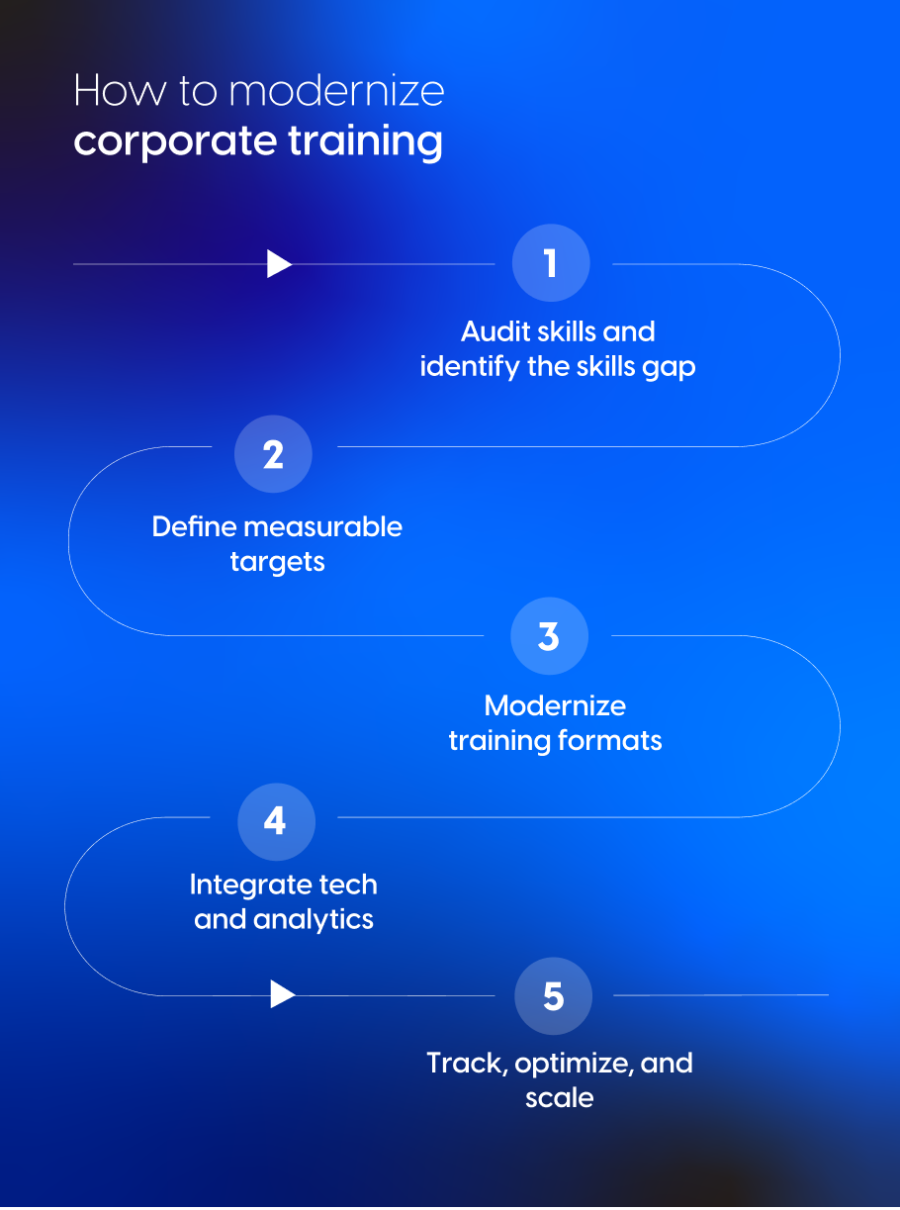
Step 1: Audit skills and identify the skills gap
Assess current workforce capabilities. Use performance management data, training metrics, and feedback from managers to identify gaps aligned with business strategy.
Step 2: Define measurable ROI targets
Set clear objectives such as reduced time-to-productivity, higher employee engagement, improved retention rates, or fewer compliance incidents. Establish baseline data before making changes.
Step 3: Modernize training formats
Replace static PDFs with interactive training materials. Combine blended learning, microlearning, instructor-led training, and virtual instructor-led training (VILT) for flexibility and scalability.
Step 4: Integrate technology and analytics
Align your Learning Management System (LMS), Learning Experience Platform (LXP), and data analytics tools. Use Artificial Intelligence, adaptive learning, and automation to personalize development paths.
Step 5: Track, optimize, and scale
Monitor engagement metrics, completion rates, retention impact, and business performance indicators. Use insights to optimize content and scale successful programs across the organization.
This five-step model supports workforce development, digital transformation in L&D, and the creation of a continuous learning culture.

Quantified large company case study: Pandora
Pandora is a global jewelry brand operating an extensive retail network and managing frequent product launches. In France, the company needed a faster way to distribute product knowledge and campaign materials across its stores.
Baseline
Pandora supported 130 retail locations using printed catalogs for product and training information. Updates required manual revisions and physical redistribution. Store associates searched long printed documents to find product details, campaign guidelines, and pricing.
Implementation
Pandora replaced print catalogs with centrally hosted interactive digital catalogs. Each store accessed materials through QR codes, ensuring employees always viewed the most current version. Content updates happened in real time without reprinting.
Results
- Immediate access to the latest product and campaign information
- Elimination of print redistribution cycles and version confusion
- Measurable engagement data showing usage and section views
- Faster information retrieval during customer interactions
By replacing static print with trackable digital materials, Pandora improved efficiency, reduced update delays, and gained visibility into how frontline teams used training content.
Quantified large company case study: Estée Lauder
Estée Lauder is a multinational cosmetics group managing multiple brands across global markets. Consistent product education and internal communication are essential for distributed teams.
Baseline
Teams relied on static files for product education and launch documentation. These files limited visibility into usage, created version control challenges, and slowed global updates.
Implementation
The company deployed interactive digital materials with centralized hosting, permission control, and engagement tracking. Teams could update content instantly while maintaining brand consistency.
Results
- Centralized control of brand and training materials
- Faster global rollout of updated documentation
- Clear visibility into content views and interaction levels
- Stronger alignment between headquarters and regional teams
Interactive, centrally hosted materials gave Estée Lauder stronger control and insight while preserving brand standards.
Defining Flipsnack in the corporate training ecosystem
Flipsnack is not a traditional LMS or Learning Experience Platform (LXP). It is an interactive content creation and hosting platform for digital training materials, knowledge management, and scalable workforce development initiatives.
It enables teams to create and manage digital content more efficiently. Teams can:
- Convert PDFs and slide decks into interactive flipbooks
- Embed videos, quizzes, forms, and links
- Host training guides securely online
- Control access permissions
- Track engagement data
In enterprise environments, Flipsnack often complements LMS platforms by enhancing content experience and document-level visibility.
Static documents vs. interactive flipbooks
Static documents used in traditional e-learning or instructor-led training present clear limitations:
- No engagement tracking
- Difficult updates at scale
- Limited interactivity
- Lower completion rates
Interactive flipbooks provide embedded assessments, multimedia integration, instant updates, mobile optimization, and centralized hosting. Many organizations adopt these formats after reviewing best practices for creating engaging training materials.

LMS vs. Flipsnack: strategic positioning
LMS platforms manage enrollment, certification tracking, structured learning paths, compliance oversight, and reporting.
Flipsnack enhances training content quality, interactivity, and distribution.
Some organizations require both systems. Others may rely primarily on interactive training guides when certification workflows are unnecessary.
When compliance tracking is mandatory, an LMS is appropriate. When the goal is faster content distribution and deeper engagement insight, interactive platforms can operate independently.
Practical comparison: LMS vs. Flipsnack
| Category | LMS | Flipsnack |
| Core purpose | Manage courses and compliance | Create and host interactive training materials |
| Primary focus | Enrollment and certification tracking | Content experience and engagement visibility |
| Content format | SCORM modules, PDFs, slides | Interactive flipbooks with embedded media |
| Analytics | Completion rates and quiz scores | Views, time spent, interaction metrics |
| Updates | Requires administrative changes | Instant updates via live links |
| Creation speed | Structured course development | Rapid conversion of existing files |
| User experience | Linear course flow | Page-level navigation and branded design |
| Best suited for | Certification and compliance programs | Guides, manuals, onboarding materials |
Together, LMS platforms and interactive content systems create a layered corporate training architecture.
ROI framework for training leaders
Training ROI within corporate training and workforce development should follow a clear cause-and-effect structure. Therefore, each initiative should begin with a defined business metric such as time-to-productivity, sales conversion rate, compliance incidents, error rate, or employee turnover.
Once the target is defined, establish a baseline using current performance data. Then, redesign content and delivery to remove friction and improve engagement. Engagement metrics alone are not enough. They must connect to behavior change or operational improvement.
Financial impact comes from translating performance shifts into economic value. Reduced ramp time increases revenue. Fewer compliance violations lower legal risk. Improved retention reduces replacement costs. Once this link is clear, corporate training becomes a strategic investment.
From training provider to strategic business driver
Modern L&D teams, training providers, and corporate universities report impact, not activity. This means, many also benchmark reporting frameworks against guidance from research firms like Gartner HR.
Executives focus on risk reduction, revenue enablement, and operational efficiency. Reporting should connect training engagement to measurable performance changes and economic impact.
The key question shifts from “Who completed the course?” to “What improved after the training?” That shift builds executive credibility.
Building a future-ready corporate training strategy
A future-ready corporate training strategy focuses on skills aligned with business goals, skill development, and career planning.
Interactive, centrally hosted training materials reduce distribution delays, improve version control, and generate engagement data. For teams transitioning from blended programs, these approaches often build on frameworks similar to those highlighted in blended learning done right. AI and automation accelerate content development and personalized learning but require governance, security controls, and compliance alignment to protect quality.
Training systems should improve continuously. Engagement data and performance metrics should guide ongoing optimization.

Presenting corporate training strategy to the board
Board-level communication requires financial clarity.
Start with business risk or opportunity. Define the modernization plan in operational terms. Quantify projected financial impact using conservative assumptions. Establish clear KPIs and review timelines.
When framed this way, corporate training becomes part of strategic planning rather than an isolated HR initiative.
Common mistakes in 2026
Additionally, organizations reduce impact when they adopt tools without linking them to measurable business goals. Tracking engagement without connecting it to performance creates noise. Ignoring workforce skills data misallocates budget. Deploying AI without governance increases compliance and quality risk. Relying on static, non-trackable formats limits scalability and visibility.
The future of corporate training beyond 2026
Looking ahead, corporate training, immersive learning, and mobile learning will integrate into daily workflows. AI assistants powered by Artificial Intelligence and Machine Learning will recommend personalized learning in real time. Interactive platforms will replace most static documents.
Organizations that align training strategy with measurable ROI and continuously modernize content will remain competitive, while those that don’t will struggle do deliver the same results.
FAQ
Skills-based workforce planning, AI-powered content creation, measurable training ROI, interactive training materials, and blended learning models.
Define business objectives, establish baseline metrics, track performance changes, and translate improvements into financial value.
An LMS manages structured programs and compliance tracking. An interactive content platform enhances employee training materials with interactivity, secure hosting, and engagement analytics.
They lack engagement tracking, embedded validation, and scalable update control.
They integrate multimedia, navigation, assessments, and engagement visibility in a single digital document.
AI accelerates content creation, supports personalization, and enables adaptive learning paths.
Yes. Static documents can be converted into interactive formats while maintaining existing LMS infrastructure.
A model that combines digital self-paced learning with live instruction.