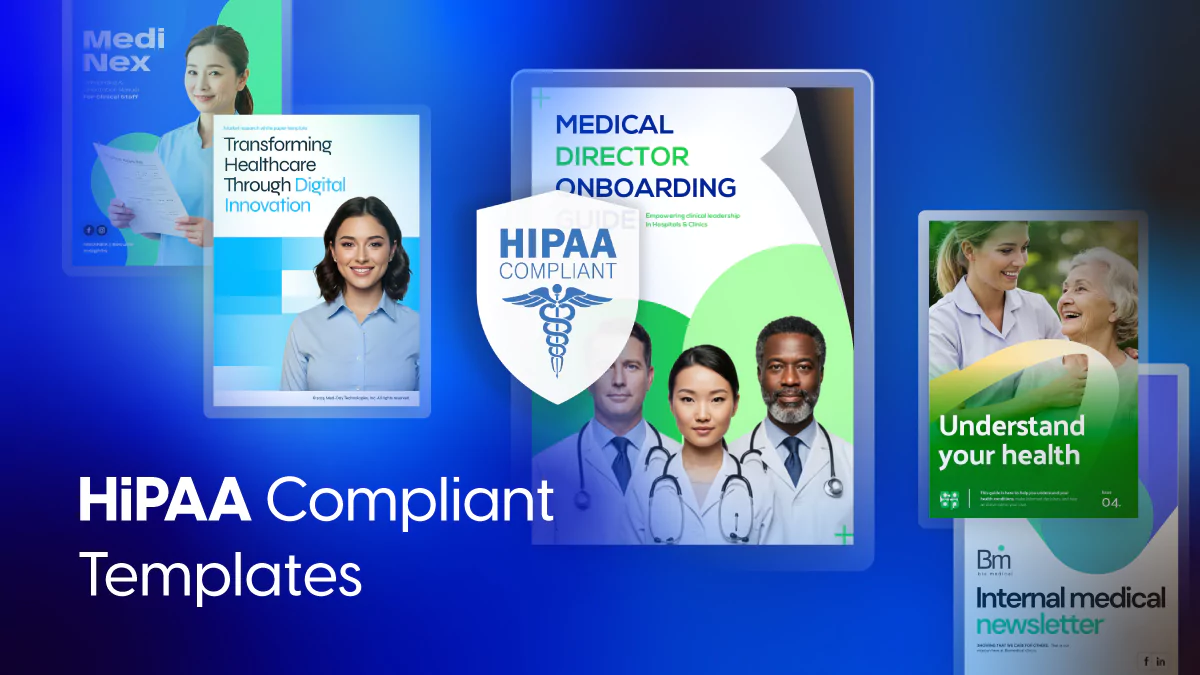
HIPAA Compliant Templates – Medical Guides, Magazines, and Newsletters
Published on: June 2, 2025
Last updated: March 12, 2026
What is a HIPAA-compliant document?
A HIPAA-compliant document is any publication, guide, report, or training material that handles protected health information (PHI) in accordance with the Health Insurance Portability and Accountability Act. This means controlling who can access the document, how it’s shared, and how interactions with it are tracked — so that patient data stays protected at every step.
Unlike standard business documents, HIPAA-compliant materials require an additional layer of security: restricted access, audit trails, and platform-level safeguards that go beyond a password on a PDF.
Table of contents
- What is a HIPAA-compliant document?
- Find how to build HIPAA-compliant documents that actually work
- Quick comparison: Choose your ideal HIPAA-compliant template
- 1. HIPAA Compliance Enrollment Guide Template
- 2. HIPAA Compliant Onboarding Manual
- 3. HIPAA Internal Medical Newsletter Template
- 4. Internal Insights Medical Newsletter Template
- 5. Modern HIPAA-Compliant Medical Magazine Template
- 6. Editable HIPAA Medical Report Template
- 7. HIPAA-Compliant Employee Training Manual Template
- 8. Interactive HIPAA Medical Guide Template
- How to create a HIPAA-compliant publication in Flipsnack
- Exploring the essentials: HIPAA compliance software and why it matters
- How Flipsnack supports HIPAA-compliant documentation
- Take your HIPAA compliance documentation to the next level
- Frequently asked questions
Find how to build HIPAA-compliant documents that actually work
Healthcare organizations are under more pressure than ever to get compliance documentation right. Over 133 million records were exposed or impermissibly disclosed in recent years — and a 2025 survey found that fewer than 40% of organizations felt “very prepared” for a HIPAA audit or OCR investigation.
And we, at Flipsnack, can see this reflected in how healthcare teams use our platform. But many compliance documents fail not because the information is wrong, but because they’re static, hard to update, and impossible to track — which means organizations can’t prove who read what, or when.
The difference between a document that satisfies an auditor and one that doesn’t lies in how clearly it controls access, documents engagement, and supports ongoing updates.
In this guide, you’ll find what makes effective HIPAA-compliant documentation, which templates work best for different use cases. And how to use Flipsnack’s healthcare compliance software to create materials your team will actually engage with — and that your compliance team can stand behind.
Quick comparison: Choose your ideal HIPAA-compliant template
| Template Name | Primary User | Best For (Organization Size) | Main Focus | Key Benefits |
| HIPAA Compliance Enrollment Guide | Compliance Officers, HR | All sizes (10–500+ employees) | Enrollment documentation, compliance onboarding | Interactive quizzes and forms; analytics tracking; adaptable to internal workflows; audit-ready structure. |
| HIPAA Compliant Onboarding Manual | HR, Compliance Teams | All sizes (10–500+ employees) | New hire compliance orientation, policy documentation | Structured policy sections; embeddable videos; password-protected sharing; tracks who has engaged. |
| HIPAA Internal Medical Newsletter | Compliance Officers, Communications | Mid-size to enterprise (50–1000+ employees) | Internal compliance updates, privacy practice communications | Brandable layout; easy to update each cycle; secure distribution to authorized staff only. |
| Internal Insights Medical Newsletter | HR, Department Heads | Mid-size to enterprise (50–1000+ employees) | Ongoing staff engagement, policy and security updates | Interactive elements; restricted access options; supports consistent compliance communication across teams. |
| Modern HIPAA-Compliant Medical Magazine | Communications, L&D | Mid-size to enterprise (100–1000+ employees) | In-depth regulatory updates, educational content distribution | Visual-first format; embedded videos and CTAs; real-time collaboration; private link sharing. |
| Editable HIPAA Medical Report | Compliance Officers, Clinical Teams | All sizes (20–500+ employees) | Medical documentation, audit-ready reporting | Structured reporting framework; customizable sections; password-protected sharing; supports data visualizations. |
| HIPAA-Compliant Employee Training Manual | HR, L&D, Compliance Officers | All sizes (10–500+ employees) | Staff HIPAA training, regulatory education | Embeddable quizzes; role-based access; real-time team collaboration; engagement tracking per employee. |
| Interactive HIPAA Medical Guide | Compliance Managers, Clinical Teams | All sizes (10–500+ employees) | Compliance education, regulation simplification | Interactive modules; clickable sections; private sharing; easy to update as regulations evolve. |
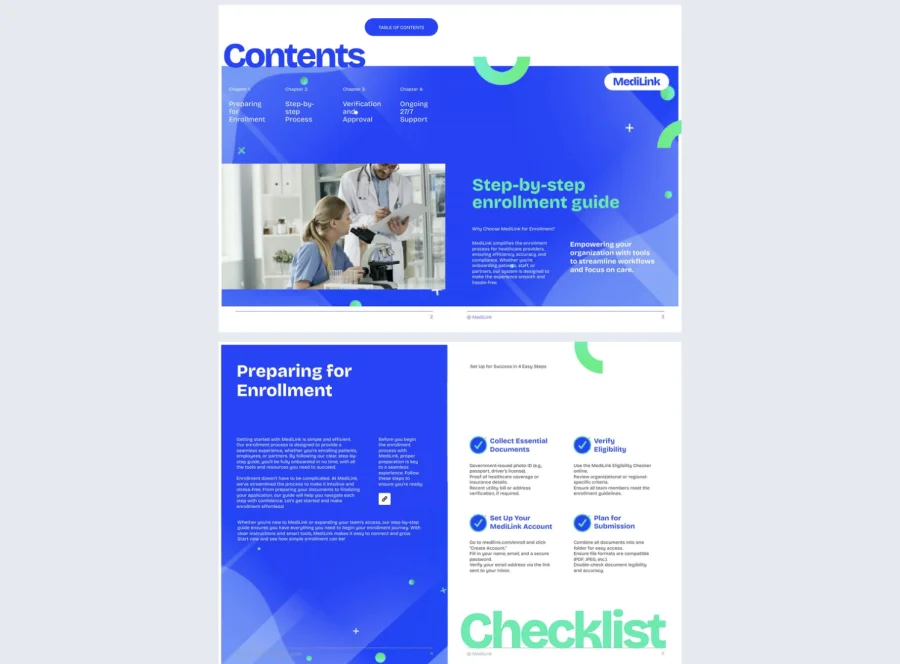
1. HIPAA Compliance Enrollment Guide Template
Enrollment processes are one of the first places HIPAA compliance can break down — not because of bad intent, but because the documentation is dense, inconsistent, or never confirmed as received. The HIPAA compliance enrollment guide template gives compliance officers and HR teams a structured, visually clear format for walking staff or patients through enrollment requirements from start to finish.
Best for: Healthcare organizations of any size that manage formal enrollment processes — whether for new employees, patients, or program participants — and need documentation that’s both accessible and audit-ready.
Real-world application: A compliance coordinator at a 200-person outpatient clinic used this template to replace a multi-page PDF enrollment packet that staff rarely read in full. By restructuring the content into a step-by-step interactive guide with embedded quizzes at key checkpoints, they were able to confirm comprehension at each stage — and had the engagement data to prove it during their next internal audit.
The template is fully editable in Flipsnack’s online design tool — update sections to reflect your organization’s specific enrollment workflows, add your branding, and embed forms for acknowledgments or signatures. Share via password-protected link to ensure only authorized recipients can access the content.
Common mistake to avoid: Don’t treat enrollment documentation as a one-time setup. Regulations change, workflows evolve, and staff turn over. Build this as a living document — duplicate it each cycle, update what’s changed, and use Flipsnack’s analytics to confirm the new version is actually being read.

2. HIPAA Compliant Onboarding Manual
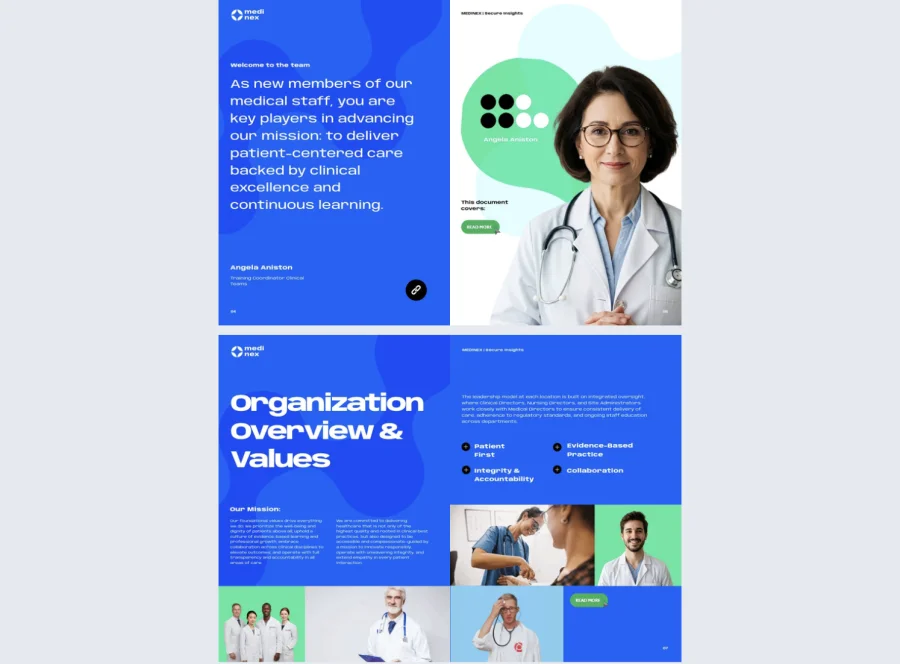
The first weeks of a new hire’s experience set the tone for how seriously they’ll take compliance going forward. A dense, unengaging onboarding manual sends the wrong message before a single policy is explained. The HIPAA compliant onboarding manual gives HR and compliance teams a structured, professional format for delivering critical information in a way that’s clear, trackable, and easy to update as policies evolve.
Best for: Healthcare organizations of any size onboarding clinical staff, administrative employees, or contractors who will handle PHI. Particularly useful when onboarding happens across multiple locations or remotely, and consistency of delivery matters.
Real-world application: An HR manager at a regional hospital network used this template to standardize onboarding across four facilities that had each been using different materials. Having one consistent manual — shared securely via Flipsnack and tracked per employee — meant compliance leadership could confirm, for the first time, that every new hire had been exposed to the same information before their first shift.
Customize the template with your institution’s specific policies, embed video introductions from compliance leadership, and add interactive quizzes to verify understanding of key sections. Use Flipsnack’s collaboration features to keep legal, HR, and compliance teams aligned on content before publishing.
Common mistake to avoid: Don’t publish the manual and assume the job is done. Opening a document isn’t the same as reading it. Use Flipsnack’s statistics to see how much time new hires are spending on each section — and follow up directly with anyone whose engagement suggests they’ve skimmed rather than read.
3. HIPAA Internal Medical Newsletter Template
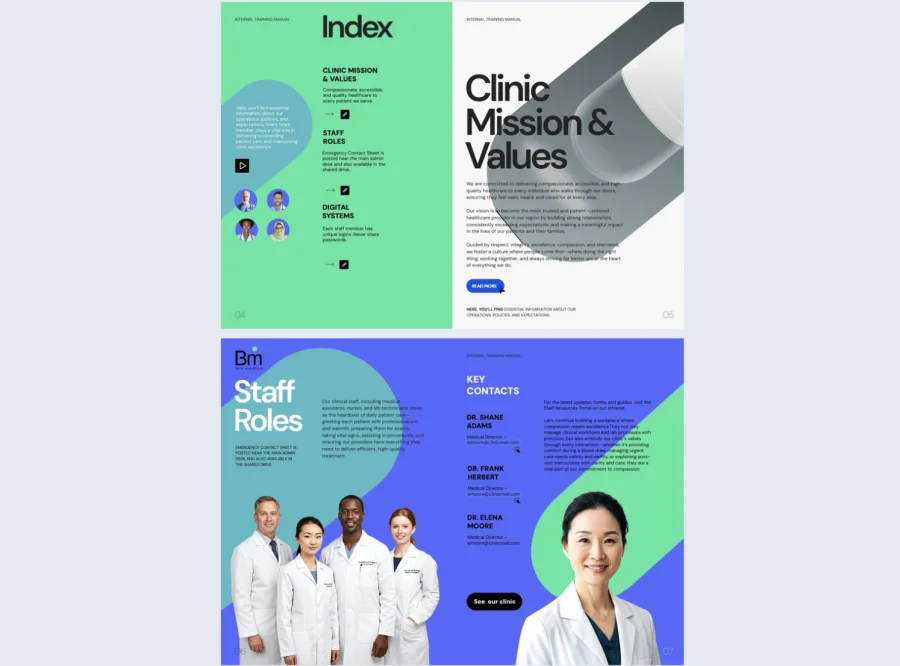
Compliance isn’t a one-time training event — it requires consistent reinforcement. The HIPAA internal medical newsletter template gives communications and compliance teams a repeatable format for keeping staff informed about data privacy updates, policy changes, and security best practices without adding to inbox fatigue.
Best for: Mid-size to enterprise healthcare organizations (50–1,000+ employees) that need a regular, structured channel for internal compliance communication — especially when updates need to reach staff across departments or locations consistently.
Real-world application: A compliance officer at a 350-person specialty care group used this template to launch a monthly internal newsletter after a routine audit revealed uneven awareness of updated privacy protocols across departments. Within two months, staff survey responses showed measurably higher familiarity with the updated policies — and the newsletter became a standing item in the organization’s compliance calendar.
The template is easy to update each cycle — swap in new content, adjust the layout if needed, and republish under the same link so staff always access the current version. Apply your institution’s branding and customization to keep the newsletter consistent with other internal communications.
Common mistake to avoid: Don’t let the newsletter become a wall of regulatory text. Compliance content is already heavy — the format should work against that, not alongside it. Use short sections, clear headings, and visuals where possible to make each issue something staff will actually open.
4. Internal Insights Medical Newsletter Template
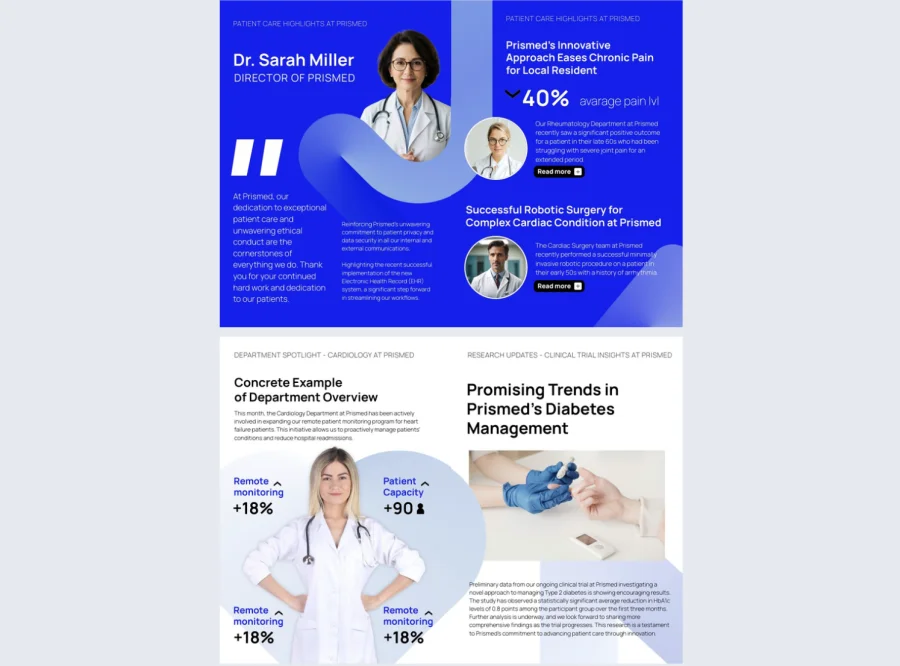
Where the HIPAA internal newsletter focuses on compliance-specific updates, the internal insights medical newsletter template is built for broader ongoing staff engagement — combining policy reminders with team updates, educational content, and organizational news in a format that feels less like a compliance document and more like an internal publication staff look forward to reading.
Best for: HR teams and department heads at mid-size to enterprise healthcare organizations that want to maintain regular communication with staff across functions — and use that channel to reinforce compliance culture without leading with regulatory language every time.
Real-world application: An internal communications manager at a 600-person healthcare system used this template to consolidate three separate department newsletters into one organization-wide publication. Engagement rates increased significantly after the switch — and compliance leadership used the platform to embed a short privacy reminder in each issue, reaching more staff than the standalone compliance newsletter had on its own.
Add interactive elements like embedded videos, clickable links to internal resources, or staff spotlight features to make each issue worth opening. Restrict access via private link or SSO to ensure the newsletter stays within your organization.
Common mistake to avoid: Don’t bury compliance content so deep in a general newsletter that it stops registering. Give data privacy and security updates a consistent, visible placement in every issue — same section, same format — so staff know where to find it and what to expect.
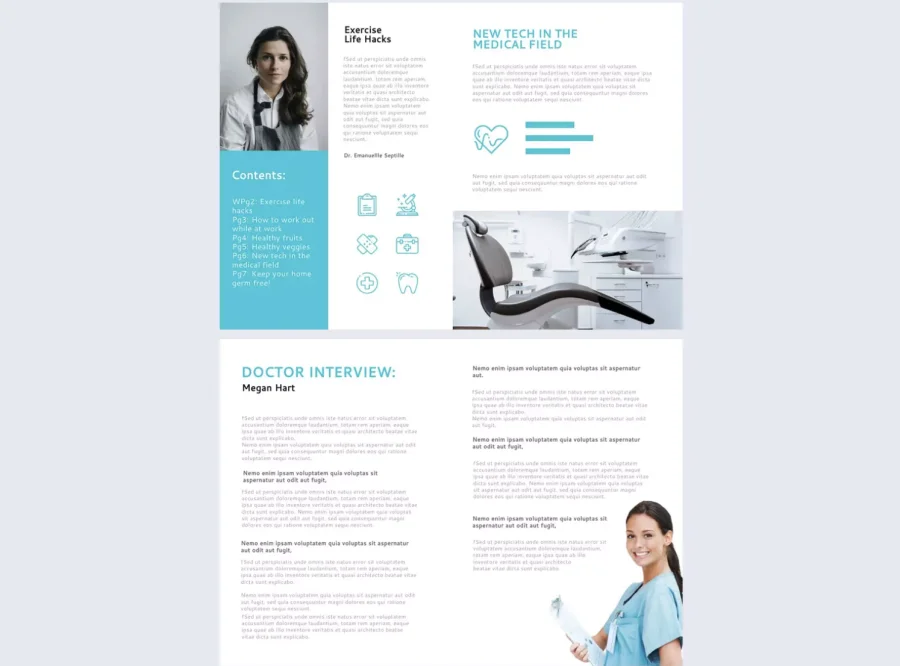
5. Modern HIPAA-Compliant Medical Magazine Template
Internal publications don’t have to look like compliance documents. The modern HIPAA-compliant medical magazine template gives communications and L&D teams a polished, magazine-style format for sharing in-depth regulatory updates, policy changes, and educational content — in a way that actually gets read rather than filed away.
Best for: Mid-size to enterprise healthcare organizations (100–1,000+ employees) that produce regular internal publications for clinical and administrative staff, and want a format that reflects the organization’s professionalism while keeping compliance content engaging.
Real-world application: A learning and development lead at a 450-person integrated health system used this template to launch a quarterly compliance magazine for department heads and senior clinical staff. The visual-first format made it easier to present complex regulatory updates alongside case studies and staff interviews — and engagement tracking showed significantly higher read-through rates compared to the text-heavy PDFs they’d been distributing previously.
The template supports embedded videos, clickable CTAs, and dynamic image galleries, making it easy to create an immersive reading experience without a dedicated design team. Use Flipsnack’s collaboration features to bring compliance officers, HR, and communications teams into the editing process simultaneously — with role-based permissions ensuring the final version is approved before it goes out. Share privately via password-protected or SSO-authenticated links to keep sensitive content within authorized channels.
Common mistake to avoid: Don’t publish a magazine-format document on an irregular schedule. The format works best when staff know to expect it — quarterly or bimonthly cadences build anticipation and routine. An inconsistent publishing schedule undermines both the engagement and the compliance culture you’re trying to build.
6. Editable HIPAA Medical Report Template
Accurate, well-structured medical reporting is one of the most scrutinized areas of HIPAA compliance — and one of the most time-consuming to get right without a reliable format. The editable HIPAA medical report template gives compliance officers and clinical teams a professional, structured framework for producing documentation that holds up under audit and communicates clearly to every stakeholder who needs to read it.
Best for: Healthcare organizations of any size (20–500+ employees) that produce regular compliance or clinical reports for internal review, regulatory submission, or interdepartmental communication — and need a consistent format that reduces preparation time without cutting corners on accuracy.
Real-world application: A compliance officer at a 280-person diagnostic center used this template to standardize quarterly compliance reports that had previously been produced differently by each department head. Having a single format meant reports were comparable across departments for the first time — and the structured layout made it significantly easier to identify gaps before they reached the review stage.
Every section is fully editable — adjust headers, insert tables, add data visualizations, or embed supporting documentation directly into the report. For distribution, use Flipsnack’s privacy options to share via password-protected links or restricted access settings, ensuring sensitive reports reach only the people authorized to view them.
Common mistake to avoid: Don’t let report formatting become a last-minute task. When teams are under pressure to produce reports quickly, structure is usually the first thing to go — and inconsistent formatting is one of the most common reasons compliance documentation fails to hold up during audits. Build from this template at the start of each reporting cycle, not the end.
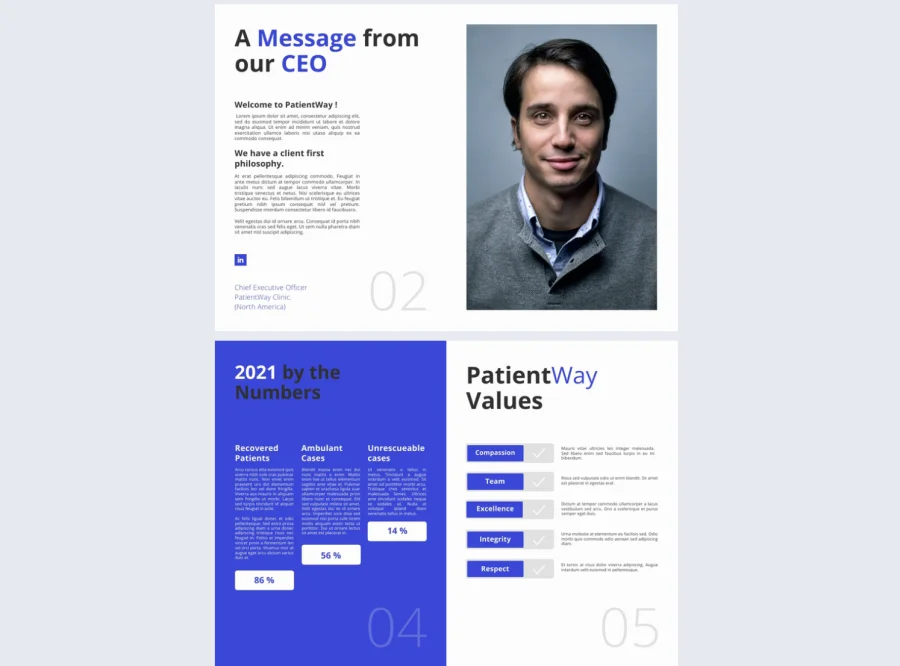
7. HIPAA-Compliant Employee Training Manual Template
Most HIPAA training failures aren’t knowledge failures — they’re format failures. When training materials are dense, static, and impossible to navigate, staff disengage before they’ve absorbed what they need to know. The HIPAA-compliant employee training manual template gives HR and L&D teams a structured, interactive format that makes compliance training easier to deliver, easier to complete, and easier to verify.
Best for: Healthcare organizations of any size running mandatory HIPAA training for clinical staff, administrative employees, or contractors — especially when training needs to be delivered remotely, tracked individually, or repeated across multiple cohorts throughout the year.
Real-world application: A training coordinator at a 320-person home health agency used this template to rebuild their annual HIPAA training program after an OCR audit flagged incomplete training records. By adding embedded quizzes at key intervals and using Flipsnack’s statistics to track completion per employee, they were able to produce a full engagement report for their next audit review — demonstrating not just that training had been distributed, but that staff had actively worked through it.
Customize the manual with your institution’s specific protocols, embed video explanations for complex regulatory concepts, and use interactive question blocks to check comprehension throughout. Role-based permissions ensure that only authorized staff can access the content, and the format can be duplicated and updated each year without rebuilding from scratch.
Common mistake to avoid: Don’t rely on a single annual training session as your entire compliance education strategy. Regulations change, staff turn over, and knowledge fades. Use this template as the foundation for a recurring program — updated annually as a minimum, with shorter refresher materials distributed in between.
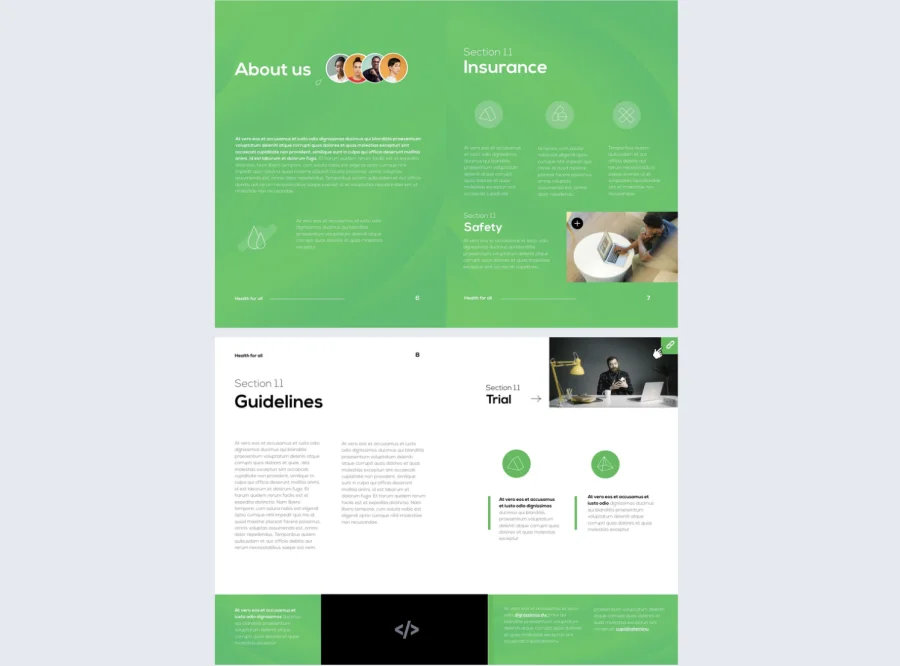
8. Interactive HIPAA Medical Guide Template
Compliance guides are often the documents staff are most expected to reference and least likely to actually use. The interactive HIPAA medical guide template solves that by turning a traditionally static reference document into a navigable, engaging resource that clinical and compliance teams can return to whenever they need it — not just when they’re told to.
Best for: Healthcare organizations of any size that need a go-to compliance reference document for staff — something that covers HIPAA requirements clearly, stays easy to navigate, and can be updated quickly as regulations evolve without requiring a full redesign.
Real-world application: A compliance manager at a multi-site dental group used this template to create a centralized HIPAA reference guide accessible to staff across six locations. Rather than maintaining separate printed guides at each site — which were frequently out of date — one digital version was shared securely via Flipsnack and updated in real time whenever protocols changed. Staff reported finding answers faster, and the compliance team spent significantly less time fielding basic questions.
Add clickable sections for quick navigation, embed short videos to explain complex concepts, and structure the guide into clearly labeled modules so staff can go directly to what they need without reading cover to cover. Share via SSO-authenticated access for enterprise teams, or password-protected links for smaller organizations that need straightforward access control.
Common mistake to avoid: Don’t build this as a comprehensive everything-you-need-to-know document. Guides that try to cover every possible scenario become too long to navigate and too daunting to open. Focus on the regulations and scenarios your staff encounter most frequently — and link out to official sources for the edge cases rather than trying to document them all internally.
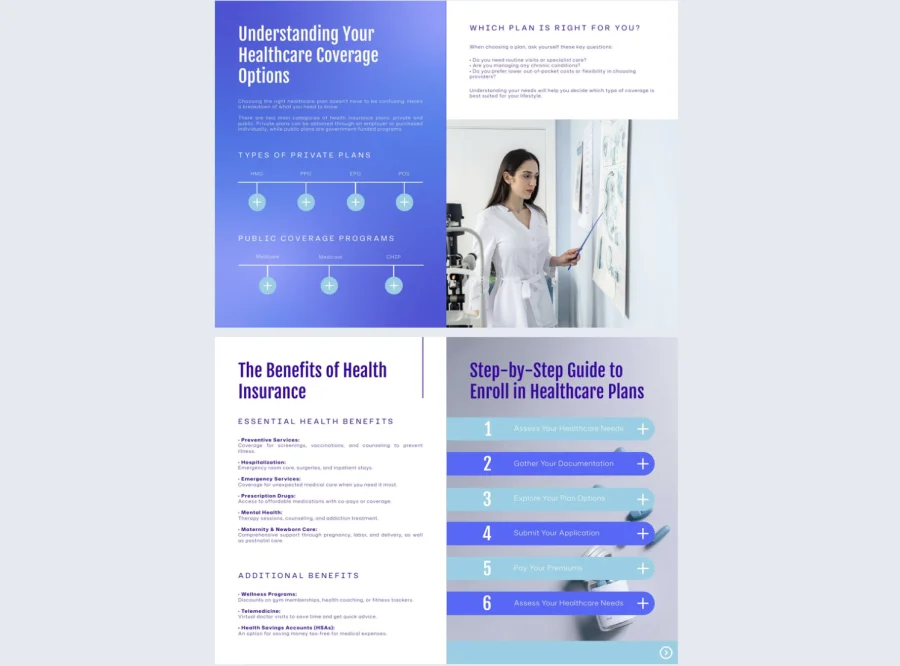
How to create a HIPAA-compliant publication in Flipsnack
A compliant document only works if staff can find it, read it, and engage with it. Flipsnack gives healthcare teams everything they need to build, distribute, and track compliance materials — without a design team or a separate IT workflow.
Note: You can start with a free trial to explore most premium features. We also have a free plan for basic PDF interactivity and up to three flipbooks. For HIPAA-specific security requirements, contact our sales team to find the right plan for your organization.
1. Choose a template or start from scratch
Start with one of Flipsnack’s HIPAA-specific templates — like the interactive HIPAA medical guide template — or open a blank canvas and build from scratch. Every template is fully editable. Adjust the structure, language, and layout to fit your workflows without redesigning anything from the ground up.
Already have compliance materials in another format? Upload your PDF directly. Flipsnack converts it instantly into an interactive digital publication. When regulations change, duplicate the file, update what’s needed, and republish. No rebuilding required.
2. Customize with branding and interactive elements
Open your template in Flipsnack’s online Design Studio. Update colors, fonts, and logos to match your institution’s brand. Then add the elements that make compliance content easier to absorb: embedded videos for complex regulations, quizzes to check staff comprehension, forms for acknowledgments, and navigation buttons for longer documents.
No design experience needed. If the content is clear and easy to navigate, it will get used.
3. Collaborate with your compliance team
Most HIPAA documents involve multiple stakeholders. Use Flipsnack’s collaboration features to bring compliance officers, HR, legal, and department heads into the same workspace. Assign roles based on what each person needs to do:
- Owners control the document and publishing rights
- Editors update content, add media, and restructure sections
- Contributors leave comments without changing the core content
All feedback stays inside the document. No email threads, no conflicting versions.
4. Share and distribute securely
Choose the sharing method that fits the sensitivity of each document:
- Password-protected links — for materials shared within a defined group
- SSO authentication — for teams that need role-based access control
- Private links — for restricted internal distribution
- Embedded — add the document to your intranet or LMS for on-demand access
Every option keeps access controlled and patient data protected.
5. Track engagement and refine
Use Flipsnack’s built-in analytics to see who opened each document, how long they spent on each page, and which sections they skipped. This turns a shared document into an audit-ready record of staff training and communication.
Use the data to spot where comprehension is weakest, simplify sections that get skipped, and decide where follow-up is needed before the next review cycle.
Exploring the essentials: HIPAA compliance software and why it matters
HIPAA compliance software is more than a regulatory checkbox — it’s the foundation that keeps patient data secure and organizations audit-ready. Tools like Noterro’s AI-powered scribe take this further by automating clinical note-taking and reducing the human error that puts sensitive records at risk.
What to look for
Not all compliance tools are built the same. When evaluating your options, prioritize these:
- Customizable compliance checklists that adapt to your workflows rather than forcing staff into rigid, generic frameworks
- Advanced access controls that limit data exposure to essential personnel only. For imaging data specifically, healthcare teams often rely on a HIPAA-compliant cloud PACS to store, route, and share diagnostic files while maintaining strict privacy controls
- Robust audit trails — automated activity logs that hold teams accountable and hold up during OCR audits
- Employee training modules that make it easier for staff to understand and follow HIPAA requirements day to day
- Automated alerts and updates that flag policy changes or potential vulnerabilities before they become violations
Communication tools matter too. If your organization uses VoIP, make sure it meets compliance standards — HIPAA-compliant phone systems cover privacy requirements, breach notification obligations, and BAA considerations that standard providers often overlook.
How Flipsnack supports HIPAA-compliant documentation
Healthcare organizations that use Flipsnack to create, distribute, or store content containing PHI need to ensure those activities meet HIPAA standards. Flipsnack makes that possible — whether you’re uploading an existing PDF and converting it into a secure, trackable flipbook, or building from scratch using one of the HIPAA-specific templates below.
The platform covers the core requirements for compliant document workflows: restricted access controls, password-protected and SSO-authenticated sharing, real-time collaboration with role-based permissions, and built-in analytics that show exactly who engaged with a document and when.
This last point matters more than most teams realize. Being able to demonstrate that staff read and interacted with a training manual is the kind of audit trail OCR investigations look for. It’s worth noting that HIPAA compliance also extends beyond digital workflows.
For organizations handling physical materials — lab specimens, medical records, or devices — working with aSTAT courier that provides chain-of-custody documentation and time-stamped handoffs is just as critical for maintaining audit readiness.
Take your HIPAA compliance documentation to the next level
HIPAA compliance doesn’t get easier by ignoring the documentation problem. It gets easier when the right materials are in place — clear, accessible, trackable, and built to hold up under scrutiny.
These eight templates give your team a head start. Whether you’re onboarding new staff, running annual training, or keeping departments informed on policy updates, each one is designed to make compliance content easier to produce and easier to engage with.
One important reminder: the templates alone don’t make your publications HIPAA compliant. The platform-level security configurations do. Contact our sales team to find out which Flipsnack plan is right for your organization — and make sure everything you publish benefits from the highest level of protection we offer.
Get started today and turn your compliance materials into documents your team will actually use — and your auditors will actually accept.
Frequently asked questions
Not automatically. The templates provide the structure and format — but HIPAA compliance depends on how your organization configures access, sharing, and data handling at the platform level. To ensure your publications meet HIPAA requirements, contact our sales team to discuss the right plan. Flipsnack offers specific security configurations designed for organizations handling PHI.
PHI includes any information that could identify a patient and relates to their health condition, treatment, or payment history. This covers names, dates, contact details, medical record numbers, and more. If your compliance documents reference, display, or are distributed alongside any of this information, they fall under HIPAA’s requirements for access control, secure sharing, and audit trails.
This is where most organizations struggle — distributing training materials is not the same as documenting completion. Flipsnack’s analytics track who opened each document, how long they spent on each page, and whether they interacted with embedded quizzes or forms. This engagement data serves as a verifiable record of staff participation, which is exactly what auditors look for during an OCR investigation.