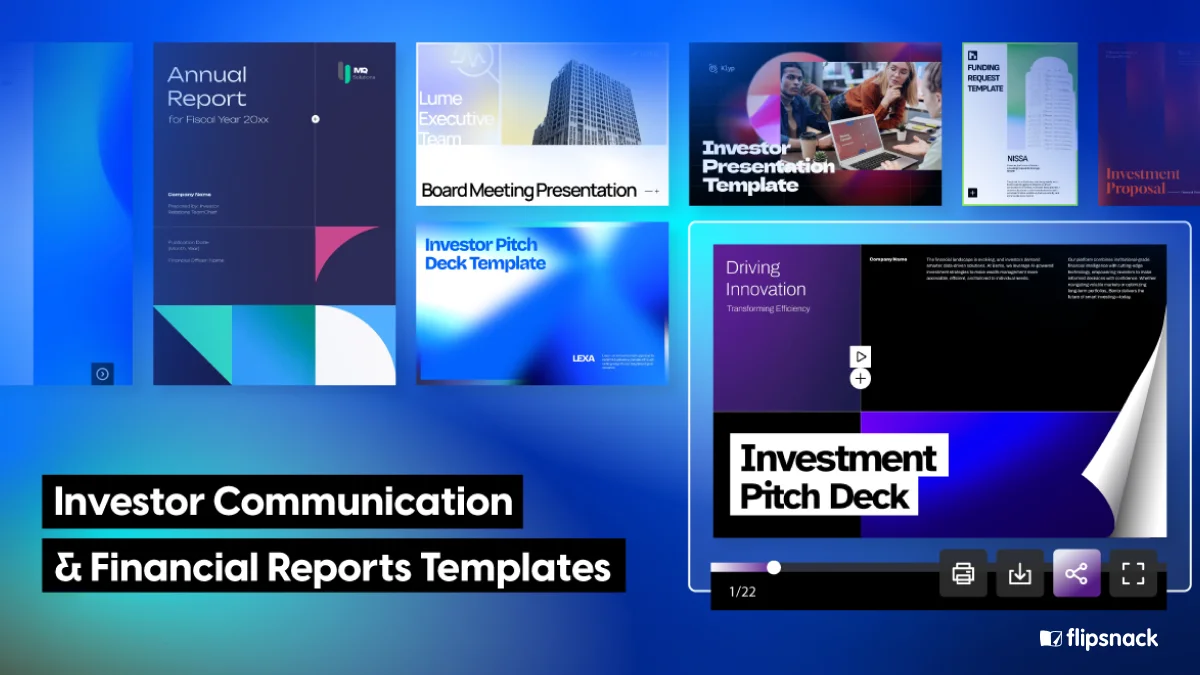
Free Templates for Pitch Decks, Investor Updates & Annual Reports
Updated on: April 21, 2026
What is an investor report template?
An investor report template is a pre-structured document that helps founders, finance teams, and investor relations professionals communicate business performance, funding needs, and strategic direction clearly and consistently. Rather than rebuilding pitch decks, board presentations, or annual reports from scratch for every cycle, templates provide a reusable framework that ensures every stakeholder receives the same level of polish, precision, and professionalism.
In investor communication contexts, a well-built template isn’t just a design shortcut. It’s a trust-building tool. It signals that the team behind it is organized, numbers-aware, and respectful of their investors’ time. With digital, interactive investor report templates, teams can go further than static PDFs, embedding live data, video commentary, and trackable sharing that shows exactly who engaged with what, and for how long.
Table of contents
- How to build investor communication that actually builds trust
- 1. Board meeting investor presentation example
- 2. Interactive investor pitch deck template
- 3. Digital investor presentation template
- 4. Investment pitch deck template
- 5. IPO prospectus template
- 6. Interactive investor update template
- 7. Investor relations strategy example
- 8. Interactive investment proposal example
- 9. Digital investor funding request example
- 10. Interactive annual report template
- How to create an investor update or financial report in Flipsnack
- Why Flipsnack is the smarter way to communicate with investors
- Frequently asked questions about financial and reports templates
How to build investor communication that actually builds trust
Poor investor communication doesn’t announce itself. It shows up quietly — in delayed follow-ups, in questions that should have been pre-empted, in funding rounds that stall because confidence eroded between updates. According to PitchBook, startups that maintain consistent investor communication are 34% more likely to raise follow-on funding. The mechanism is simple: clarity builds trust, and trust is what moves capital.
But building polished, insightful, brand-consistent investor materials takes time that most teams don’t have. Updates get delayed. Pitch decks feel rushed. Annual reports end up as generic PDFs that get skimmed rather than studied. The gap between what a team knows about their business and what their investors actually understand is usually a documentation problem, not a performance problem.
In this guide, you’ll see what makes each type of investor template effective, when to use different formats, and how to customize interactive investor and financial report templates in Flipsnack that stakeholders will genuinely engage with — not just download and forget.
Common investor communication mistakes to avoid
Even experienced teams make the same documentation errors when it comes to investor materials. Here’s what to watch for before you start:
Leading with features instead of story
Investors invest in people and purpose before they invest in products. A pitch deck that jumps straight into product features without first establishing why the problem matters and why this team is uniquely positioned to solve it loses the emotional thread that makes numbers meaningful. Start with the narrative, then support it with data.
Overloading slides with information
A deck past 15 slides often signals uncertainty and a lack of focus. Dense text, data dumps, and tiny fonts are the hallmarks of a document that hasn’t been edited ruthlessly enough. Every slide should earn its place. If you can’t articulate what a slide is doing in one sentence, cut it or merge it.
Using vanity metrics instead of investor-relevant KPIs
Website visits and social media followers are not what investors are evaluating. Revenue, MRR, burn rate, runway, customer acquisition cost, churn, and unit economics are. Presenting vanity metrics even alongside real ones signals that the team may not understand what actually drives business value.
Inconsistent numbers across documents
If your pitch deck shows one revenue figure and your financial model shows another, that discrepancy will be noticed. Inconsistencies between documents damage credibility faster than almost anything else. Maintain a single source of truth and build all investor documents from the same data.
No version control on shared documents
Sending updated pitch decks as new email attachments creates a version management problem, as investors may be referencing an outdated document when they revisit it before a call. A live digital document that updates without changing the link solves this entirely.
Generic, unbranded presentation
A pitch deck that looks like it was built from a default PowerPoint template signals that design and attention to detail aren’t priorities for this team. Investor materials are a proxy for product quality in the absence of direct product experience. Consistent branding, professional layouts, and visual clarity communicate that the team applies the same standards to everything they produce.
Hiding challenges
Investors who find out about significant problems after the fact, rather than hearing about them directly from the team, lose trust quickly and permanently. Transparent communication about obstacles, alongside a clear plan to address them, builds far more confidence than a polished presentation that papers over real issues.
What makes investor communication actually work — success metrics
An investor template is doing its job when:
- Investors open and engage with documents rather than filing them away after a quick scan
- Board meetings start from a shared understanding rather than re-establishing context
- Follow-on funding conversations happen proactively, not reactively
- Updates go out on a consistent cadence without requiring heroic effort each time
- Compliance and disclosure requirements are met cleanly because documentation was built with that structure from the start
- The team knows which sections investors engage with most — and uses that data to sharpen future communications
Quick comparison: Choose your ideal investor template
| Template Name | Primary Use | Best For (Stage / Team) | Main Focus | Key Benefits |
|---|---|---|---|---|
| Board Meeting Investor Presentation | Governance and strategic updates | Growth-stage to enterprise; Leadership and Finance teams | KPIs, strategic goals, key initiatives, quarterly performance | Smart visual structure; embeddable data and video; analytics on investor engagement; secure sharing |
| Interactive Investor Pitch Deck | First-impression fundraising | Pre-seed to Series B; Founders and Finance | Problem, solution, traction, market, team narrative | Modular persuasive layout; password-protected sharing; per-slide engagement analytics; no design tools needed |
| Digital Investor Presentation | Hybrid and async investor meetings | Seed to Series B; Founders, IR teams | Storytelling, product walkthroughs, financial narrative | Full brand kit integration; embedded interactive media; downloadable attachments; guided navigation |
| Investment Pitch Deck | High-stakes funding conversations | Series A and beyond; Finance and Leadership | Business model, unit economics, funding rationale | Interactive feedback modules; contact forms inside the deck; engagement tracking per investor |
| IPO Prospectus | Public market preparation | Pre-IPO companies; IR, Legal, Finance | Financial disclosures, leadership bios, risk factors, growth strategy | Always-current live document; audience-segmented navigation; engagement tracking for targeted follow-up |
| Interactive Investor Update | Between-round stakeholder communication | All funded stages; Founders, IR teams | Progress, KPIs, wins, hiring, market updates | Fast duplication for recurring updates; SSO-controlled access; full branding; update without resending |
| Investor Relations Strategy | Long-term IR planning | Series B and beyond; IR teams, Leadership | Communication calendar, investor tiers, message pillars, QBRs | Collaborative editing; multi-team alignment; editable IR frameworks; slide-level permissions |
| Interactive Investment Proposal | Responding to inbound or targeted asks | All fundraising stages; Founders, BD teams | Structured funding narrative, personalized persuasion | Embeddable testimonials and demos; live chart links; branching reader pathways; lead capture forms |
| Digital Investor Funding Request | Grant and project capital requests | Nonprofits, project teams, early-stage startups | Goals, budgets, impact projections, funding tiers | Multi-channel sharing (link, embed, social); real-time engagement tracking; personalized by funder |
| Interactive Annual Report | Year-end stakeholder reporting | Growth-stage to enterprise; Finance, IR, Leadership | Performance highlights, ESG updates, financial statements, future outlook | Immersive multimedia format; full brand kit; section-based navigation; QR code distribution |
What customers say about Flipsnack templates
I absolutely love that Flipsnack makes it incredibly easy to create professional-looking work, which enhances the visual appeal of our documents significantly. The platform’s user-friendliness means that navigating through its features is straightforward, allowing me to accomplish tasks without unnecessary complications. I particularly appreciate the digital contents page, which adds an organized and accessible component to our presentations. Flipsnack has also been instrumental in reducing our print costs by providing a digital platform for document sharing, ensuring that anyone can access these materials easily. As a testament to its practicality and effectiveness, new departments in my organization have begun using Flipsnack. The initial setup was a breeze, and I was up and running, creating my first project within minutes, which speaks to the intuitive design of the software.
Rebekah Fice-Thomson, Marketing Manager
Reviewed on G2
Investor and financial report templates to customize
Each template below is fully customizable in Flipsnack’s Design Studio and supports interactive elements, secure sharing, and real-time analytics, so your investor materials are always current, always on-brand, and always trackable.
1. Board meeting investor presentation example
Board meetings only work if everyone enters the room or the call with the same shared context. The board meeting presentation template integrates seamlessly with board management software, turning quarterly updates into clear, credible conversations.
Best for: Leadership and Finance teams at growth-stage to enterprise companies running quarterly board meetings or investor governance calls, particularly those where multiple board members or external investors attend, and consistency of information matters as much as content quality.
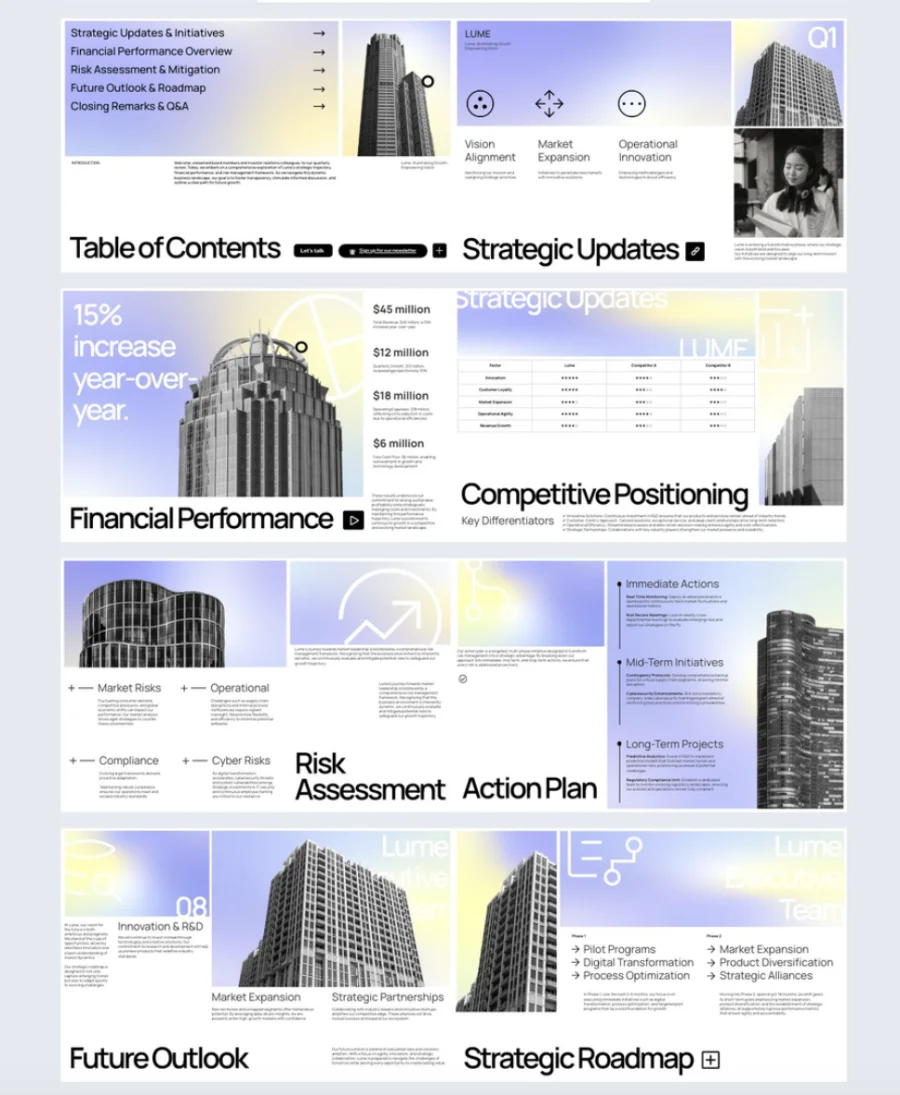

When to use this vs. others: Choose this over the investor update template when the audience is a formal governance body board members with fiduciary oversight rather than general investors receiving a progress update. Board presentations require a higher level of structural rigor, data precision, and strategic framing than a standard investor email or update deck.
Real implementation example: A finance team at a 120-person SaaS company used this template to replace their quarterly board deck — previously assembled from three separate documents by different team members with a single, consistently branded presentation. Board preparation time dropped by four hours per cycle, and post-meeting follow-up questions decreased significantly because key concerns were preempted in the document structure.
Common pitfall to avoid: Don’t use board presentations to only share good news. Boards that only hear positive framing become less useful to the business over time they can’t provide informed guidance without honest context. Structure a dedicated section for challenges and open questions, and treat it as part of the meeting that generates the most strategic value.
Unique features: Smart visual structure with KPI and strategic goal sections; embeddable video commentary and data links; Flipsnack analytics showing which sections board members engage with most; secure sharing with role-based access control.
2. Interactive investor pitch deck template
For startups making their first impression count, this pitch deck template delivers the core narrative with flow, focus, and persuasive structure. It’s built around the investor-facing story arc that works: problem, solution, market size, traction, business model, team, and the ask, organized into a modular layout that’s logical, compelling, and fully adaptable to your specific business.
Best for: Founders and Finance teams at pre-seed to Series B companies preparing for fundraising conversations, particularly first-time founders who want a proven structural framework rather than starting from a blank canvas and guessing what investors expect to see.
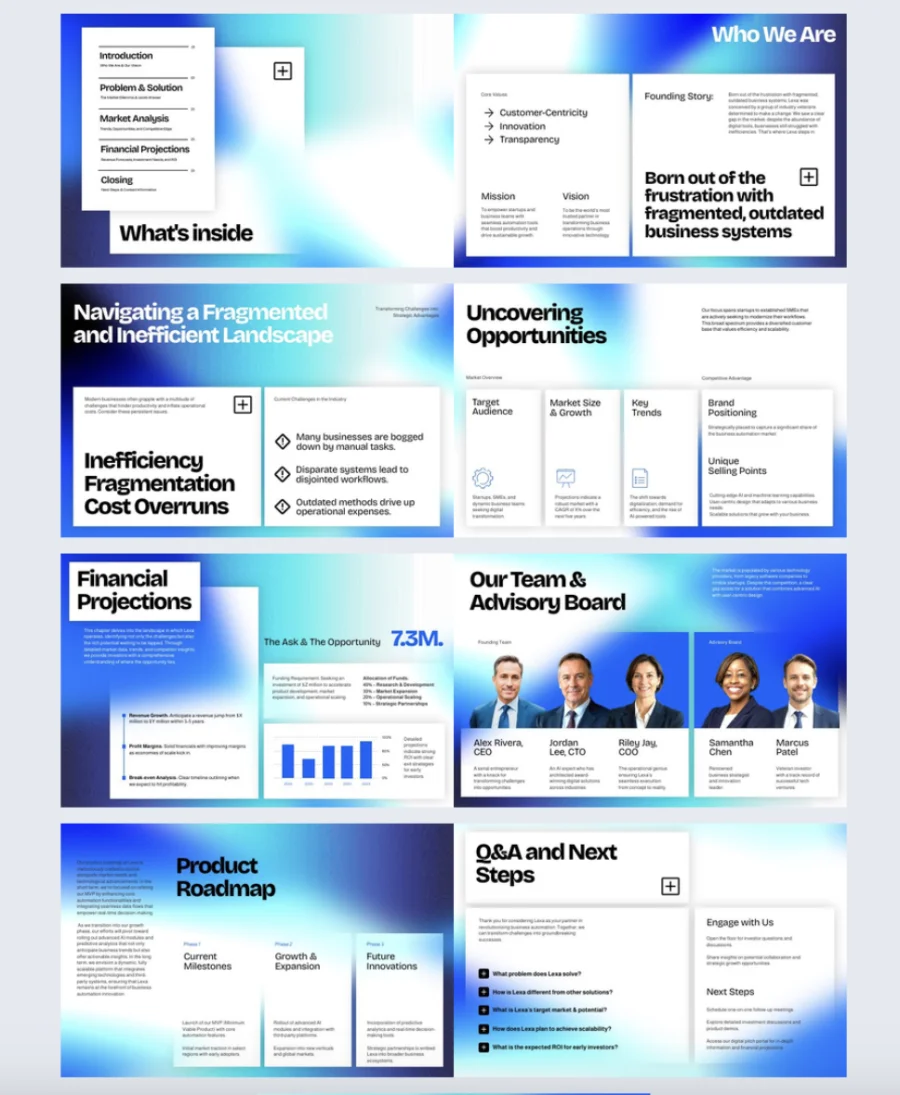

When to use this vs. others: Choose this over the digital investor presentation when your primary use case is a live pitch meeting or a deck being sent cold to investors for a first impression. This template is built for the fundraising narrative problem-solution-traction, while the digital presentation is built for deeper storytelling in hybrid or async contexts.
Real implementation example: A two-person founding team used this template to prepare for their seed round after struggling to structure their pitch coherently. By following the template’s narrative flow and filling in their specific traction data and market sizing, they condensed a previously unwieldy 22-slide deck into a focused 12-slide story. They closed their seed round within 8 weeks of starting outreach.
Common pitfall to avoid: Don’t send the same pitch deck to every investor without personalization. Use Flipsnack’s sharing controls to send different versions to different investor types. Strategic angels may want more product depth, while institutional VCs may want more emphasis on unit economics. Knowing which slides each investor spent the most time on tells you exactly how to open your follow-up call.
Unique features: Modular persuasive layout built around the investor narrative arc; password-protected personalized sharing links; per-slide engagement analytics; no external design tools required.
3. Digital investor presentation template
Some investor conversations don’t happen in real time. This digital investor presentation template is built for hybrid meetings and asynchronous sharing — where the document itself needs to tell the full story without a presenter in the room to fill the gaps. It brings motion and interactivity into a format designed to inform and persuade independently.
Best for: Founders and IR teams at seed to Series B companies sharing materials with investors across time zones, or in situations where investors review documents before or after a live meeting and need the content to stand on its own. Also ideal for follow-up distribution after a live pitch.
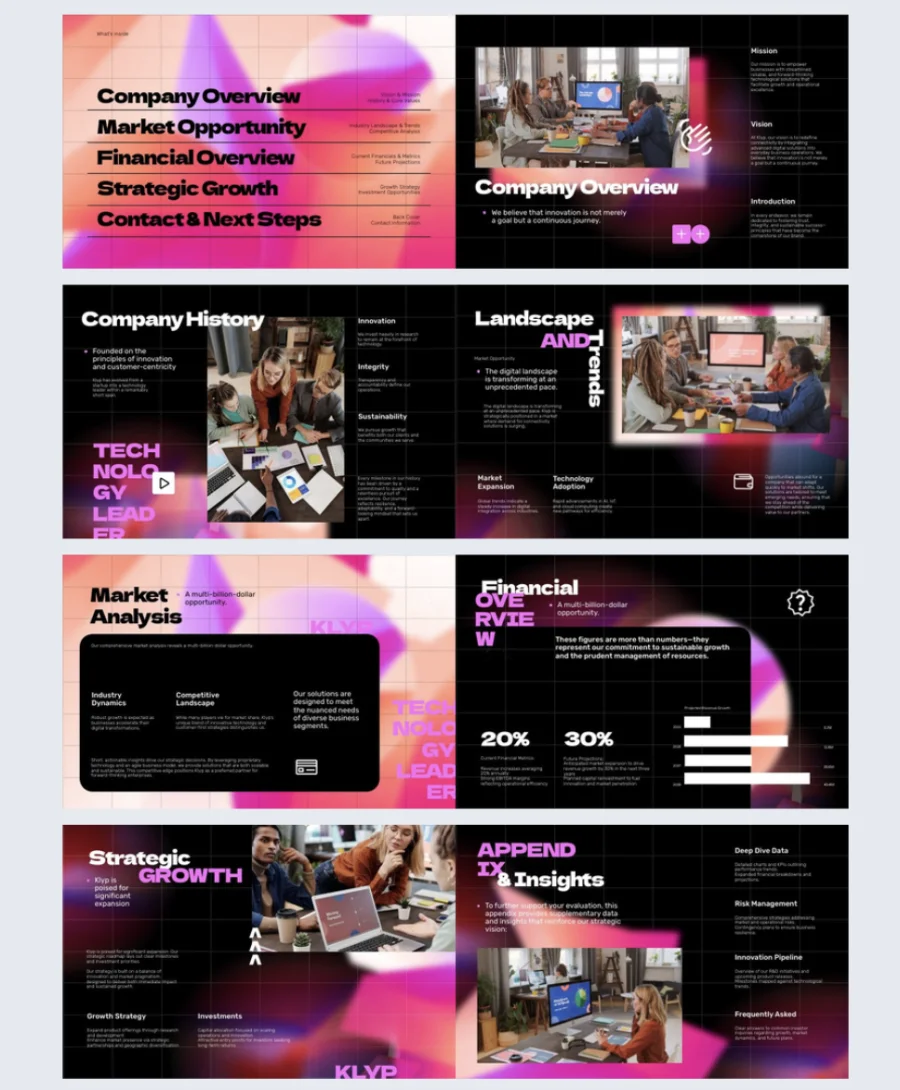
When to use this vs. others: Choose this over the pitch deck template when the document will be shared asynchronously rather than presented live. The digital presentation format supports richer media and more detailed navigation, making it better suited for self-guided exploration than for a time-limited live meeting context.
Real implementation example: A B2B SaaS company used this template for post-meeting distribution after initial investor calls. Instead of sending a static PDF recap, they shared an interactive presentation that included a CEO video walkthrough, embedded product demo clips, and a direct link to schedule a follow-up call. Their meeting-to-second-call conversion rate improved measurably compared to their previous static follow-up approach.
Common pitfall to avoid: Don’t embed so much media that the document becomes slow or overwhelming to navigate. The goal is guided clarity, not comprehensiveness. One well-placed CEO video and one embedded product walkthrough add more value than six media elements competing for attention on the same page.
Unique features: Full brand kit integration (logo, fonts, color palette applied across the document); embedded interactive media, including videos, linked sections, and expandable charts; downloadable attachment support; Flipsnack Design Studio with no external tools needed.
The presentation itself is fully interactive: embed product walkthrough videos, link sections for guided navigation, add expandable data charts, or attach downloadable resources like your full pitch deck or business plan. All of it happens right inside the Flipsnack editor.
4. Investment pitch deck template
When the conversation moves from early interest to serious due diligence, the pitch deck needs to go deeper. This investment pitch deck template is built for high-stakes funding conversations guiding the reader through business model economics, market positioning, competitive landscape, and funding rationale with the authority and precision that later-stage investors expect.
Best for: Finance and Leadership teams at Series A and beyond, preparing materials for institutional investors, growth equity funds, or strategic partners who will scrutinize unit economics, competitive positioning, and the specific use of funds in detail.
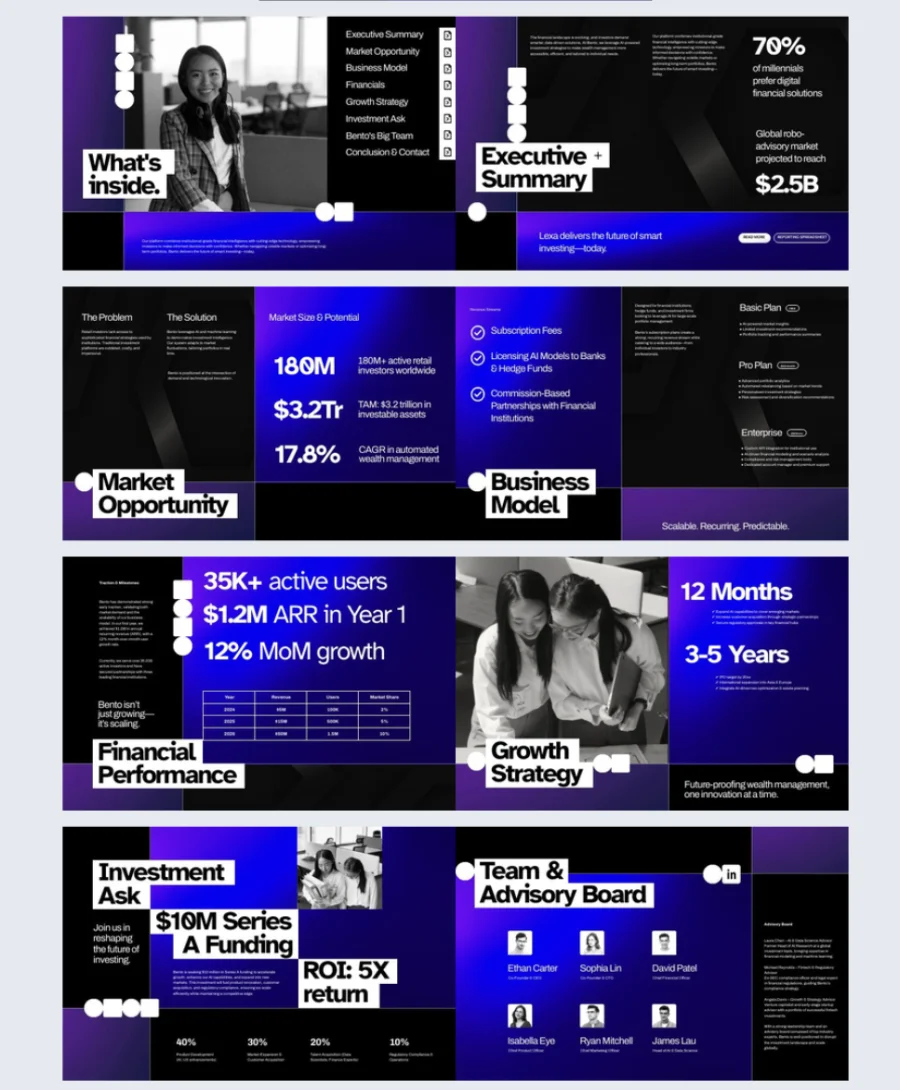
When to use this vs. others: Choose this over the standard pitch deck template when your audience is conducting due diligence, not just forming first impressions. The investment pitch deck goes deeper on financial and strategic substance; it’s for investors who have already expressed interest and are now evaluating seriously.
Real implementation example: A Series A company used this template to prepare materials for a follow-on growth round. By restructuring their existing pitch around the template’s business model and unit economics sections and adding an interactive chart that let investors explore different growth scenarios, they reduced the number of back-and-forth data requests during due diligence from 14 to 3.
Common pitfall to avoid: Don’t present financial projections without showing the assumptions behind them. Investors who can’t trace how you got from the current state to the projected state will discount your numbers or disengage entirely. Use expandable sections or linked financial models to make assumptions transparent and traceable.
Unique features: Interactive feedback and question modules; embedded contact forms for interest capture and meeting scheduling directly inside the deck; per-investor engagement tracking; clean layout optimized for financial and strategic depth.
5. IPO prospectus template
Going public requires a document that combines financial precision, legal rigor, and presentation quality that instills confidence across a highly diverse audience potential shareholders, institutional analysts, regulators, journalists, and the general public. This IPO prospectus template provides the structure to present financial disclosures, leadership bios, growth strategy, and risk factors in a visually polished, navigable format.
Best for: IR, Legal, and Finance teams at pre-IPO companies preparing public market documentation, particularly teams managing multiple rounds of content updates as financials and disclosures evolve during the IPO process.
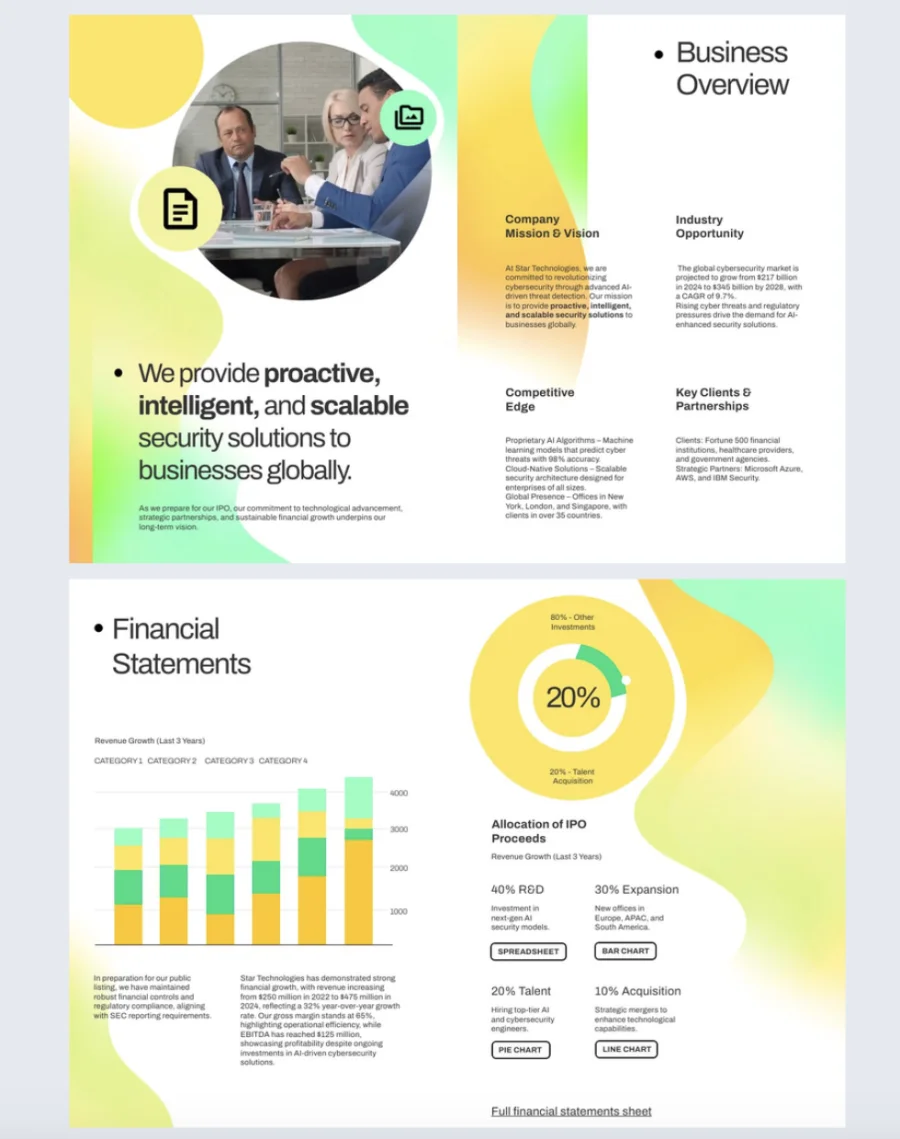
When to use this vs. others: This template is purpose-built for public market disclosure and has no direct equivalent in the collection. If you’re not preparing for an IPO or public offering, the annual report template is the closest equivalent for formal external stakeholder communication.
Real implementation example: An IR team at a pre-IPO company used this template to manage their prospectus through six content revision cycles without ever resending the document. Each time financial data or legal language was updated, the live document reflected the change immediately. Their legal and banking advisors always worked from the current version, eliminating the version confusion that had plagued their previous documentation process.
Common pitfall to avoid: Don’t treat the prospectus as a legal document first and a communication document second. Regulatory completeness is non-negotiable, but investors and analysts are simultaneously evaluating your ability to tell a coherent strategic story. Structure the document so that the growth narrative is as clear as the risk disclosures.
Unique features: Always-current live document updates without changing the link; audience-segmented navigation for different stakeholder types; engagement analytics tracking, which sections draw the most attention; clean scrollable format designed for both regulatory and commercial audiences.
6. Interactive investor update template
Between funding rounds, consistent investor communication is what separates founders who have warm relationships with their investors from those who only reach out when they need something. This investor update template gives fast-moving teams a structured, brandable format for regular updates — covering wins, revenue highlights, hiring updates, market shifts, and open asks without requiring a new document every time.
Best for: Founders and IR teams at all funded stages sending monthly or quarterly updates to existing investors, angels, or board observers. Particularly valuable for teams who want to maintain investor engagement between rounds without spending hours formatting each update.
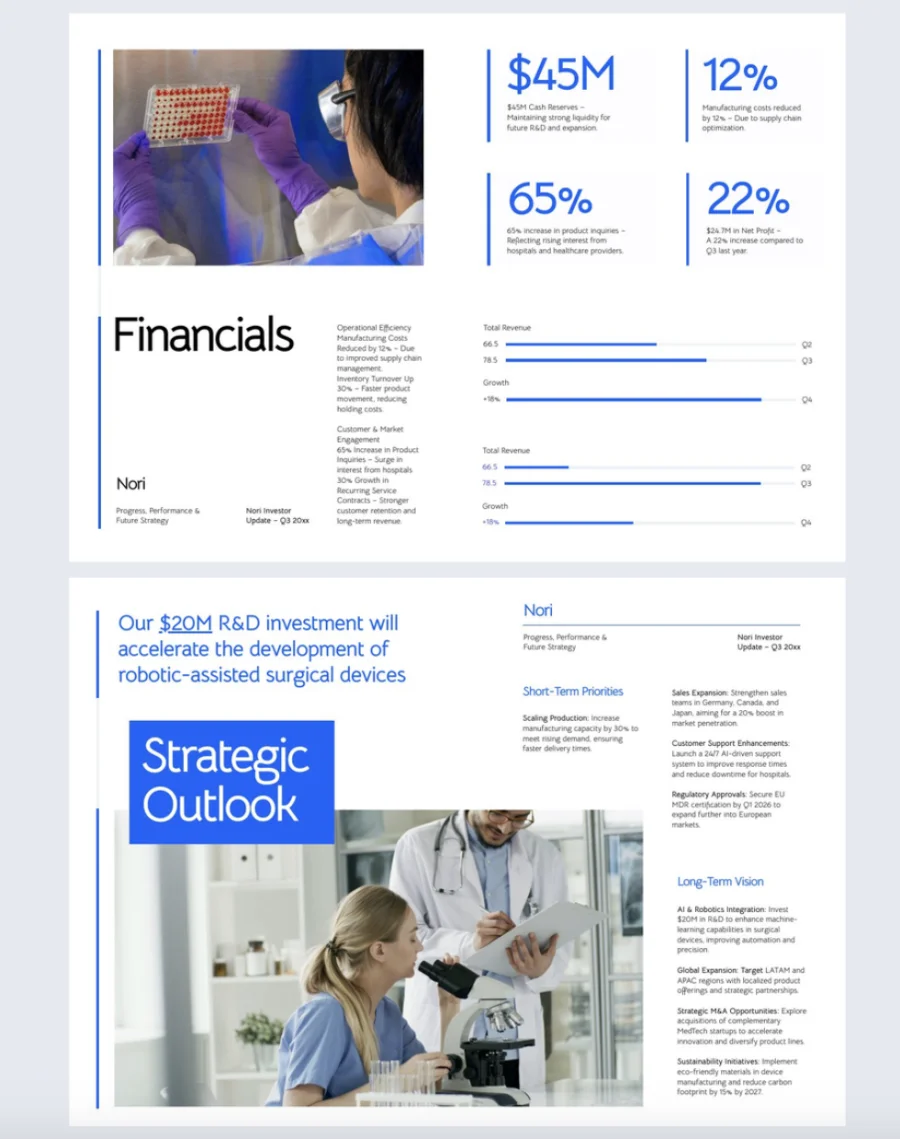
When to use this vs. others: Choose this over the board meeting presentation when your audience is a broader group of investors receiving a general update, not a formal governance body requiring structured decision support. The investor update is informative and relationship-maintaining; the board presentation is governance-oriented and strategically formal.
Real implementation example: A founder at a seed-stage company switched from quarterly email updates to a recurring Flipsnack investor update template. By duplicating and updating the same template each quarter, their update preparation time dropped from a full day to under two hours. Several investors responded proactively with introductions and support after reading the update behavior the founder attributed to the increased clarity and consistency of the new format.
Common pitfall to avoid: Don’t only share updates when things are going well. Investors who only hear from founders during good news become skeptical and disengaged. The most trust-building updates are the ones that are honest about challenges alongside wins and that demonstrate the team has a clear plan to address what isn’t working.
Unique features: Fast duplication for recurring update cycles; SSO-controlled access for sensitive financial content; full branding consistency across all updates; update content without changing the shared link.

7. Investor relations strategy example
Investor relations without a documented strategy is just reactive communication responding to questions rather than shaping the narrative. This IR strategy template brings structure to long-term stakeholder planning, turning your investor playbook into something visible, shareable, and actionable across the full team.
Best for: IR teams and Leadership at Series B and beyond, where investor communication involves multiple team members, multiple investor tiers, and a communication calendar that needs to be coordinated rather than improvised. Also valuable for companies preparing for a fundraising process that want to systematize outreach and messaging before it begins.
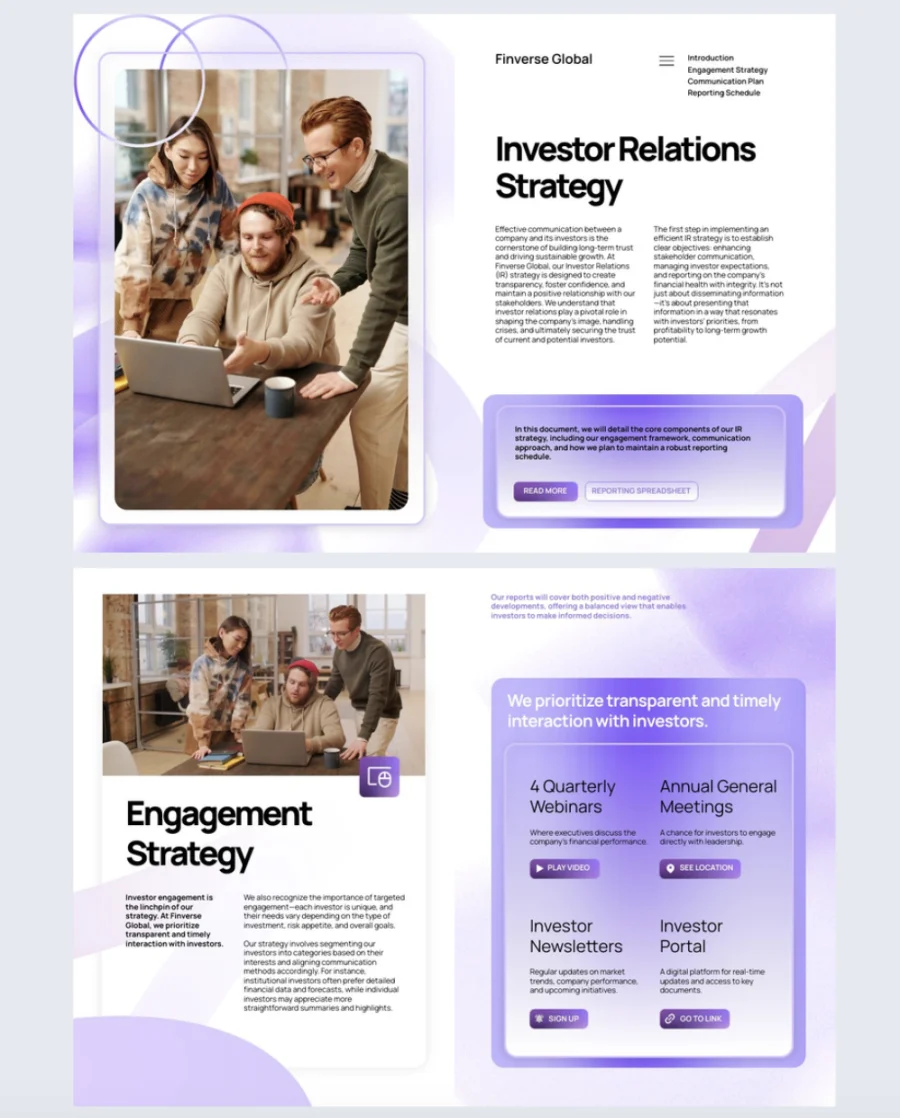
When to use this vs. others: Choose this over the investor update template when the work to be done is strategic planning, defining who your investors are, what they need to hear, when, and from whom — rather than producing a specific communication deliverable. Think of this as the document that governs all other investor documents.
Real implementation example: An IR team at a 200-person company used this template ahead of their Series C process to align their CEO, CFO, and communications lead around a shared messaging framework for the first time. Having investor tiers, key message pillars, and a 12-month communication calendar in one shared document reduced internal misalignment during investor conversations; everyone was saying the same things to the right audiences at the right time.
Common pitfall to avoid: Don’t build an IR strategy document and file it away. Its value is in active use; reference it before every investor meeting, update it after every significant business development, and review it quarterly. An IR strategy that’s 18 months out of date is worse than no strategy, because it creates false confidence about how you’re managing investor relationships.
Unique features: Editable IR calendar, investor tier, and message pillar frameworks; simultaneous multi-team editing; slide-level role-based permissions; comment and annotation tools for cross-functional alignment.
8. Interactive investment proposal example
An investment proposal is different from a pitch deck; it’s less about first impressions and more about structured persuasion for an investor who is already engaged. This interactive investment template helps you turn a funding ask into a guided, investor-focused journey, whether you’re responding to an inbound inquiry or presenting a targeted case to a specific backer.
Best for: Founders and Business Development teams at all fundraising stages responding to investor interest, preparing for partnership conversations, or building tailored proposals for strategic investors who need a more customized narrative than a standard pitch deck provides.
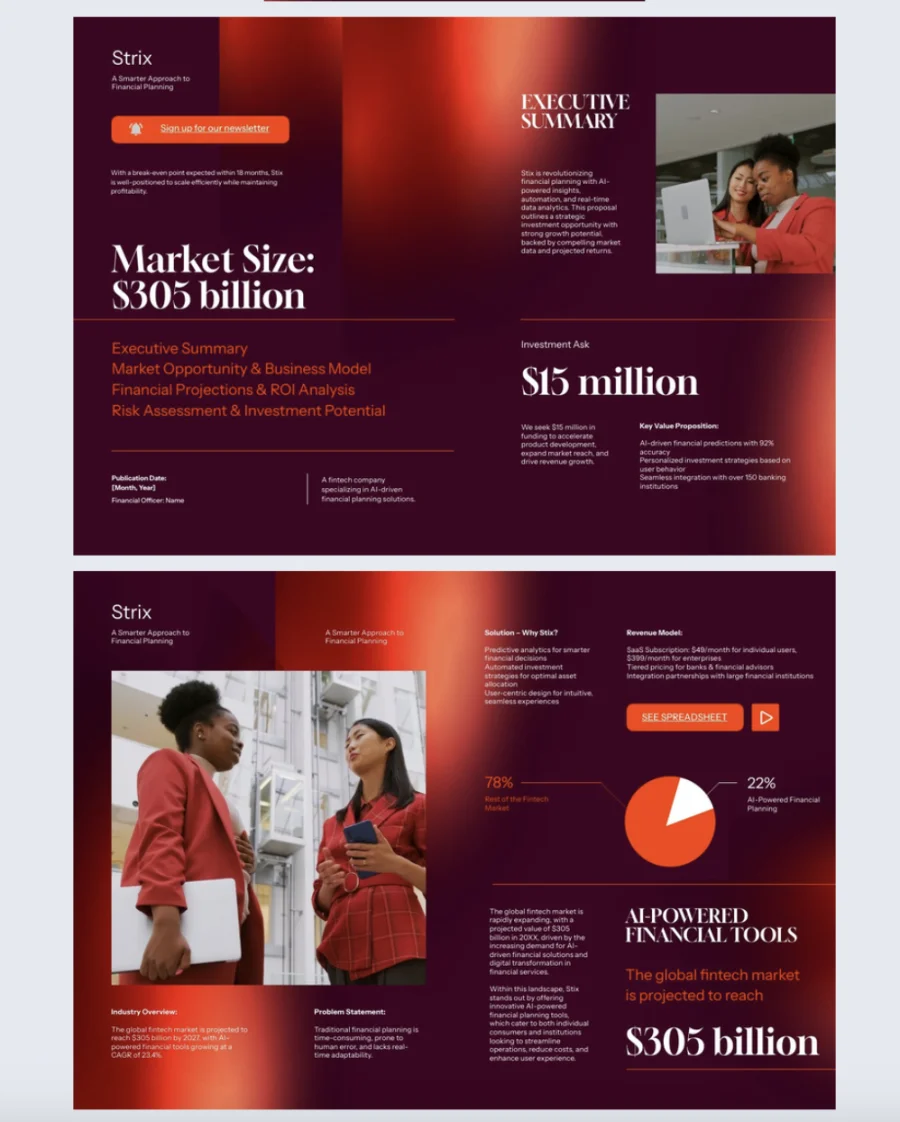

When to use this vs. others: Choose this over the pitch deck templates when the investor is already in conversation with you and needs a document that goes deeper on the specific terms, opportunity framing, and strategic rationale of this particular investment, not a general introduction to the company.
Real implementation example: A growth-stage company used this template to respond to inbound interest from a strategic investor, personalizing the proposal with a product walkthrough video, an embedded live financial model, and a custom call-to-action linking directly to their data room. The investor commented in their follow-up call that it was the most navigable investment document they had received that year the deal moved to a term sheet within three weeks.
Common pitfall to avoid: Don’t send a generic investment proposal to multiple investors simultaneously and expect it to convert. The value of this format is personalization, embedding content, and framing the opportunity around what you know about this specific investor’s portfolio, thesis, and priorities. A proposal that feels written for someone else is worse than no proposal at all.
Unique features: Embeddable testimonial videos, product demos, and team introductions; interactive charts linked to live spreadsheets; branching reader pathways based on investor interest; lead capture forms and CRM-linked CTAs; personalized access per investor.
9. Digital investor funding request example
Not every capital ask happens in a boardroom. This funding request template is built for teams and organizations that need to make a compelling written case for capital whether that’s a nonprofit grant application, a project proposal, a campaign pitch, or an early-stage funding request where the relationship is being built asynchronously.
Best for: Nonprofits, social enterprises, project teams, and early-stage startups making funding requests to foundations, grant bodies, impact investors, or campaign donors where a formal, written proposal is the primary medium of persuasion.
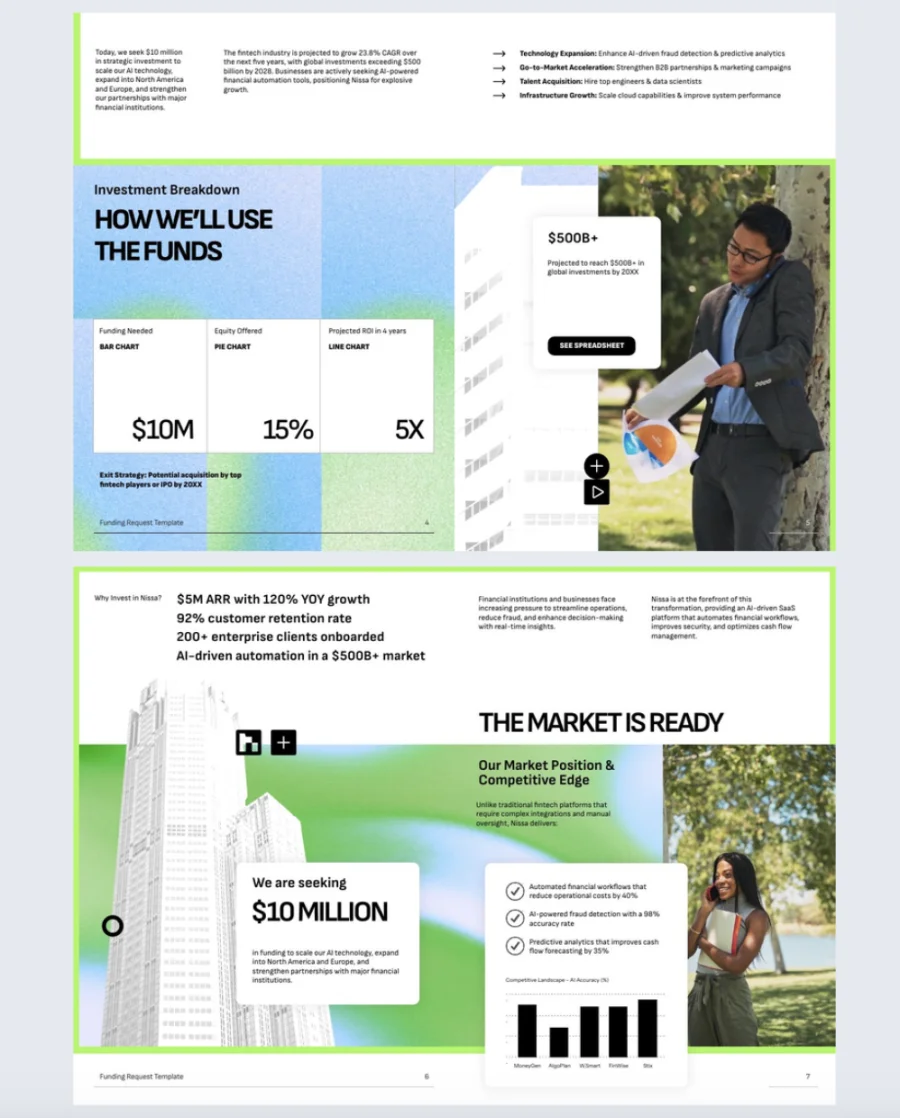
When to use this vs. others: Choose this over the investment proposal template when your funding context is philanthropic, grant-based, or campaign-driven rather than equity-based. The funding request structure is oriented around impact, goals, and budget justification rather than business model and return expectations.
Real implementation example: A nonprofit used this template to replace their static grant application PDF with an interactive funding request featuring embedded impact videos, linked program documentation, and a segmented budget breakdown. Their application stood out among the submissions reviewed by the grant committee. The program officer noted that the interactive format made it significantly easier to evaluate the proposal than the standard PDF submissions they typically received.
Common pitfall to avoid: Don’t lead with your organization’s history before establishing the urgency of the need you’re addressing. Funders are impact-focused; they want to understand why this problem matters and why it needs to be addressed now before they evaluate whether your organization is the right one to address it.
Unique features: Multi-channel sharing via direct link, website embed, and social distribution; real-time engagement tracking on who viewed what and for how long; embeddable funding tiers and donation buttons; full personalization by funder type.
10. Interactive annual report template
The annual report is the highest-stakes investor communication document most companies produce each year. It needs to serve multiple audiences simultaneously: shareholders, analysts, employees, press, and regulators with content that is accurate, navigable, and compelling enough to be read rather than filed. This interactive annual report template reimagines year-end reporting as an immersive experience, not just an information dump.
Best for: Finance, IR, and Leadership teams at growth-stage to enterprise companies producing formal annual reports for shareholders and external stakeholders, particularly organizations that want their annual report to function as a genuine brand and credibility asset rather than a compliance obligation.
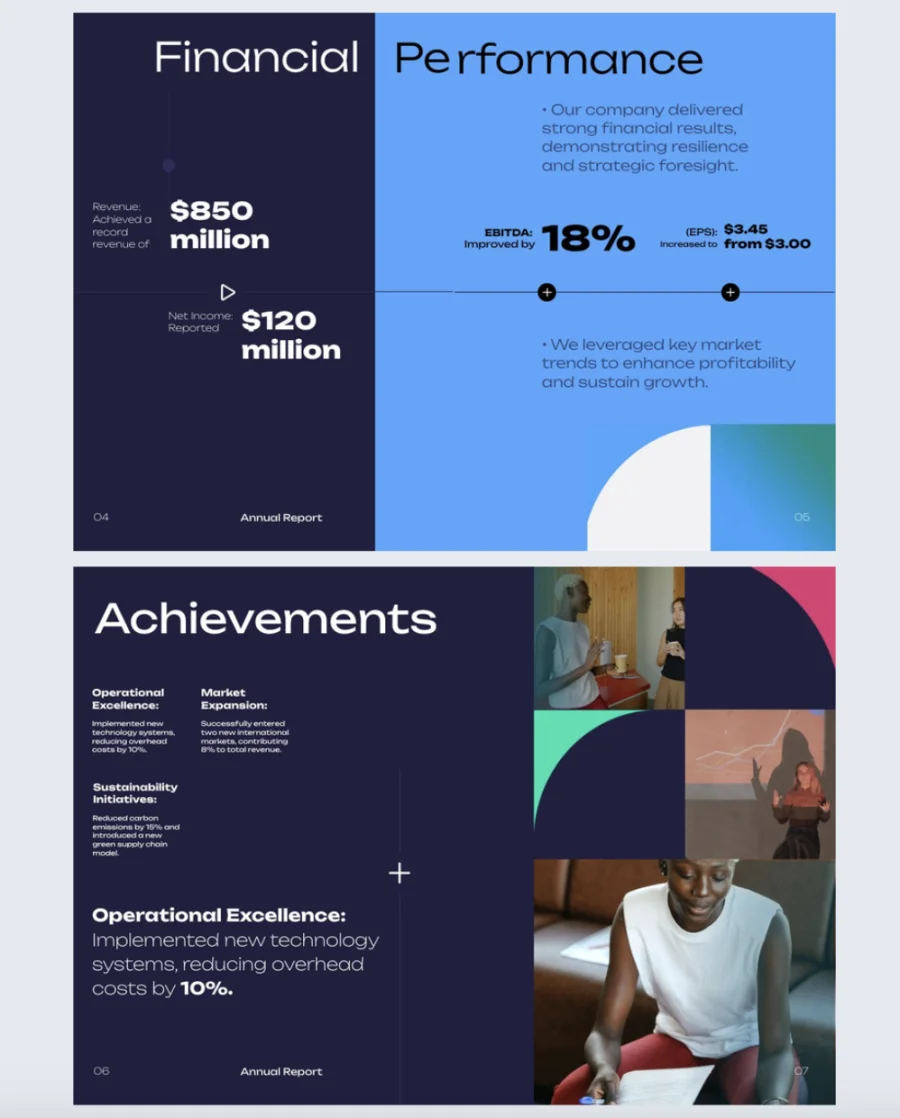
When to use this vs. others: Choose this over the investor update template when the purpose is formal, comprehensive year-end reporting for a broad stakeholder audience — not a targeted update for existing investors. The annual report covers the full year across performance, strategy, governance, and outlook; the investor update covers recent developments for an engaged investor audience.
Real implementation example: A 400-person company used this template to replace their static PDF annual report, which averaged 4 minutes of engagement time per recipient — with an interactive flipbook featuring embedded leadership videos, animated financial charts, and section-based navigation. Average engagement time increased to 11 minutes, and the report was shared organically by employees and partners in a way their previous format never was.
Common pitfall to avoid: Don’t treat the annual report as purely backward-looking. Investors and analysts are evaluating future potential as much as past performance. Dedicate meaningful space to strategic priorities, market opportunity, and forward-looking context, and make sure that the narrative connects clearly to the financial results you’re reporting.
Unique features: Embedded leadership videos and animated financial charts; full brand kit customization; section-based navigation for multi-audience accessibility; QR code generation for printed materials distribution; password protection, private access, and SSO for controlled sharing.
How to create an investor update or financial report in Flipsnack
Crafting a polished investor document doesn’t require a design degree or days of formatting. Once you’ve picked your template, Flipsnack gives you a powerful set of tools to tailor it, brand it, and share it in just a few clicks.
Here’s how to turn a template into a fully customized investor communication asset:
1. Choose the right template for your message
From pitch decks to quarterly reports, Flipsnack offers templates designed specifically for investor communication. Whether you’re asking for funding, reporting performance, or preparing for a board meeting, each template includes smart layouts and pre-structured sections so you can focus on content, not design.
Not sure where to start? The digital investor pitch deck and interactive annual report template are both versatile, high-performing starting points.
2. Customize it to match your brand and voice
Once inside Flipsnack’s Design Studio, you have full creative control, without the complexity of traditional tools.
- Upload your brand kit (logo, fonts, colors) for instant consistency
- Swap images, rearrange layouts, and insert custom data visuals
- Personalize charts, graphs, and tables with real numbers
- Create modular sections for different investor types or regional updates
Your deck, your message, polished in minutes.
3. Add interactive elements to boost clarity and engagement
Investor documents aren’t just meant to be read—they’re meant to be understood. With Flipsnack, you can add interactive features that make your content easier to explore and harder to ignore.
- Embed video messages from your CEO or CFO
- Add internal navigation buttons and slide-to-slide jump links
- Include downloadable attachments like financial statements or forecasts
- Add contact buttons and calendar links for seamless follow-up
These elements help investors stay engaged and feel confident in what they’re reading.
4. Secure, trackable, and up-to-date
Once your presentation is ready, share it with the precision that today’s investor relationships demand:
- Publish as a digital flipbook or export as a PDF
- Set password protection or viewer permissions
- Embed it into investor portals, pitch emails, or secure data rooms
- Get real-time analytics: see who opened it, how long they spent on each page, and where they dropped off
And if you spot a typo or update your numbers? No need to resend—just make the edit and republish. Your shared link always reflects the latest version.
5. Duplicate and reuse for future reporting
Once your template is customized, you don’t have to start over each time. Simply duplicate the file, update the content, and send your next investor update in minutes, not hours.
It’s a system that scales with you, quarter after quarter.
Why Flipsnack is the smarter way to communicate with investors
Why Flipsnack is the smarter way to communicate with investors
Whether you’re pitching for funding, preparing for an IPO, or sharing quarterly results, your investor materials aren’t just information delivery they’re perception management. Every document you send is a signal about how organized, credible, and investor-ready your team is.
Flipsnack gives investor and finance teams the tools to build materials that reflect that standard consistently across every document, every cycle, every stakeholder. Full brand control, interactive elements that aid comprehension, secure and trackable sharing, real-time content updates, and analytics that tell you what’s actually working.
From a first-impression pitch deck to a year-end annual report, everything your investors receive should feel like it came from the same professional, precise, and prepared team. Flipsnack makes that possible without a dedicated design resource or days of formatting work.
Frequently asked questions about financial and reports templates
What is an investor report template?
An investor report template is a pre-structured document framework that helps founders, finance teams, and IR professionals communicate business performance, funding needs, and strategic direction consistently and professionally. Templates save time, enforce quality standards, and ensure that every stakeholder receives the same level of clarity regardless of who produced the document.
What types of investor communication templates do companies need?
The core set covers the full funding and reporting lifecycle: a pitch deck for fundraising, an investor update template for between-round communication, a board presentation for governance, an annual report for year-end reporting, and an investment proposal for targeted funding asks. Companies preparing for public markets additionally need an IPO prospectus template, and IR teams at scale benefit from a dedicated investor relations strategy template.
What should a pitch deck include?
A well-structured pitch deck typically covers the problem being solved, the solution and product, the market size and opportunity, the business model, traction and key metrics, the competitive landscape, the team, and the funding ask with intended use of funds. Each element should earn its slide, decks past 12–15 slides, often diluting the core message.
What is the difference between a pitch deck and an investment proposal?
A pitch deck is typically used for first-impression fundraising it tells the company story concisely to investors who are evaluating whether to engage further. An investment proposal is a deeper, more tailored document used later in the process, when an investor is already engaged and needs a structured case for this specific investment opportunity. Pitch decks are for opening conversations; investment proposals are for closing them.
How often should investor updates be sent?
Early-stage startups typically benefit from monthly updates the communication frequency helps maintain investor engagement and builds the trust that drives referrals and follow-on funding. Growth-stage companies typically shift to quarterly updates as the governance structure matures. The most important factor isn’t frequency, it’s consistency. An investor who knows to expect an update on the first Monday of each month is more engaged than one who receives sporadic updates of varying quality.
What makes an investor update effective?
Effective investor updates are concise, honest, and structured consistently across cycles. They cover key metrics with context (not just numbers), notable wins, honest challenges alongside a plan to address them, team updates, and a specific ask introductions, advice, or a heads-up about an upcoming round. Updates that only share good news erode trust over time; the most valuable investor relationships are built on transparent communication through difficult periods as well as good ones.
How do you make investor documents that actually get read?
Structure and visual clarity matter more than length. Use clear section headers and logical narrative flow so investors can navigate to what matters most to them. Replace text-heavy slides with visual data representations. Embed short videos for complex explanations. And use a platform like Flipsnack to track engagement, knowing which sections investors actually spend time on tells you more about what they care about than any survey.
What is the difference between an investor update and an annual report?
An investor update is a targeted, regular communication to existing investors covering recent developments — wins, metrics, challenges, and asks. An annual report is a comprehensive, formal document covering the full year across financial performance, strategic priorities, governance, and outlook, often intended for a broader stakeholder audience including shareholders, analysts, and the public. Updates maintain relationships; annual reports establish the formal record.
How do you control who can access sensitive investor documents?
Flipsnack supports password-protected links, SSO authentication, and domain-restricted access for sensitive investor materials. These controls ensure that only authorized stakeholders can view confidential financial data, term sheets, or pre-IPO disclosures without requiring recipients to create accounts or navigate complex access systems.