7 Sales Deck Examples That Win Clients
Published on: September 17, 2026
Sales reps at Radioshuttle used to present from a PowerPoint that ran to 45 slides. Files that size were hard to email, and meetings ended with nothing useful left behind.
That deck had two jobs. Support a live conversation, then keep working once the rep left the room. Plenty of decks only get built for the first one.
Studying good decks is hard, since most companies keep theirs private. We found seven real sales deck examples published as digital presentations you can open in a browser right now. They cover warehouse automation, luxury real estate, retail leasing, wholesale, public safety, facilities management and custom furniture.
Each breakdown below gives you the page count, the section order and what to borrow.
Table of contents
- What is a sales deck?
- 7 real sales deck examples and what to borrow from each
- 1. Radioshuttle: a product sales deck built for self-navigation
- 2. Macerich x Din Tai Fung: a personalized sales deck for one prospect
- 3. LION: a sales deck that opens on the buyer’s problem
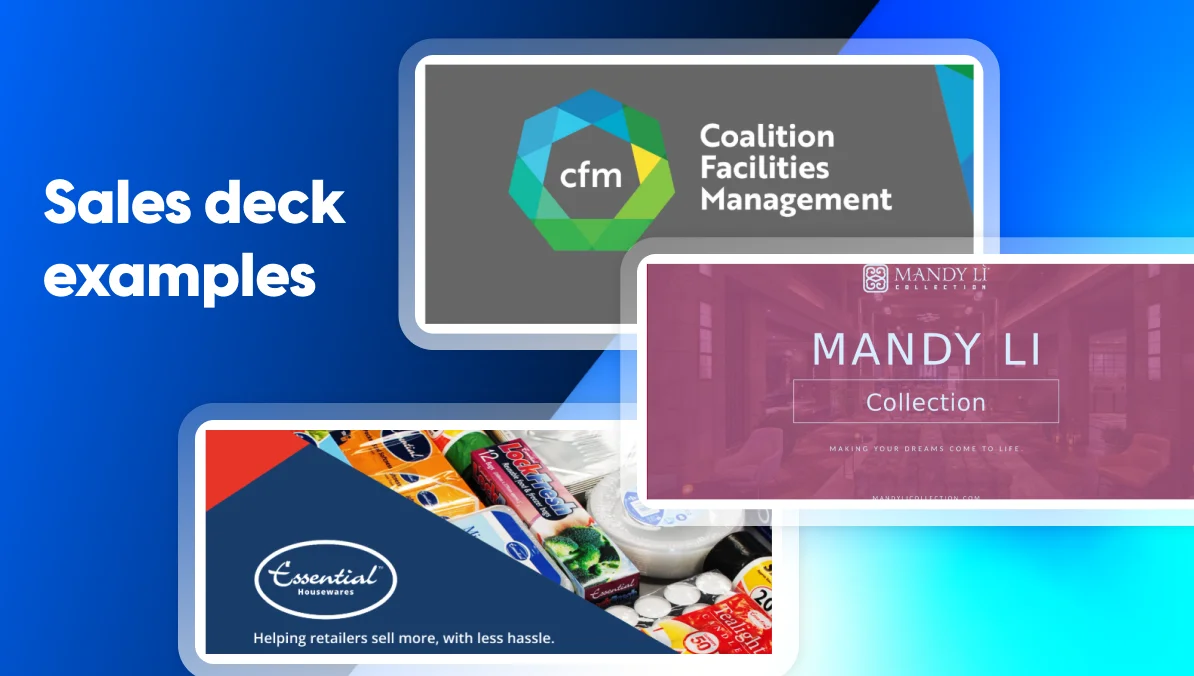
- 4. Essential Housewares: a wholesale sales deck that simplifies a large range
- 5. CFM: a client sales presentation organized around buyer questions
- 6. Mandy Li Collection: a sales deck built around capabilities and project proof
- 7. Kurfiss Sotheby’s: a listing presentation backed by global reach
- What to include in a sales deck
- Five types of proof that make sales decks credible
- Match sales deck length to the job it does
- Make your sales deck interactive and trackable with Flipsnack
- What these sales deck examples show
- Frequently asked questions about sales decks
What is a sales deck?
A sales deck is a presentation that persuades a prospective buyer by connecting their problem to a solution, supporting proof and a clear next step.
Some support a live sales conversation. Others work as interactive sales presentations that buyers can explore on their own. Many do both, which is why the running order matters as much as the design.
Pitch decks ask investors to fund a business. Sales decks move a buyer toward a commercial decision, so relevance to that one buyer decides whether they work.
7 real sales deck examples and what to borrow from each
For this article, we reviewed seven publicly accessible sales decks, counted their pages, mapped their section order and checked for interactive elements.
1. Radioshuttle: a product sales deck built for self-navigation
Radioshuttle sells automated pallet handling systems for manufacturing, logistics, retail, food and beverage and cold storage operations.
The deck opens with the company, its team and the Raymond partnership. It then moves into Radioshuttle’s solutions, storage benefits, system structure, applications, components and accessories. Success stories and customer proof come toward the end, followed by a “Talk to an expert” call to action.
What makes this deck easier to explore is its interactive structure. Buyers can use the contents page to jump directly to applications or accessories instead of reading all 20 pages in order. Embedded videos show the systems in action, while photo features and lead capture forms add more detail without making the deck harder to navigate.
The deck is hosted on a branded domain, brochure.radioshuttle.co. Reps also use an offline version on iPads at trade shows.
According to Radioshuttle’s customer story, the new sales deck reached an average viewing time above 11 minutes and increased engagement by 650% in the month after launch. It was also shared with 500 Raymond sales representatives. Gabrielle McCarthy, Digital Marketing Manager at Radioshuttle, describes it as “our most competitive sales tool.”
Pages: 20
Best for: technical products sold through distributors
Format: interactive, with contents page, videos and lead forms
What to borrow: Use an interactive contents page when buyers may want different parts of the same sales story. It lets them choose what matters without removing useful detail.
2. Macerich x Din Tai Fung: a personalized sales deck for one prospect
Macerich is a retail real estate investment trust that operates shopping centers in major US markets, including Queens Center in Elmhurst, New York.
The deck names both companies on the cover, then moves through an introduction, executive summary, shopper traffic, local demographics, location proof, retail performance and the leasing opportunity.
The executive summary makes the case for Queens Center with specific data. The deck reports 12.2 million annual visits, a 1.9 million daytime population within five miles, a large nearby Asian population and no Din Tai Fung location within a 45-minute drive. Every section supports the same expansion decision.
Pages: 14
Best for: high-value pitches to one named account
Format: static, data-led
What to borrow: Put the prospect on the cover and build the evidence around the decision you want them to make.
Worth knowing: This level of personalization takes more work, so it makes the most sense for high-value accounts where a tailored pitch can justify the effort.
3. LION: a sales deck that opens on the buyer’s problem
LION provides protective equipment, training systems and safety solutions for firefighters and first responders. The family-owned company has operated since 1898.
The deck starts with recruitment, safety and training challenges before moving into digital tools, recruitment results and new fire training technology. It then compares training methods, ten-year ownership costs and environmental impact before introducing more product capabilities and the Training Ready Unit.
The product does not lead the story. LION first builds the case for changing how fire departments recruit and train. One example in the deck reports 200 participants, 133 prospects and a 66.7% conversion rate, while charts and comparison tables make the cost argument easier to follow.
Pages: 21
Best for: sales where buyers need to understand the problem before the solution
Format: static with embedded video
What to borrow: Use cost comparisons when the initial price does not tell the whole story. Showing long-term ownership costs can make alternatives easier to compare.
4. Essential Housewares: a wholesale sales deck that simplifies a large range
Essential Housewares supplies household disposables, food packaging, tableware and partyware to UK retailers, wholesalers and trade buyers.
The deck starts with its value proposition and company overview, then narrows a range of more than 600 products down to its Top 100 and best-selling categories. Retailer benefits and the wider range follow before the final contact section.
Instead of fitting every product into one presentation, Essential Housewares links buyers to more detail. The Top 100 section opens a separate product presentation, while another link leads to the complete digital catalog.
Pages: 16
Best for: wholesale and distribution pitches with large product ranges
Format: static, with links to other publications
What to borrow: Lead with the products buyers need to understand first, then link to the full range for those who want more detail.
5. CFM: a client sales presentation organized around buyer questions
Coalition Facilities Management provides hard and soft facilities management, commercial cleaning, construction and building services across the UK.
The deck moves from CFM’s story, mission and values into why clients choose the company, its facilities management services and its delivery process. Qualified teams, safety and compliance then support the service offer.
Its structure answers a simple sequence of buyer questions: Why this company? What does it provide? How does delivery work? What helps reduce risk? Compliance and team qualifications sit inside the sales story rather than being left for a later conversation.
Pages: 12
Best for: service businesses where compliance is part of the buying criteria
Format: static
What to borrow: Bring compliance and qualifications into the main deck when they influence whether a buyer can choose you.
6. Mandy Li Collection: a sales deck built around capabilities and project proof
Mandy Li Collection makes custom furniture and architectural products for hospitality and multi-family projects. Its range includes casegoods, seating, vanities, stone, doors and millwork.
The deck covers the company, capabilities, manufacturing footprint, process, compliance and sustainability before moving into testimonials, clients, brand programs and project examples. It finishes with order execution, documentation and a clear invitation to start from a drawing.
The extra space allows Mandy Li to combine operational detail with strong proof. The deck names brands including Marriott, Hilton, Ritz-Carlton, Four Seasons, Waldorf Astoria, IHG and MGM. It also reports 4,200 guest rooms delivered and a $22 million contract value for The Venetian Las Vegas.
Pages: 38
Best for: complex purchases that require detailed capabilities and proof
Format: static
What to borrow: Combine process, certifications, recognizable clients and project results when buyers need evidence that you can deliver at scale.
Worth knowing: A deck this detailed works best when the buying decision needs more than a quick product overview.
7. Kurfiss Sotheby’s: a listing presentation backed by global reach
Kurfiss Sotheby’s International Realty is a luxury residential brokerage serving Philadelphia, the Main Line, Bucks County and nearby New Jersey as a Sotheby’s International Realty affiliate.
The deck is organized into three main chapters. Your property covers the home and selling strategy. Next, Your partner introduces the brokerage and Sotheby’s heritage, while Your advantage focuses on global connections, online reach, syndication, press exposure and performance proof.
The presentation combines local service with global brand proof. It reports 52 million website visits, content in 15 languages, 49% of visitors from outside the US, 41% organic search traffic and 88 million video plays for Sotheby’s International Realty. The local brokerage remains clearly separate from those network-level figures.
Pages: 42
Best for: pitches that combine local expertise with the reach of a larger brand
Format: static
What to borrow: Use the reach of a larger network when it strengthens the local offer, but make it clear which results belong to the network and which belong to your own team.
What to include in a sales deck
There is no fixed running order, but the seven decks reviewed here repeat the same building blocks. Most open by establishing who the company is, then move through what they offer, how delivery works, proof and a next step.
Worth noting: four of the seven open with the company rather than the buyer’s situation. Radioshuttle, Essential Housewares, CFM and Mandy Li all establish who they are first. Common advice says never lead with yourself, yet most of these decks do, and they sell into categories where credibility decides whether the rest gets read.
| Section | Appears in | What it does |
| Company and credibility | 5 of 7 | Establishes who is selling before what they sell |
| Buyer’s problem or situation | LION, Macerich, Kurfiss | Frames the decision before the offer arrives |
| What you offer | All 7 | Products, services or capabilities in detail |
| How delivery works | CFM, Mandy Li, LION | Answers the “what happens next” question |
| Proof | All 7 | Results, data, clients, certifications or product-range evidence |
| Risk reduction | CFM, Mandy Li | Compliance, qualifications and standards |
| Next step | 5 of 7 | A named action, from a contact page to “Talk to an expert” |
Two elements appear across all seven decks: a clear offer and some form of supporting evidence. Compliance pages earn their space when a buyer cannot choose you without them, and a problem-first opening works when the buyer has not yet accepted that the problem exists.
Five types of proof that make sales decks credible
Claims cost nothing, which is why buyers discount them. Each deck above earns trust in a different way.
- Project results. Mandy Li reports 4,200 guest rooms and a $22 million project value, tied to a named property.
- Operational math. LION compares ten-year ownership costs across training methods, turning a budget objection into arithmetic.
- Audience data. Macerich opens on visit and demographic figures a restaurant operator already tracks.
- Compliance credentials. CFM treats qualification and safety records as selling material.
- Network reach. Kurfiss cites global brand figures while four local offices stay in view.
One thing to consider: proof only works when a buyer can check it. Name the person, their role and their company whenever you use a quote. An attributed testimonial carries weight that an anonymous endorsement never will.
Match sales deck length to the job it does
Sales deck length depends on what the deck needs to do. In these examples, page counts range from 12 to 42 pages, with a median of 20. The biggest difference is how much product detail, proof, process or context each sales situation requires.
| Sales deck | Pages | Sales job | What the extra space covers |
| CFM | 12 | Win a facilities management client | Services, delivery process and compliance |
| Macerich x Din Tai Fung | 14 | Make the case for one leasing opportunity | Traffic, demographics and location fit |
| Essential Housewares | 16 | Simplify a 600+ product range | Core products, categories and links to deeper catalogs |
| Radioshuttle | 20 | Explain a technical product | Applications, components, video and customer proof |
| LION | 21 | Build the case for a new training approach | Buyer challenges, results, TCO and product capabilities |
| Mandy Li Collection | 38 | Reduce risk in a custom manufacturing purchase | Process, compliance, clients and project portfolio |
| Kurfiss Sotheby’s | 42 | Win a luxury property listing | Selling strategy, local expertise, global reach and marketing proof |
The shorter examples stay close to one focused sales case. The longer ones use more pages when the buyer needs additional process, proof, portfolio or technical detail.
That does not make a longer deck better. It means page count should follow the job of the deck. A presentation used live in a meeting may need tighter pacing, while a deck that buyers revisit or forward can carry more supporting detail.
Make your sales deck interactive and trackable with Flipsnack
Every deck above is a published document rather than a file, which changes three things.
- Add interactivity where the buyer stalls. Video answers questions a page cannot. A contents page rescues a long deck. Lead capture forms let interest turn into a reply without anybody opening email. Radioshuttle uses all three.
- Share one link and keep it current. Publish publicly or keep the deck unlisted, add a password or limit access to named recipients. Pricing changes and new case studies go live under the same URL, so a link you sent last month still opens the current version. You can also embed the deck on your site.
- Measure what buyers actually read. Flipsnack Analytics reports views, clicks, average time and page level data, so follow-up starts from evidence rather than guesswork. For the full setup, including reusable decks and reader level tracking, see how to create trackable sales decks.
A file still wins sometimes. Procurement portals want a PDF upload, some buyers review offline and regulated categories need a fixed document of record.
What these sales deck examples show
The examples above make one thing clear: there is no single structure or page count that works for every sale. What matters is choosing the product details, proof and next step that support the decision your buyer needs to make.
Use the examples as a starting point, then shape your own deck around the questions your buyers actually ask. Keep only the sections that make the offer clearer, strengthen trust or move the conversation forward.
Ready to build your own sales deck? Create it with Flipsnack, add interactive content and share it as a link you can keep updating as your sales story evolves.

Frequently asked questions about sales decks
Guy Kawasaki’s 10/20/30 rule recommends 10 slides, 20 minutes and 30-point type. He introduced it for venture capital pitches but applies it to sales presentations too. It works as a guideline for live delivery, not a fixed page limit. The decks reviewed here run from 12 to 42 pages, since buyers revisiting one alone can handle more detail.
A sales deck helps persuade a prospective buyer to choose a product or service, while an investor pitch deck asks investors to fund a business. Sales decks focus on the buyer’s problem, the proposed solution, supporting proof and the next step. Investor decks typically cover the market, business model, traction and financial opportunity.
Change the cover and opening pages first, where the client’s name and situation carry the most weight. Then swap in data they already track and cut examples from industries they will not recognize. In Flipsnack, duplicate the deck and publish a separate link per account.
Yes, but the level of reader identification depends on how the deck is shared. Flipsnack Analytics can show views, clicks, average reading time and page-level engagement. If you need to connect that activity to individual readers, the deck needs to be shared using the appropriate reader-tracking setup.
You can share a sales deck through a direct link or embed it on a website. With Flipsnack, a deck can be public, unlisted or protected depending on how you want clients to access it. You can also update the content under the same link, so clients continue to see the latest version without receiving a new file.