How to Optimize Marketing Materials for AI Search (and Get Cited by AI Platforms)
Published on: August 6, 2026
You spent three days building a catalog. Every product photo is sharp, the layout matches your brand guide exactly, and the copy reads well. Then someone asks ChatGPT to recommend a supplier in your category, and your brand never surfaces. Nothing is technically wrong with what you made. It simply isn’t something an AI system can read.
That gap is exactly why learning how to optimize marketing materials for AI search matters now. Answer engines reward passages that can be lifted out, quoted, and trusted on their own, replacing an older model built around keywords and backlinks. If your blog posts, brochures, or digital flipbooks aren’t built for extraction, they stay invisible no matter how good they look.
.fs-banner { /* scoped design tokens */ –fs-primary: #0362FC; –fs-primary-dark: #0250D0; –fs-white: #FFFFFF; –fs-text: #000000; –fs-body: #4A5568; –fs-bg: #F5F7FA; –fs-border: #E2E8F0; –fs-font-heading: ‘Inter’, ‘Helvetica Neue’, sans-serif; –fs-font-body: ‘Roboto’, ‘Helvetica Neue’, Arial, sans-serif; display: flex; align-items: center; justify-content: space-between; gap: 32px; flex-wrap: wrap; max-width: 1200px; margin: 48px auto; padding: 40px; background: var(–fs-bg); border: 1px solid var(–fs-border); border-radius: 16px; box-sizing: border-box; } .fs-banner *, .fs-banner *::before, .fs-banner *::after { box-sizing: border-box; } .fs-banner__content { flex: 1 1 420px; min-width: 0; } .fs-banner__title { font: 700 26px/1.3 var(–fs-font-heading); color: var(–fs-text); margin: 0 0 10px; } .fs-banner__text { font: 400 17px/1.6 var(–fs-font-body); color: var(–fs-body); margin: 0; max-width: 620px; } .fs-banner__cta { display: inline-flex; align-items: center; gap: 8px; flex: 0 0 auto; background-color: var(–fs-primary); color: var(–fs-white) !important; font: 600 15px/1 var(–fs-font-body); padding: 15px 28px; border-radius: 8px; text-decoration: none !important; white-space: nowrap; transition: background-color 0.2s ease, box-shadow 0.2s ease; } .fs-banner__cta:hover { background-color: var(–fs-primary-dark); box-shadow: 0 4px 12px rgba(3, 98, 252, 0.2); } .fs-banner__cta svg { flex: 0 0 auto; } @media (max-width: 768px) { .fs-banner { padding: 28px 24px; margin: 32px auto; gap: 24px; } .fs-banner__title { font-size: 22px; } .fs-banner__text { font-size: 16px; } .fs-banner__cta { width: 100%; justify-content: center; } }What is AI search optimization?
AI search optimization is the practice of structuring content so systems like ChatGPT, Perplexity, and Google AI Overviews can extract, quote, and cite it directly in a generated answer, rather than simply ranking it in a results list. It covers two connected disciplines: answer engine optimization (AEO), which focuses on structure and extractability, and generative engine optimization (GEO), which focuses on earning the third-party signals that make a brand worth citing in the first place.
Traditional SEO still matters. Crawlability, site speed, and clean metadata remain the foundation everything else sits on. What changed is the layer above that foundation: an AI system doesn’t send a reader to ten blue links; it writes one answer and picks which sources deserve credit inside it.
How do AI search engines decide what to cite?
AI search engines score content on two forces: extractability, meaning how cleanly a passage can be pulled out of context and still make sense, and citation preference, meaning whether other trusted sources already back up the same claim. A page can rank well in Google and still get skipped by an AI Overview if its best sentence needs three paragraphs of setup to make sense.
Think of it as auditioning individual paragraphs instead of entire pages. Each section has to stand alone, answer one question fully, and carry enough outside validation that the model trusts repeating it. That’s a stricter bar than ranking a page once and moving on.
How to structure content so AI can extract and quote it
Open every section with a direct, self-contained statement an AI system could quote without needing the paragraph before it. Then support that statement with scannable formatting, because generative systems parse structure, not prose.
Lead with bottom-line-upfront (BLUF) answers. Put your conclusion first, then explain it. A paragraph that spends three sentences building context before answering the question rarely gets extracted, no matter how accurate it eventually becomes.
Use scannable formats. Bullet points, numbered steps, and comparison tables break dense reasoning into pieces a model can quote individually. A single wall of text forces an AI system to guess where one idea ends, and the next begins.
Write toward conversational queries. Phrase headings the way someone would type them into ChatGPT: who, what, how, why. “Benefits of digital catalogs” performs worse for AI retrieval than “How do digital catalogs help retailers save on printing costs?”
Chunk for retrieval. Aim for passages of roughly 150 to 300 words that fully resolve one idea. Shorter chunks read as incomplete; much longer ones bury the answer an AI system is trying to lift.
How to make your marketing materials AI-readable
Blog posts aren’t the only content competing for AI citation. Brochures, catalogs, and lookbooks published as flat PDFs or flipbooks carry real information that AI systems simply cannot see, because there’s no extractable text layer behind the visual design.
This is the gap every AI search guide skips. Guidance on schema markup and answer blocks assumes you’re editing HTML. It says nothing about what happens when your best product information lives inside a beautifully designed catalog that renders as an image to a crawler.
The risk compounds for formats like wholesale catalogs, where hundreds of SKUs’ worth of specs, pricing, and variants sit inside one static PDF. Every product buried in that format stays equally invisible to an AI system, not just the featured ones on the cover.
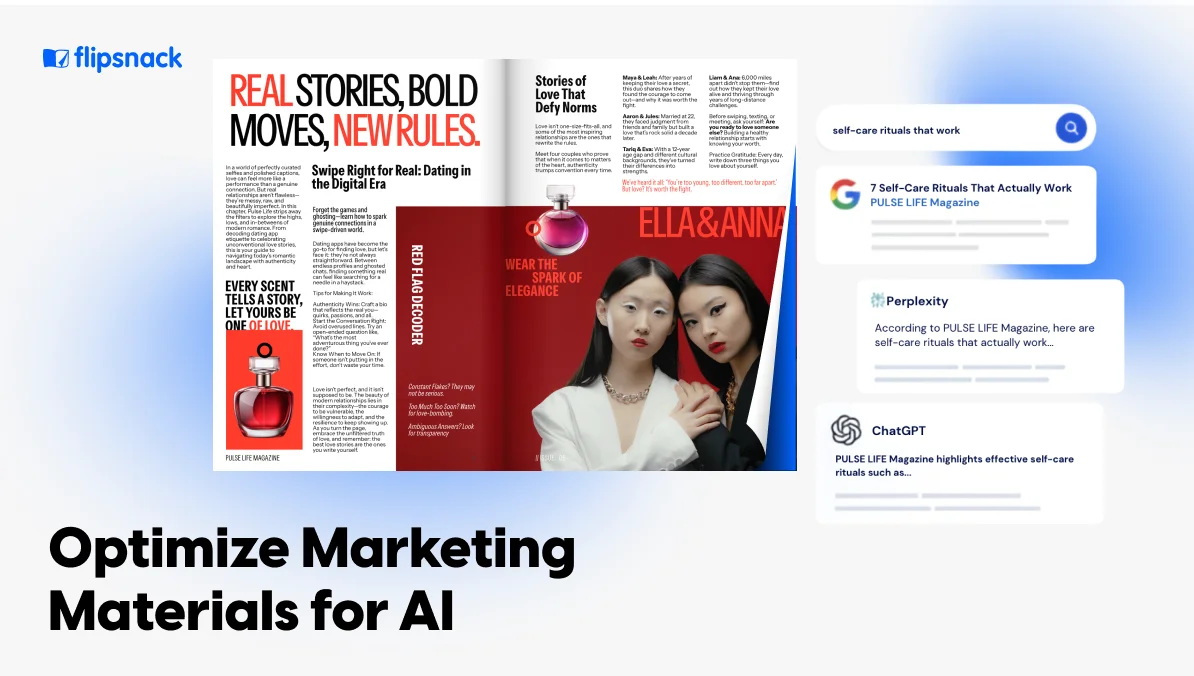
Flipsnack’s Article Mode addresses this directly. It uses AI to extract the text from a published flipbook and generate a crawlable article version alongside it, so readers can toggle between the visual experience and a fully indexable text version. Search engines and AI tools can then read, extract, and cite the content the same way they would a standard web page.
Article Mode solves the visibility half of the problem. It doesn’t replace the off-site trust-building work described later in this guide, and it won’t auto-update if you edit the flipbook afterward, so plan to regenerate after major revisions.
Article Mode handles the text layer. Metadata handles the label on the door.
Flipsnack now generates a meta title, meta description, and abstract for a publication with AI, reading the actual content of your flipbook instead of asking you to write three fields from scratch. Search engines use those fields to classify a page, and AI systems read them as an early relevance signal when deciding whether a source belongs in an answer.
Coverage is the practical gain here. Teams publishing dozens of catalogs rarely fill in metadata for every one, so half a library ships with a default title and no description at all. Generating those fields in seconds means each publication carries a real label rather than a filename.
Treat AI output as a first draft. Read it once, align phrasing with how you name that product elsewhere on your site, then publish.
.fs-banner { /* scoped design tokens */ –fs-primary: #0362FC; –fs-primary-dark: #0250D0; –fs-white: #FFFFFF; –fs-text: #000000; –fs-body: #4A5568; –fs-bg: #F5F7FA; –fs-border: #E2E8F0; –fs-font-heading: ‘Inter’, ‘Helvetica Neue’, sans-serif; –fs-font-body: ‘Roboto’, ‘Helvetica Neue’, Arial, sans-serif; display: flex; align-items: center; justify-content: space-between; gap: 32px; flex-wrap: wrap; max-width: 1200px; margin: 48px auto; padding: 40px; background: var(–fs-bg); border: 1px solid var(–fs-border); border-radius: 16px; box-sizing: border-box; } .fs-banner *, .fs-banner *::before, .fs-banner *::after { box-sizing: border-box; } .fs-banner__content { flex: 1 1 420px; min-width: 0; } .fs-banner__title { font: 700 26px/1.3 var(–fs-font-heading); color: var(–fs-text); margin: 0 0 10px; } .fs-banner__text { font: 400 17px/1.6 var(–fs-font-body); color: var(–fs-body); margin: 0; max-width: 620px; } .fs-banner__cta { display: inline-flex; align-items: center; gap: 8px; flex: 0 0 auto; background-color: var(–fs-primary); color: var(–fs-white) !important; font: 600 15px/1 var(–fs-font-body); padding: 15px 28px; border-radius: 8px; text-decoration: none !important; white-space: nowrap; transition: background-color 0.2s ease, box-shadow 0.2s ease; } .fs-banner__cta:hover { background-color: var(–fs-primary-dark); box-shadow: 0 4px 12px rgba(3, 98, 252, 0.2); } .fs-banner__cta svg { flex: 0 0 auto; } @media (max-width: 768px) { .fs-banner { padding: 28px 24px; margin: 32px auto; gap: 24px; } .fs-banner__title { font-size: 22px; } .fs-banner__text { font-size: 16px; } .fs-banner__cta { width: 100%; justify-content: center; } }How to design a flipbook that’s ready for AI search before you publish in Flipsnack
Article Mode can only extract what’s already on the page in a usable form. A few design choices made before you publish determine whether that extraction produces a clean, citable article or a wall of undifferentiated text.
Keep one idea per page or spread. This is already how most flipbooks get built, one product, one story, one spread, so it’s less a new habit than a reason to protect the one you already have. A page trying to cover three products at once gives Article Mode nothing clean to extract.
Lead each page with the direct answer. A product page that opens with the one sentence that matters, what it is, what it does, what it costs, extracts far better than one that opens with a mood-setting tagline and buries the actual information below it.
Put specs, pricing, and comparisons in lists or tables on the page itself. Design elements that convey information visually, like an icon grid with no accompanying text, disappear entirely once that page becomes plain text. If the information only exists as a graphic, Article Mode has nothing to pull from.
Phrase section titles as real questions. A catalog section titled “Features” extracts as a fragment. One titled “What makes this model different from the standard version?” extracts as a complete, citable answer.
Put real specifics on the page. Named products, real numbers, and an actual customer quote or case study give both readers and AI systems something worth citing. Generic marketing copy gives a model nothing it couldn’t have written itself.
Keep naming consistent with your website. If a product is called one thing in the flipbook and something slightly different on your site, that inconsistency makes it harder for an AI system to connect the two as the same entity.
Regenerate Article Mode after major edits. The extracted article doesn’t update automatically when you revise the flipbook, so a pricing change or a new product page needs a fresh generation to actually show up in what AI systems can read.
How to elevate content quality for AI citation
AI systems favor original material they cannot fabricate themselves, and they penalize pages that mash multiple topics together instead of resolving one clearly.
1. Publish non-commodity insight
A generic summary of what AEO means offers a model nothing it doesn’t already know. Original data, a documented case study, or a screenshot of a real result gives it something worth attributing to you specifically.
Originality matters for AI citation. If a case study, research finding, or other marketing asset closely mirrors material already published elsewhere, there’s less for an AI system to attribute specifically to you. Run important content through a plagiarism checker before publishing to catch overlapping passages and make sure the insights you want cited are genuinely your own.
2. Keep one intent per page
A single, hyper-focused subtopic outperforms a page trying to cover five related ideas at once, because AI retrieval rewards clarity over breadth.
3. Maintain consistent entity naming
Use the same product names, feature names, and definitions everywhere you publish, on your site and in outside citations. Inconsistent terminology makes it harder for a model to connect mentions of your brand across sources.
4. Keep content fresh
Audit and update older pages on a quarterly cadence. Both stale statistics and outdated screenshots signal to an AI system that a page may no longer reflect reality.
How to expand off-site presence so AI trusts your brand
Owned content earns citations only when outside sources back it up. AI systems cross-reference reviews, forums, and press coverage before deciding a brand is worth recommending, which means off-site work now sits inside the content strategy, not beside it.
That reordering matters more than most teams expect. Reporting on generative AI content strategy from SearchInfluence notes that a large share of citations on branded queries trace back to sources a company doesn’t own, such as review platforms and press coverage, rather than its own website (SearchInfluence, 2026).
Eighteen agency leaders surveyed by Forbes Agency Council reached a similar conclusion from a different angle: earned media and authentic customer conversation now carry more weight with AI systems than page-level keyword work (Forbes Agency Council, 2026).
Three actions build that trust layer over time: request detailed reviews from customers who can speak to a specific use case rather than a generic star rating, pitch category-relevant journalists on one press placement per quarter instead of waiting to be discovered, and participate in the communities and forums where your buyers already discuss your category.
Which schema markup actually helps AI search visibility?
Schema markup gives AI crawlers a machine-readable map of what a page is and how its parts relate, which speeds up extraction even when the writing itself is already well structured.
| Schema type | What it clarifies for AI systems | Best used on |
| Article | Author, publish date, and headline structure | Blog posts and guides |
| FAQPage | Discrete question-and-answer pairs | FAQ sections |
| HowTo | Sequential steps with clear start and end | Tutorials and setup guides |
| Organization | Brand identity, logo, and official channels | Homepage and about page |
| Product | Pricing, availability, and feature attributes | Feature and pricing pages |
Adding one or two of these where they genuinely fit beats stacking every type on every page. A blog post claiming Product schema that has no pricing data to support only confuses the crawler it’s meant to help.
Should you block or allow AI crawlers like GPTBot?
Most marketing teams should allow AI crawlers such as GPTBot, ClaudeBot, and Google-Extended to access public content, since blocking them removes any chance of appearing in AI-generated answers at all.
This is a robots.txt setting your developer or platform admin can check in minutes. Unless a page contains information you specifically don’t want summarized by an AI system, such as gated customer data, there’s little upside to excluding these crawlers from content you’re actively trying to get cited.
Your AI search optimization checklist
Nine sections, one running theme: structure your content so an AI system can lift it, and back that structure with real proof a model can’t fabricate on its own. Here’s the whole strategy condensed into a single table you can save, print, or hand straight to whoever owns your content calendar, and just as easily build into your next catalog or brochure with Flipsnack.
| Action | Why it matters |
| Open sections with a direct, quotable answer | Extractable passages get cited; buried answers don’t |
| Use lists, tables, and question-based headers | Matches how AI systems parse and retrieve structure |
| Publish original data or a real case study | Non-commodity insight can’t be fabricated by a model |
| Keep one subtopic per page | Focused pages outperform pages covering several ideas at once |
| Refresh key pages quarterly | Freshness signals ongoing accuracy to AI systems |
| Earn reviews and press mentions | Off-site validation drives most brand citations |
| Add FAQPage, Article, or HowTo schema where it fits | Speeds up machine parsing of already well-structured content |
| Allow AI crawlers like GPTBot in robots.txt | Blocking them removes any chance of AI citation entirely |
| Digitize and publish static materials as Flipsnack flipbooks | Turns a flat PDF into shareable, on-brand digital content, the necessary first step before it can be made crawlable at all |
| Enable Article Mode on published flipbooks | Generates a text version search engines and AI tools can read, index, and cite, closing the gap that visual-only formats leave open |
| Generate meta title, description, and abstract with AI | Gives every publication a label search engines and AI systems can read, instead of a default filename |
None of these rows work in isolation forever. Treat the list as a recurring quarterly review rather than a one-time setup, since freshness is one of the very signals sitting inside it. Start with whichever row addresses your biggest visibility gap today, then work outward from there.
Great content deserves to be found
The catalog from the opening didn’t fall short because the design was wrong. It fell short because nothing about it could be lifted, quoted, or trusted by a system that never renders an image in the first place. AI search rewards content built to be extracted, not merely published, and it rewards brands that back up their claims with third-party proof they didn’t write themselves.
None of this replaces good marketing. It sits on top of it. The same catalog, the same flipbook, the same blog post, now built so ChatGPT and Perplexity can actually read them and choose to say your name instead of a competitor’s. Work through the checklist above, revisit the AI-readable materials section for anything still locked inside a static PDF, and set a quarterly reminder to check the whole page again before it goes stale itself.
Your best work only counts if something can find it.
AI search optimization FAQs
Do I need to rewrite my entire website for AI search? No. Start with your highest-traffic or highest-intent pages, restructure those for BLUF answers and schema, then expand outward. A full rewrite isn’t necessary before you see any benefit.
Will optimizing for AI search hurt my traditional SEO rankings? No. Extractable structure, clear headings, and legitimate schema markup all support traditional SEO as well. The two disciplines overlap far more than they conflict.
Can AI systems actually read content inside a PDF? Only if there’s a text layer for them to read. A flat, image-based PDF or an unconverted flipbook is invisible to most crawlers, which is why formats like Flipsnack’s Article Mode exist to generate a readable version alongside the visual one.
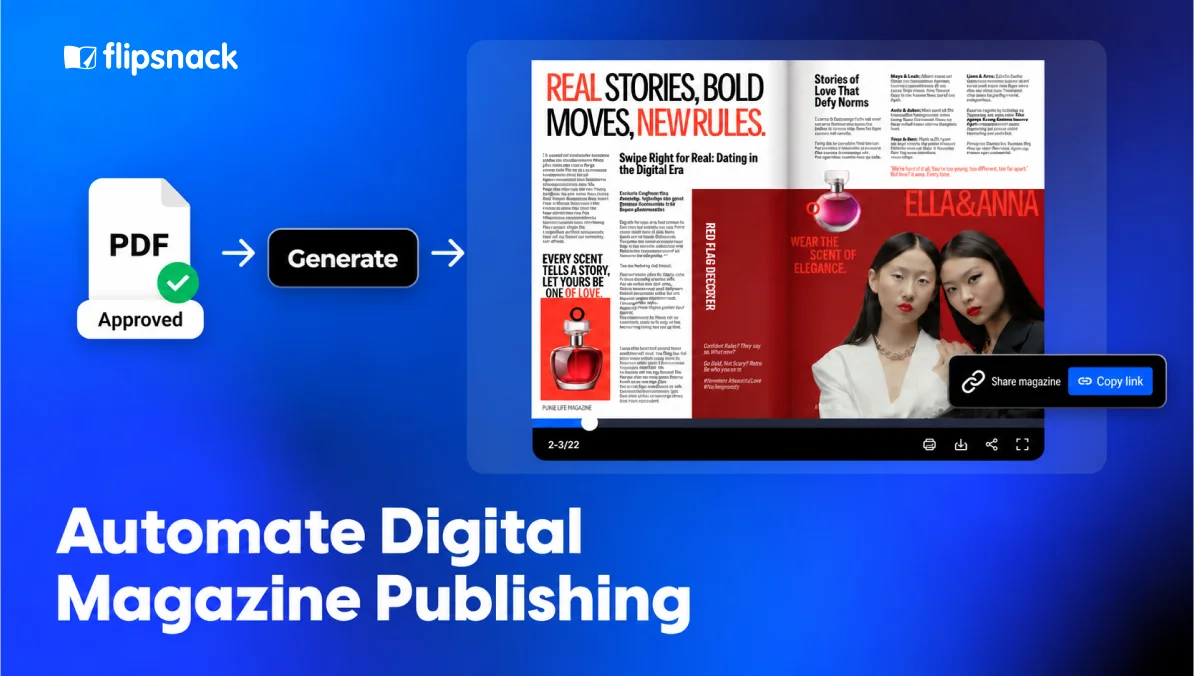
What’s the fastest way to make an existing brochure or catalog AI-readable? Digitize the PDF as a Flipsnack flipbook, publish it, then enable Article Mode on it. Flipsnack’s AI extracts the text and generates a crawlable article version alongside the visual flipbook, so readers still get the design while search engines and AI tools get a version they can actually index and cite. No rebuild from scratch required.
Do I need to write meta tags for a flipbook myself?
No. Flipsnack generates a meta title, meta description, and abstract from the content of your publication, on all plans. Review that draft for naming consistency with your website, then publish. Metadata helps search engines and AI systems classify a page, but it won’t replace an extractable text layer, so pair it with Article Mode for anything you want cited.
How do I know if ChatGPT or Perplexity is already citing my brand? Run the same category-relevant prompt several times across each platform and log whether your brand appears. A single run isn’t reliable; repeated testing over weeks shows whether the pattern is rising, stable, or fading.
Is generative engine optimization (GEO) replacing SEO? No. GEO adds a citation-focused layer on top of SEO’s crawlability and structure foundation. Neither works well without the other.