Hotel Operations Management: How to Turn a Scattered Folder of PDFs into a Measurable Hub
Published on: April 14, 2026
Somewhere in a shared drive, there is a folder called something like “Program Resources” or “Owner Materials.” Inside it: a 40-slide PowerPoint from 2022, three versions of a one-pager with slightly different logos, a case study in PDF that nobody can find unless they already know it exists, and a cost-benefit sheet that may or may not reflect current pricing.
This is how most hotel management companies distribute their program content today. And for a team managing 50, 100, or 300 properties, it creates a problem that goes far beyond disorganization.
Field services representatives spend time re-explaining programs that should sell themselves. Ownership groups make decisions based on outdated materials because nobody flagged that a newer version existed. Corporate teams invest weeks producing case studies and testimonials that get downloaded once and never opened again. The content does the work of getting created. It never gets the chance to do the work of convincing.
The deeper issue is that none of this is visible. When a PDF goes out to 200 property owners, the team that produced it has no way of knowing who opened it, which sections held their attention, or whether the cost data on page four was the reason someone said yes or no to a program. As Rebecca Ford, a hospitality operations manager, put it: “Nobody clicks on this, maybe we move that to the back.” That kind of signal does not exist in a folder of PDFs.
This article is about what changes when hotel management companies move from scattered files to a structured, trackable owner resource hub. Not a website redesign or a new intranet project, but a practical shift in how program content gets organized, distributed, and measured across a distributed portfolio.
Table of contents
- What hotel program resources actually are
- Why the folder of PDFs fails at scale
- The scale problem specific to hotel management companies
- What a measurable resource hub looks like
- Use cases across hotel management contexts
- How to get started using Flipsnack
- Take hold of your hotel’s management
- Frequently asked questions
What hotel program resources actually are
Before getting into what breaks, it helps to define what we’re talking about.
Hotel program resources are the internal materials that corporate teams and hotel management companies use to communicate the value of their programs to property owners, operators, and field teams. These are not brochures for guests. They are the documents that answer the question ownership groups ask before signing anything: why should we adopt this program, and what will it cost us?
That content typically includes a mix of:
- Case studies showing results at comparable properties
- Cost-benefit analyses and ROI data
- Service offering decks explaining what a program covers
- Testimonials and references from other owners or GMs
- Compliance and brand standard documentation
- Vendor catalogs and approved supplier lists
- Training materials for property-level teams
In a well-resourced hotel management company, this library can be substantial. Years of program development, real performance data, genuine client voices. The problem is rarely the quality of the content. It is how that content gets stored, distributed, and tracked once it leaves the corporate team.
The audience for these materials is also worth understanding clearly. A GM or ownership group evaluating a new program is not browsing passively. They are making a financial decision, often with limited time and multiple competing priorities. If the right case study is buried in a shared drive, or the cost data is three versions out of date, the content fails not because it is unconvincing but because it is unreachable.
That is the gap a structured resource hub addresses: not just organizing content, but making sure the right material gets to the right person at the right moment in the decision process.
Why the folder of PDFs fails at scale
The shared drive made sense when portfolios were smaller and programs changed slowly. Drop a file, share the link, done. At 20 properties, that works. At 200, it starts to break.
Here is what actually happens when a hotel management company distributes program content through a folder of PDFs:
Version chaos
An owner downloads the cost-benefit one-pager in January. In March, pricing changes. A new version goes into the folder. The owner is still looking at January’s numbers when the conversation happens in April.
There is no way to push an update to someone who already downloaded a file. And there is no reliable way to know who has the old version.
Zero visibility
A field services rep shares a case study before a meeting. The owner says they looked at it. Did they read page one or all twelve pages? Did the ROI data land, or did they skip straight to the testimonials? Nobody knows.
Without that signal, the team producing content is flying blind. They cannot tell:
- Which materials are actually influencing decisions
- Which ones are being ignored despite the effort that went into them
- Where in the content ownership groups tend to drop off
Format friction
Program content rarely lives in one format. There is the deck that was built in PowerPoint and does not translate well to PDF. The one-pager that looks fine on screen but loses all formatting when printed. The video testimonial that cannot be embedded anywhere and has to be shared as a separate link.
Ownership groups end up piecing together information from three different sources when they should be looking at one cohesive resource. That friction costs credibility before the conversation even starts.
The result is a content library that represents real investment — in time, in data, in client relationships — but delivers a fraction of its potential because the infrastructure around it was never built to scale.
The scale problem specific to hotel management companies
The PDF problem exists in a lot of industries. What makes it acute in hotel management is the structure of the business itself.
A company managing 300 properties is not managing 300 identical relationships. Some properties are newly onboarded. Some are long-term accounts evaluating program renewals. Some are franchise operations with ownership groups who have full autonomy over what they adopt. Others are managed properties where corporate has more direct influence but field teams still need to make the case for each program.
Across all of them, the same content needs to do different jobs:
- Introduce a program to an owner who has never heard of it
- Reinforce the value of a program to a GM who is already using it but considering dropping it
- Support a field services rep walking into a renewal conversation with three competing priorities on the table
- Bring a new ownership group up to speed during a property transition
One folder of PDFs cannot do all of that well. The content is the same regardless of who is receiving it or where they are in the decision process. There is no way to know which materials are being used in which conversations, or whether the field services team in one region is consistently using a case study that another region has never seen.
This is where hotel operations management breaks down at the content level. The programs themselves may be well-designed. The data may be compelling. But if the materials that communicate that value are scattered, outdated, and untrackable, the programs are always going to be harder to sell than they should be.
Hotel brand standards face the same problem from a compliance angle. Corporate teams produce detailed documentation. It goes out. Whether it lands, whether it gets read, whether it actually influences behavior at the property level is largely unknown.
The companies that solve this are not necessarily producing better content. They are building better infrastructure around the content they already have.
What a measurable resource hub looks like
The shift from a folder of PDFs to a resource hub is less dramatic in practice than it sounds. It does not require a new platform built from scratch or a months-long IT project. What it requires is a different way of thinking about how content is organized, accessed, and tracked.
In practical terms, a resource hub for hotel program content looks like this:
One destination, always current
Instead of a shared drive with nested folders and multiple file versions, there is a single link. Owners and field teams bookmark it once. When content updates, the link stays the same and the material behind it changes. Nobody is working from a version they downloaded six months ago.
Organized by how people actually look for content
Rather than organized by date or department, content is structured around the decisions owners are making:
- Evaluating a new program for the first time
- Comparing costs across program tiers
- Looking for evidence from comparable properties
- Checking compliance requirements before a renewal
That structure means a field services rep can find and share the right case study in two clicks rather than digging through a folder tree.
Analytics that close the feedback loop
This is where the operational shift becomes most visible. Instead of sending content into silence, teams can see:
- Which case studies get the most time on page
- Which sections of a cost-benefit document ownership groups skip
- Which properties have engaged with a program deck and which have not opened it
Over time, that data changes how content gets produced. The materials that consistently influence decisions get refined and expanded. The ones that get ignored get restructured or cut. The content library stops being an archive and starts being a tool.
Use cases across hotel management contexts
The resource hub model applies differently depending on where a hotel management company sits in its portfolio and what its field teams are actually trying to accomplish. Here are three contexts where it tends to have the most immediate impact.
Field services teams making the case to ownership groups
A field services representative walking into a program adoption conversation needs to arrive prepared. The right case study for that ownership group’s property type, the current pricing tier, the testimonial from a comparable GM. In most companies, assembling that package means pulling from three different folders and hoping nothing is out of date.
With a structured resource hub, the rep shares one link before the meeting. The ownership group arrives having already seen the relevant materials. The conversation starts further along, and the rep can see afterwards which sections the owner spent time on before walking in.
Corporate teams managing brand compliance across franchise properties
Franchise properties operate with significant autonomy. Corporate teams cannot mandate behavior the way they can with managed properties. What they can do is make the right information easier to access than the wrong information.
A compliance resource hub organized by brand standard, updated centrally, and tracked by property gives corporate teams visibility they have never had before. Instead of sending a document and hoping for the best, they can see which properties have engaged with updated standards and which need a follow-up call.
Pre-opening teams onboarding incoming GMs
A hotel opening involves a significant transfer of program knowledge in a short window of time. Vendor catalogs, approved supplier lists, service agreements, operational SOPs. Pre-opening teams typically manage this through email threads and shared drives, with no reliable way to confirm what the incoming GM has actually reviewed.
A structured hub with access controls and engagement tracking means the pre-opening team can see exactly where a new GM is in the onboarding process and step in before gaps become problems.
How to get started using Flipsnack
The most common concern from hotel management teams considering this shift is not about the technology. It is about the content itself. The assumption is that the existing library needs to be cleaned up, redesigned, or rebuilt before it can be moved anywhere.
In practice, that is the wrong place to start.
The better approach is to move what exists first and improve from there. Here is what that typically looks like:
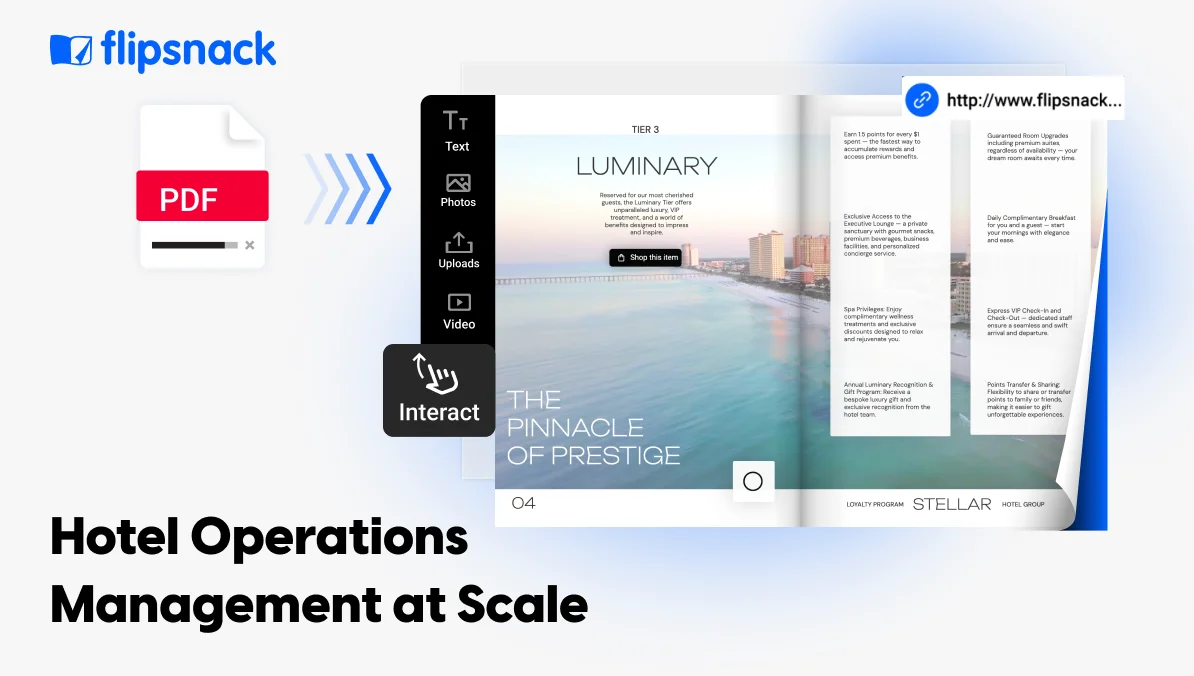
- Upload existing PDFs, decks, and one-pagers as they are
- Organize them into a simple structure based on program type and audience
- Set access by role or property tier so ownership groups only see what is relevant to them
- Publish and start tracking engagement from day one
The analytics from the first few weeks will tell you more about what needs fixing than any internal content audit. If a case study is getting consistent attention, it is working. If a cost-benefit document is being opened but abandoned on page two, that is where the effort goes next.
On the ownership question, hotel management companies tend to split this between operations and marketing depending on the content type. Program compliance documentation usually sits with operations. Sales enablement materials like case studies and service decks tend to live with marketing or field services leadership. The hub does not resolve that split, but it makes it easier to manage because both teams are working from the same source.
The transition does not need to be perfect on day one. It needs to be accessible, current, and trackable. Everything else follows from the data.
Take hold of your hotel’s management
The scattered folder of PDFs is not a content problem. It is an infrastructure problem. The case studies, cost data, and program decks inside it are often genuinely useful. What fails is the layer around them: how they get organized, whether they stay current, and whether anyone can tell if they are working.
For hotel management companies operating at scale, that gap has a real cost. Field teams compensate for content that should sell itself. Ownership groups decide based on outdated materials. Corporate teams produce resources that disappear into a shared drive.
A resource hub changes three things that matter:
- Content becomes findable without someone having to know where to look
- Updates reach everyone automatically, without a new email and a new download
- Engagement data shows what is working and what is not
That last point is the one that compounds. When you can see which materials influence decisions and which ones get skipped, the library gets smaller, sharper, and more effective over time.
The goal was never a better shared drive. It was program content that actually reaches the people making decisions, and enough visibility to know whether it landed.
Frequently asked questions
A hotel intranet is built for internal teams. It requires a login, lives behind a firewall, and is designed around employee communications and operational systems. A resource hub is built to be shared externally with ownership groups and franchisees who are not part of the corporate network.
The key difference: an ownership group evaluating a program will not log into your intranet. They will open a link.
No. Upload what you have, organize it into a basic structure, and publish. The engagement data from the first few weeks will show you what needs improving and what is already working.
Redesigning content before you know what gets read is guesswork. Doing it after the analytics is a much better use of time.
Yes, and this matters more than most teams realize. Ownership groups evaluating a program will not create a login to read a case study. The right setup is a shareable link that opens directly to the content, with access controls applied at the document level rather than behind a login gate.
Three metrics worth tracking from day one:
• Engagement rate by property — which ownership groups are opening content and which have not
• Time spent per document — thirty seconds of attention is very different from four minutes
• Content-to-decision correlation — which materials consistently appear in the journey of ownership groups who say yes
No. A company managing 20 properties faces the same version control problem as one managing 300. An owner making a decision based on a PDF they downloaded six months ago is just as costly at small scale.
The analytics layer is arguably more useful for smaller teams, where there is no dedicated sales enablement function to compensate for the lack of visibility.