Business Playbook Templates: How to Build, Customize & Use Them Effectively
Last updated: February 23, 2026
Published on: January 27, 2025
What is a business playbook?
A business playbook is a structured document that defines how a company executes specific processes, strategies, or initiatives in a consistent and repeatable way. It translates high-level goals into clear, actionable workflows by outlining steps, responsibilities, tools, standards, and performance metrics, ensuring teams are aligned and not dependent on individual knowledge. That only holds if the playbook stays current, which is why teams keep the underlying process documentation in a living knowledge base and publish the polished version from it, instead of letting the two drift apart.
When shared in a searchable flip book format, a business playbook becomes easier to navigate, update, and reuse across teams.
Unlike a general strategy document, a playbook focuses on execution, serving as a single source of truth that helps organizations scale efficiently, onboard new employees faster, maintain quality, and continuously improve how work gets done.
Table of contents
- What is a business playbook?
- Find how to build a business playbook that actually works
- Quick comparison: Choose your ideal playbook template
- What customers say about Flipsnack templates
- Professional playbook templates to customize
- 1. Customizable Onboarding Playbook Template
- 2. Engaging Onboarding Playbook Template
- 3. Sales Process Playbook Template
- 4. Professional Retention Playbook Template
- 5. Dynamic Operations Playbook Template
- 6. Outbound Sales Playbook Template
- 7. Inbound Sales Playbook Template
- 8. Remote Sales Playbook Template
- 9. Sales Strategy Playbook Template
- 10. Employee Retention Playbook Template
- How to create a business playbook with Flipsnack
- Take your business playbooks to the next level with Flipsnack
- Frequently asked questions
Find how to build a business playbook that actually works
A well-structured business playbook is essential for maintaining consistency and efficiency across teams. Research shows that companies with standardized processes can improve productivity by up to 30% (McKinsey). And we, at Flipsnack, can confirm that with our own data. But many playbooks fail because they’re too generic, disconnected from real workflows, or never updated — which leads teams to ignore them altogether.
The difference between a document that collects dust and one that drives results lies in how clearly it defines responsibilities, workflows, tools, and measurable outcomes. In this guide, you’ll learn what makes an effective business playbook, when to use different types, and how to customize practical playbook templates that teams actually adopt and use.
Quick comparison: Choose your ideal playbook template
| Template Name | Primary Department | Best For (Company Size) | Main Focus | Key Benefits |
|---|---|---|---|---|
| Customizable Onboarding Playbook | HR | All sizes (10–500+ employees) | New hire integration, policy documentation, compliance training | Structured compliance framework; formal policy docs; role clarity; quiz-based knowledge testing; engagement tracking; private sharing for confidential materials. |
| Engaging Onboarding Playbook | HR | Startups to mid-market (5–200 employees) | Culture immersion, interactive learning, team integration | Visual-first design; multimedia support (videos, GIFs); interactive checklists; feedback forms; faster time-to-productivity. |
| Professional Retention Playbook | HR | Mid-market to enterprise (100–1000+ employees) | Employee engagement, career development, retention planning | Executive-level framework; data-driven initiatives; career pathing templates; performance dashboards; reduces turnover costs. |
| Employee Retention Playbook | HR / Leadership | Companies with retention challenges (50–500 employees) | Turnover reduction, culture improvement, feedback mechanisms | Identifies attrition root causes; actionable interventions; survey templates; sentiment tracking; measurable retention metrics. |
| Dynamic Operations Playbook | Operations | All sizes with complex processes (25–500+ employees) | SOP documentation, cross-functional workflows, process standardization | Adaptable across departments; visual process mapping; version control; multi-team collaboration; reduces errors; preserves institutional knowledge. |
| Sales Process Playbook | Sales | Growing companies (50–500 employees) | End-to-end sales methodology, best practice standardization, team alignment | Full lifecycle coverage (prospecting to close); faster ramp time; consistent messaging; objection-handling frameworks; improves win rates by 15–25%. |
| Outbound Sales Playbook | Sales | B2B companies (20–300 employees) | Cold outreach, prospecting workflows, high-volume activity management | Daily SDR/BDR workflows; proven call scripts and email templates; cadence management; increases outreach efficiency and response rates. |
| Inbound Sales Playbook | Sales | Marketing-driven companies (30–400 employees) | Lead qualification, nurture workflows, marketing-sales handoff | Marketing-sales alignment; lead scoring; automated nurture sequences; CRM guidance; reduces lead leakage; improves MQL-to-SQL conversion. |
| Remote Sales Playbook | Sales | Remote/hybrid teams (10–250 employees) | Virtual selling, digital communication, async collaboration | Tool-stack guides (Zoom, Slack, CRM); video meeting best practices; async follow-up strategies; time zone management; reduces remote isolation. |
| Sales Strategy Playbook | Sales Leadership | Mid-market to enterprise (100–1000+ employees) | Go-to-market strategy, revenue planning, competitive positioning | Executive strategic framework; territory and quota planning; competitive intelligence templates; revenue forecasting; aligns multiple sales teams. |
What customers say about Flipsnack templates
The best flipbook tool I have used
Flipsnack is easy to use and offers all the features a small business needs, at a very affordable price. There are plenty of templates to choose from to speed up the project. Each template is easily tailored to your needs. The support is good and fast through the chat function, and they also provide a phone number (infrequently these days) in case you prefer a phone call.
Leonardo Soto, President of SotoNets Cloud Solutions
Reviewed on G2
Professional playbook templates to customize
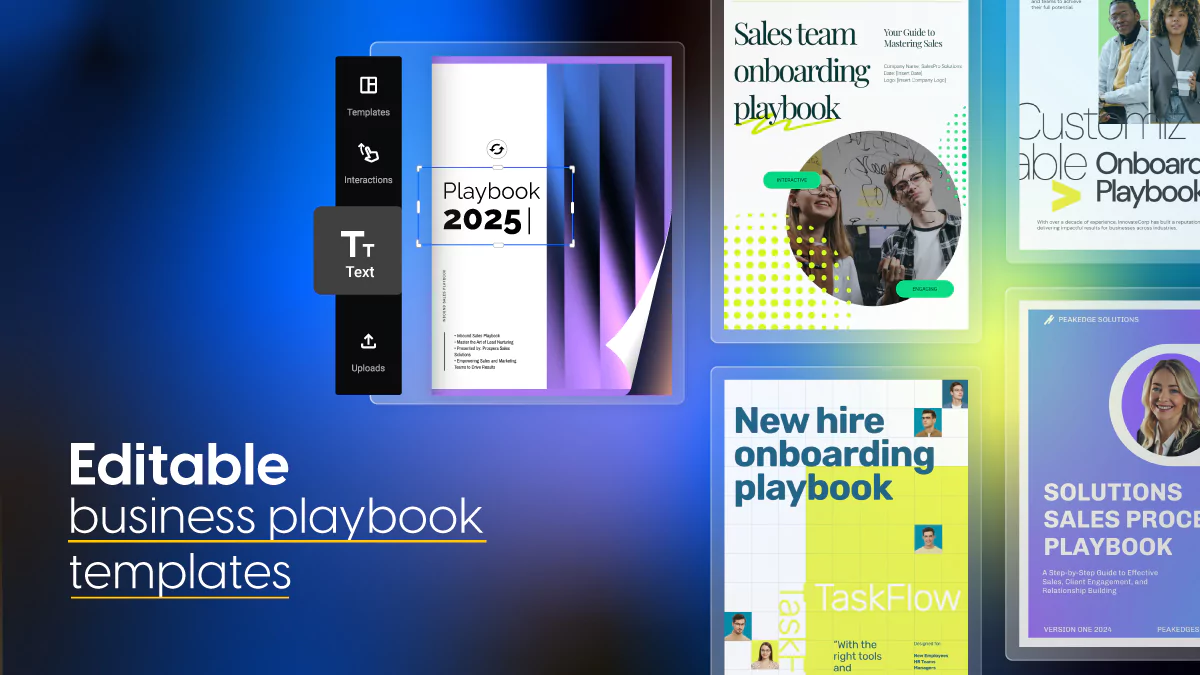
A well-structured business playbook template is essential for streamlining workflows, ensuring consistency, and improving team collaboration. Whether you’re onboarding new employees, refining your sales strategy, or documenting key operational procedures, a corporate playbook template provides a clear, organized framework to keep your team aligned. Below, we’ve compiled ten professionally designed playbook templates that are fully customizable in Flipsnack—allowing you to add branding, interactive elements; and secure sharing options to create an efficient and engaging resource for your business.
1. Customizable Onboarding Playbook Template
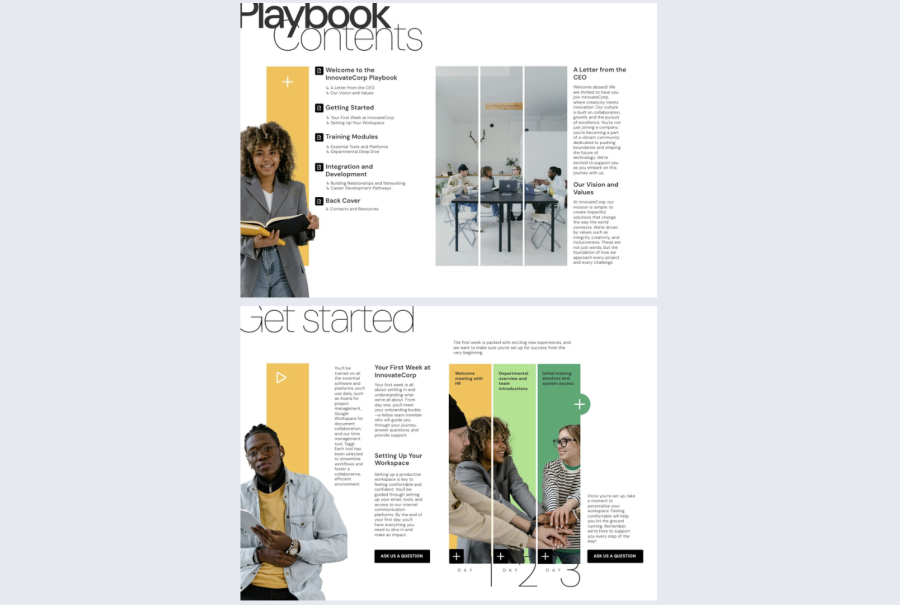
New hires in regulated industries need clear documentation and structured learning paths from day one. This template provides the comprehensive framework required for compliance-focused organizations where policy documentation and role clarity are non-negotiable.
Best for: Companies of all sizes (10-500+ employees) in regulated industries—healthcare, financial services, manufacturing, or enterprises with strict compliance requirements. If your onboarding includes mandatory policy acknowledgments or certifications, this is your starting point.
Real-world application: A long-term client of Flipsnack, a mid-sized logistics company with 280 employees used this template to standardize safety and compliance training across multiple warehouses. By adding interactive quizzes and acknowledgment forms, they reduced onboarding-related incidents by 41% within the first year and improved their compliance audit scores.
The professional layout includes editable sections for policies, role expectations, training schedules, and compliance checkpoints. Add quizzes to verify understanding, embed forms for acknowledgments, and use Flipsnack’s analytics to identify which sections need clearer explanations.
Common mistake to avoid: Don’t overwhelm new hires with 100+ pages on day one. Structure it progressively: Week 1 essentials (15-20 pages), Month 1 deep-dive, ongoing reference sections. This increases completion rates from 60% to 90%+. Share via password-protected links for confidential materials, embed on your intranet, or store in a virtual bookshelf for organized access.

2. Engaging Onboarding Playbook Template
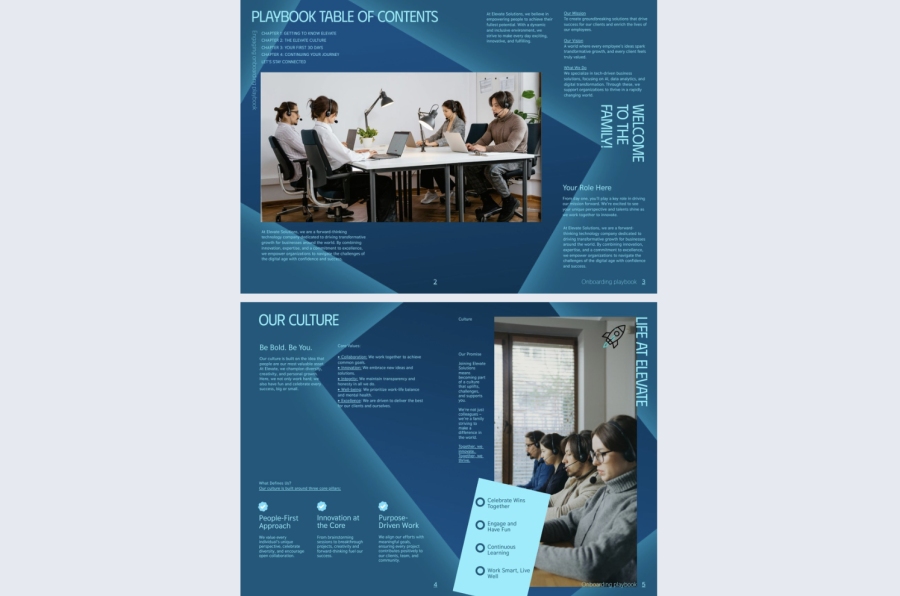
Startups and fast-growing companies need onboarding that reflects their dynamic culture, not bureaucratic policy manuals. This engaging onboarding playbook template uses visual storytelling and interactive elements to immerse new hires in your company’s mission, values, and team dynamics from day one.
Best for: Startups to mid-market companies (5-200 employees) with younger workforces, creative teams, or organizations prioritizing culture fit over formal compliance. If your onboarding emphasizes “who we are” more than “what you must do,” and you want new hires excited rather than overwhelmed, this template delivers.
Real-world application: One of the latest Flipsnack customers is a 75-person SaaS startup that used this template to transform their onboarding from a 40-page PDF into an interactive experience with embedded team introduction videos, clickable department guides, and a feedback form. Their new hire engagement scores jumped from 6.2 to 8.9 out of 10, and time-to-first-contribution dropped from 6 weeks to 3.5 weeks. The HR team used Flipsnack’s analytics to identify that new hires rewatched the company values video most frequently, which informed their culture-building strategy.
Customize the template with videos showcasing your team culture, clickable links to internal resources, and interactive checklists that guide new hires through their first 30 days. Add feedback forms to capture insights from each onboarding cohort, helping you continuously improve the experience. The visual-first design keeps remote and hybrid employees engaged without requiring live training sessions.
Common mistake to avoid: Don’t treat this like a policy document with prettier formatting. The power is in multimedia storytelling—if 80% of your content is still text paragraphs, you’re missing the point. Aim for 50% visual elements (videos, photos, infographics) and 50% concise text.
Share via private links for new hire access, embed on your company wiki for ongoing reference, or organize multiple onboarding resources in a virtual bookshelf.

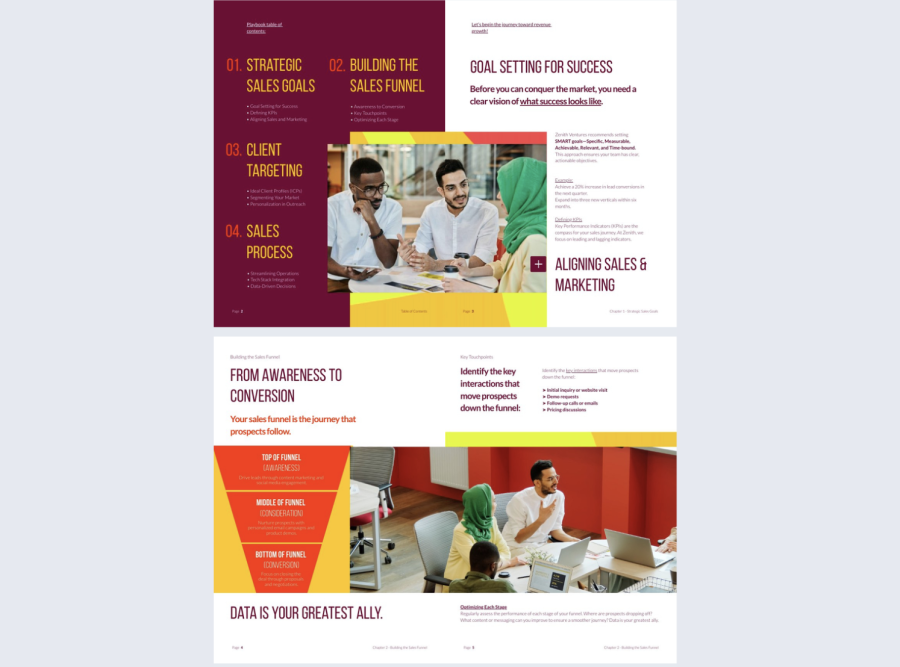
3. Sales Process Playbook Template
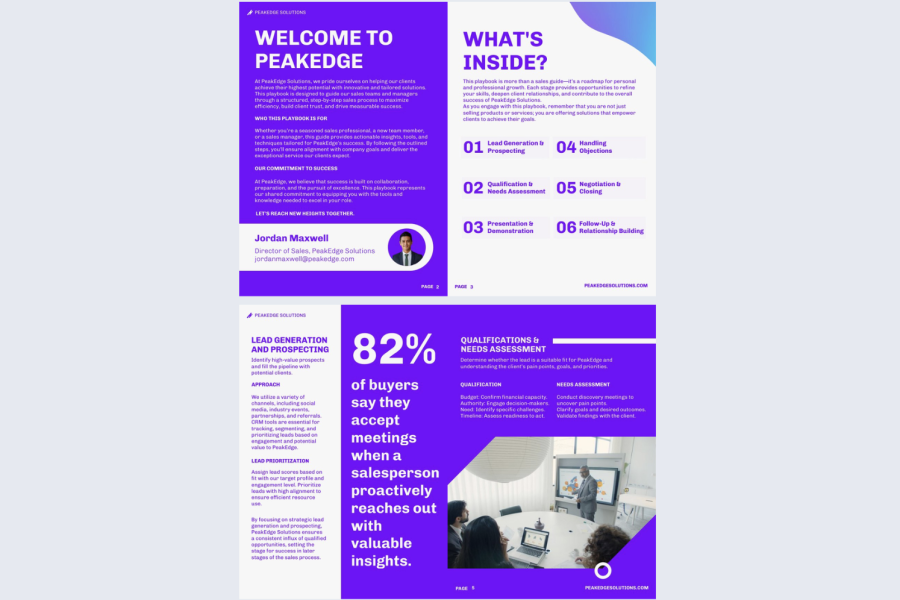
Sales teams lose deals not because of bad products, but because of inconsistent execution. This sales process playbook template standardizes your best practices — from prospecting to closing — so every rep performs like your top performer, not just the ones who’ve been around longest.
Best for: B2B sales teams (5–100 reps) with defined sales cycles, structured pipeline stages, and managers who need to scale what’s working. Ideal if you’re onboarding new reps frequently, dealing with inconsistent conversion rates across the team, or trying to document tribal knowledge before it walks out the door. If your top rep’s process lives only in their head, this template fixes that.
Real-world application: One of the latest Flipsnack customers is a 40-person SaaS sales team that used this template to consolidate their scattered onboarding docs, email scripts, and objection-handling guides into one interactive playbook. Ramp time for new reps dropped from 10 weeks to 6, and the team’s average deal close rate improved by 18% within one quarter. The sales manager used Flipsnack’s analytics to discover that reps were repeatedly revisiting the objection-handling section — which led to a live training session focused specifically on those scenarios.
Customize the template with step-by-step sales procedures, best-performing email scripts, and objection-handling techniques tailored to your market. Embed explainer videos for complex stages like demo delivery or negotiation, add interactive charts to visualize pipeline health, or insert an internal contact form to connect junior reps with senior mentors when they need real-time guidance.

Common mistake to avoid: Don’t just copy-paste your existing process doc into a prettier format. A playbook only works if reps actually use it — which means interactive elements, not walls of text. Embed short videos for the stages reps struggle with most, and use Flipsnack’s analytics to see which sections are being skipped entirely. If nobody’s reading the objection-handling page, that’s a signal, not a coincidence.
Share via a secure private link for team-wide access, store it in your internal resource hub for on-demand reference, or organize it alongside other sales enablement materials in a virtual bookshelf.
4. Professional Retention Playbook Template
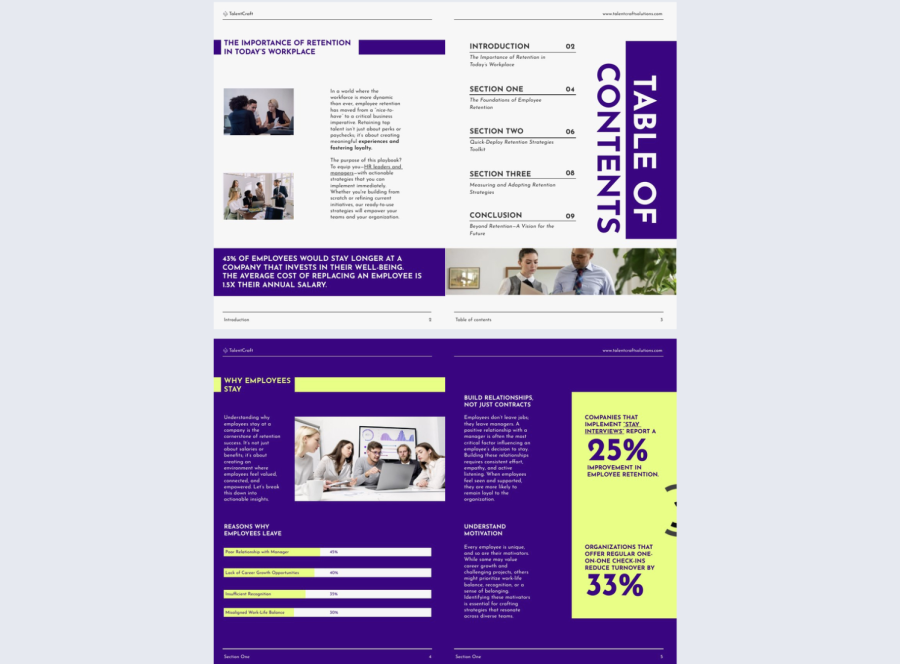
Replacing a top performer costs up to 200% of their annual salary — yet most retention strategies live in scattered HR docs nobody reads. This professional retention playbook template gives HR teams and managers a structured, engaging framework to document, communicate, and actually execute the retention initiatives that keep your best people around.
Best for: Mid-size to enterprise companies (100+ employees) with dedicated HR teams, high-growth organizations experiencing retention challenges, or executive recruiting firms advising clients on workforce strategy. Ideal if you’re dealing with rising turnover in specific departments, trying to scale a retention program beyond a handful of managers, or need to align leadership around a consistent employee engagement approach.
Real-world application: One of the latest Flipsnack customers is an HR team at a 300-person tech company that used this template to consolidate their retention strategy — previously split across three separate documents and a spreadsheet — into one interactive playbook shared with department heads. Within six months, voluntary turnover in their engineering department dropped from 22% to 14%. The HR team used Flipsnack’s analytics to track which sections were being revisited most, discovering that the compensation benchmarking page drove the most repeat views — a clear signal to prioritize that content in their next update.
Customize the template with case studies of successful retention programs from within your organization, interactive surveys to collect real-time employee feedback, or an embedded performance-tracking dashboard to monitor engagement metrics over time. The sleek purple and white design keeps the content professional without feeling like another bureaucratic policy manual — use interactive slideshows, embedded videos, and spotlight images to bring your retention strategies to life.

Common mistake to avoid: Don’t build this playbook in isolation and call it done. Retention strategies only work when managers actually use them in day-to-day conversations — so design with that in mind. Include clickable frameworks, short video walkthroughs for complex programs like career pathing, and feedback forms that make it easy to collect input from employees directly. Use Flipsnack’s analytics to see which sections managers skip, and treat that as your roadmap for what needs simplifying.
Share as a private document for HR teams and department heads, store it in a virtual HR library for on-demand reference, or organize it alongside other people-ops resources in a virtual bookshelf.
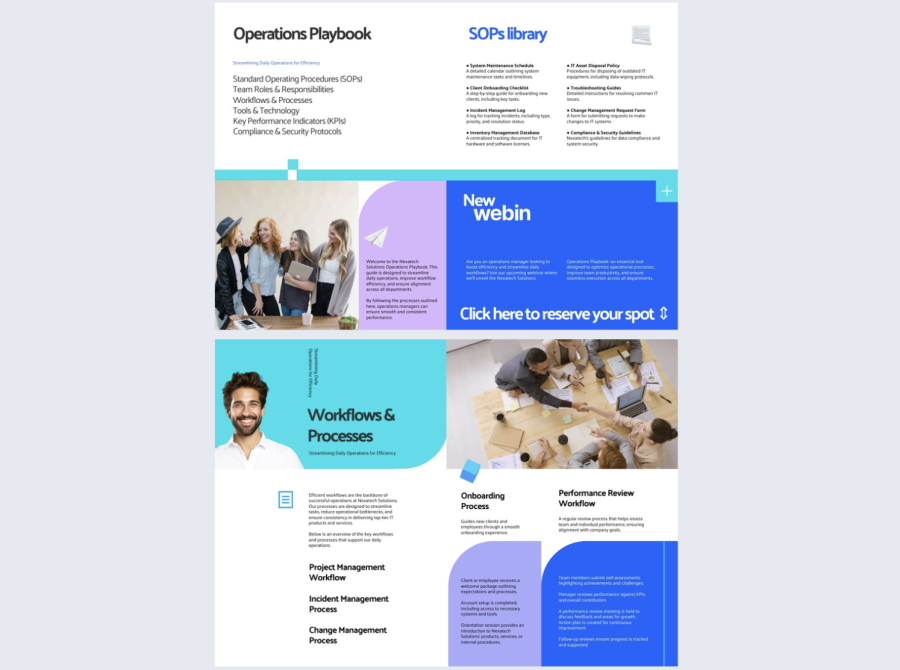
5. Dynamic Operations Playbook Template
Most operational breakdowns don’t happen because teams lack talent — they happen because critical processes live in someone’s head, a buried email thread, or a Google Doc nobody can find. This dynamic operations playbook template gives operations managers and business executives a centralized, structured hub to document workflows, SOPs, and best practices in a format teams will actually open and use.
Best for: Operations managers at scaling companies (50–500 employees) who need to standardize daily processes across departments, reduce dependency on specific individuals, and keep distributed or hybrid teams aligned. Teams still relying on physical records can use document digitization services to centralize documentation into a single, accessible digital system. Particularly valuable during periods of rapid growth, leadership transitions, or operational audits — when having documented, accessible processes stops being a nice-to-have and becomes critical.
Real-world application: One of the latest Flipsnack customers is an operations team at a 180-person logistics company that used this template to replace a sprawling collection of Word docs and email chains with a single interactive operations playbook. Onboarding time for new operations staff dropped by 35%, and the team reported significantly fewer escalations to managers for process clarification. Using Flipsnack’s analytics, the operations director discovered that the inventory management SOP section had the highest repeat view rate — which prompted a full review and simplification of that process. The update reduced handling errors by 20% in the following quarter.
Customize the template with embedded videos for process overviews, photo slideshows to visually illustrate step-by-step instructions, and go-to-page buttons for quick navigation between sections. Use Flipsnack’s collaboration tools to invite team members, assign roles — owner, editor, or contributor — and streamline the review process with comments and annotations, so your playbook stays accurate as processes evolve.
Common mistake to avoid: Don’t build this once and treat it as finished. An operations playbook is only as useful as it is current — outdated SOPs are often worse than no SOPs, because teams follow the wrong process with confidence. Schedule quarterly reviews, use Flipsnack’s analytics to identify which sections get the most traffic (those are your highest-risk processes), and make it easy for contributors to flag outdated content through embedded comment forms.

6. Outbound Sales Playbook Template
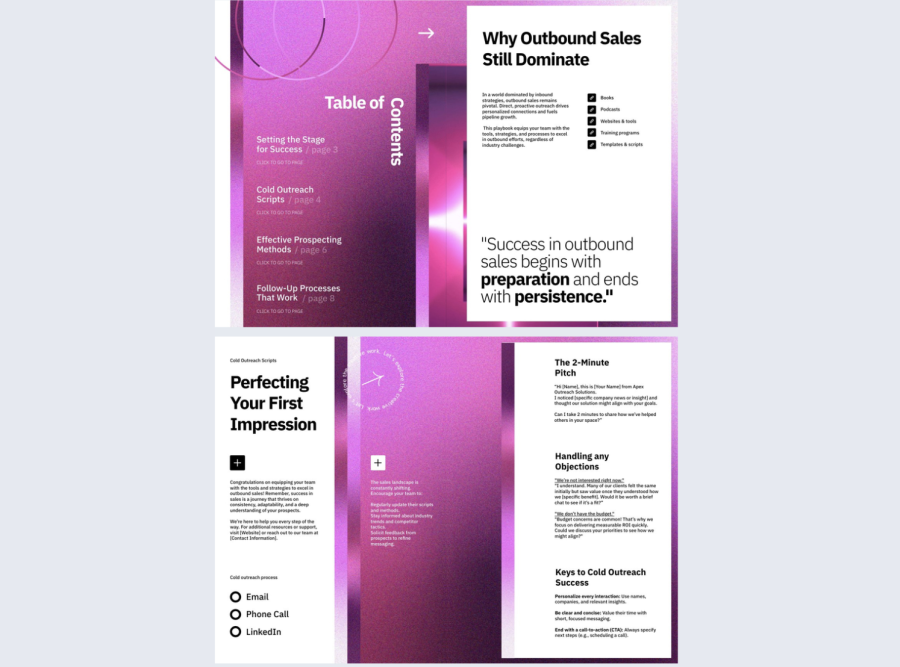
Inconsistent outbound efforts are one of the biggest drags on sales team performance. This outbound sales playbook template standardizes your cold outreach, prospecting, and lead conversion strategies so every rep works from a proven framework — not just instinct.
Best for: Outbound sales teams of any size that rely on structured sequences of cold calls, emails, and follow-ups to generate pipeline. Especially useful for teams onboarding new SDRs frequently, or managers who need to document what’s working before top performers leave and take their knowledge with them.
Real-world application: One of the latest Flipsnack customers is a B2B sales team that used this template to consolidate their scattered outreach scripts and objection-handling docs into one interactive playbook. New SDR ramp time dropped by four weeks, and the team saw a measurable lift in cold email response rates after standardizing their best-performing sequences. Flipsnack’s analytics revealed that reps were revisiting the objection-handling section most — prompting a dedicated live training session on that topic.
Customize the template with call scripts, email templates, and objection-handling strategies tailored to your market. Add clickable links to CRM dashboards, embedded training videos, and real-time performance tracking charts. Use Flipsnack’s Design Studio to align fonts, colors, and layouts with your brand, and collaborative features to let sales managers review and annotate directly within the playbook.
Common mistake to avoid: Don’t build this as a one-time resource and expect reps to memorize it. The best outbound playbooks are living documents — updated regularly as messaging evolves and new objections emerge. Use analytics to see which sections get skipped and treat that as your editing queue.
Share as a private digital document, embed in your sales training portal, or download as a PDF for offline access.

7. Inbound Sales Playbook Template
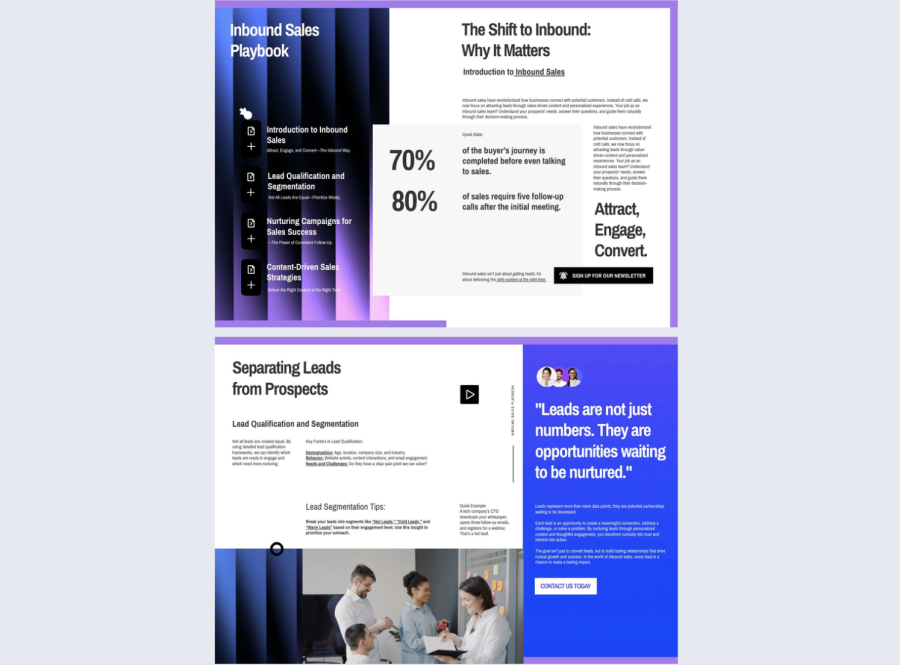
The gap between marketing and sales doesn’t close itself. This inbound sales playbook template gives content-driven sales teams a shared framework for lead nurturing workflows, follow-up processes, and automation techniques — so qualified leads don’t fall through the cracks between teams.
Best for: B2B companies where marketing generates inbound leads that sales then follows up on, particularly teams struggling with inconsistent handoff processes, unclear lead qualification criteria, or disconnected nurture sequences. If your sales reps are working leads generated by content, paid, or SEO efforts and you want that process standardized, this template is built for that.
Real-world application: One of the latest Flipsnack customers is a SaaS company whose sales and marketing teams used this template to document and align their lead handoff process for the first time. Lead response time dropped from 4 hours to under 45 minutes after reps had a clear, accessible follow-up framework to reference. Flipsnack’s analytics showed which workflow sections were revisited most, helping the team identify exactly where the handoff was breaking down.
Customize the template with embedded explainer videos, go-to-page buttons for quick navigation between stages, and feedback forms to collect input directly from reps. Use Flipsnack’s multi-user editing features to let sales and marketing refine strategies together in real time, keeping the playbook accurate as campaigns and messaging evolve.
Common mistake to avoid: Don’t let this become a marketing-only document that sales ignores. Build it collaboratively from the start — if reps weren’t involved in creating it, they’re unlikely to follow it. Use the feedback forms to capture their input regularly and make updates visible so the team knows the playbook is a living resource, not a one-time deliverable.
Share via private links or store it in a virtual bookshelf alongside other sales enablement resources, making it easy to distribute multiple documents through a single link.

8. Remote Sales Playbook Template
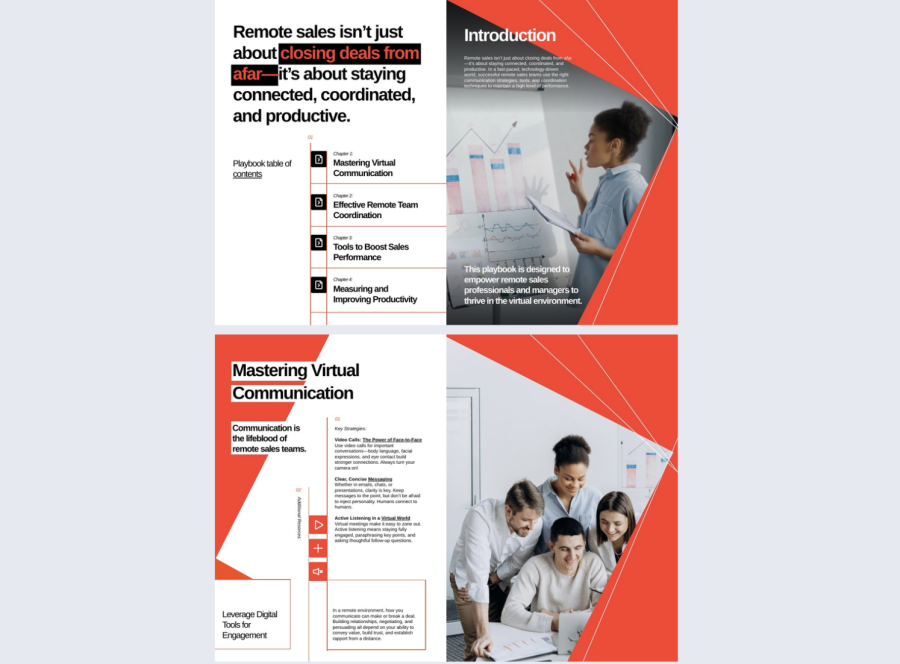
Remote sales teams face a challenge office-based teams don’t: there’s no hallway conversation, no shoulder-tap coaching moment, and no shared whiteboard to align on strategy. This remote sales playbook template gives distributed and hybrid sales teams a centralized, always-accessible guide covering virtual communication best practices, CRM usage, video conferencing etiquette, and remote team coordination.
Best for: Sales teams operating fully remotely or in hybrid setups, particularly those spread across time zones where real-time coaching is limited. Ideal if you’re managing reps who joined the team without in-person onboarding, or if inconsistent tool usage and communication habits are quietly dragging down performance. Inconsistent habits like taking notes manually during calls are worth standardizing too. An AI note-taker gives every rep the same reliable record of what was discussed, regardless of time zone or how new they are to the team.
Real-world application: One of the latest Flipsnack customers is a fully remote sales team that used this template to standardize how reps communicated with prospects and tracked activity in their CRM. Within two months, CRM data quality improved significantly and managers spent less time chasing updates — Flipsnack’s analytics revealed that reps were returning most frequently to the video call preparation section, which prompted a dedicated async training video on that topic.
Customize the template with screen-recorded tutorials, clickable links to sales tracking tools, and interactive daily task checklists. Enable commenting so team leads can provide feedback directly within the playbook, keeping guidance contextual and easy to act on.
Common mistake to avoid: Don’t assume remote reps will read a long playbook linearly. Structure it for quick reference — short sections, clear headers, and embedded videos for anything that’s easier to show than explain. If it takes more than 30 seconds to find what they need, they’ll stop opening it.
Distribute via password-protected links for secure internal access or embed it in your remote training hub, and track engagement with Flipsnack’s analytics to see which sections drive the most repeat views.

9. Sales Strategy Playbook Template
A sales strategy is only as effective as the team’s ability to understand and execute it. This sales strategy playbook template gives sales managers and executives a structured, visually engaging way to communicate market positioning, revenue forecasting, target audience segmentation, and sales funnel priorities — so strategy doesn’t stay locked in leadership’s heads or buried in a slide deck nobody revisits.
Best for: Sales managers and executives at growth-stage or enterprise companies who need to align their teams around a unified go-to-market approach. Particularly useful during annual planning cycles, market pivots, or when bringing new leadership into an existing team that needs strategic realignment.
Real-world application: One of the latest FlipSnack customers is a sales director at a 120-person B2B company who used this template to replace their annual strategy slide deck with an interactive playbook. Managers reported that having the strategy in a navigable, always-accessible format made it significantly easier to reference during team meetings and 1:1s — rather than hunting for the right slide in a 60-page presentation.
Customize the template with interactive data visualizations, embedded presentation slides, and training videos to turn a static strategy document into a dynamic team resource. Use Flipsnack’s collaborative tools to invite key stakeholders — marketing leads, finance, or senior reps — for input and approvals before publishing, ensuring cross-departmental alignment from the start.
Common mistake to avoid: Don’t present strategy without context. Numbers and frameworks land differently when reps understand the reasoning behind them. Use embedded videos or GIFs to walk through the thinking on key decisions — a 60-second explanation of why you’re targeting a new segment is worth more than three bullet points saying that you are.

10. Employee Retention Playbook Template
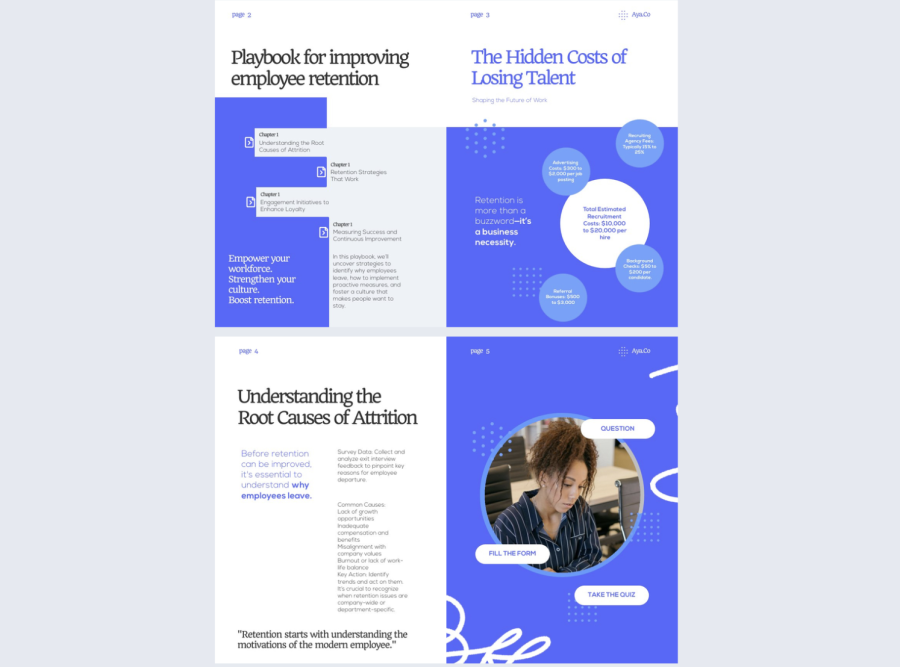
High turnover rarely comes as a surprise in hindsight — the warning signs were there, but there was no structured plan to act on them. This employee retention playbook template gives HR professionals and company leadership a clear, actionable roadmap for improving workplace culture, employee satisfaction, and long-term retention, in a format managers will actually engage with rather than file away.
Best for: HR teams at mid-size to enterprise companies dealing with rising turnover, declining engagement scores, or a lack of consistency in how managers handle retention conversations. Also valuable for organizations scaling quickly and needing to formalize people-first practices before informal culture erodes under growth pressure.
Real-world application: One of the latest Flipsnack customers is an HR team at a 250-person company that used this template to align managers around a shared set of retention initiatives for the first time. Having strategies, success stories, and engagement frameworks in one interactive document made it easier for managers to reference and apply them in day-to-day conversations with their teams — rather than waiting for quarterly HR check-ins.
Customize the template with embedded employee success stories, interactive surveys for ongoing feedback collection, and video messages from leadership to make the content feel personal rather than procedural. Use Flipsnack’s commenting and role-based permissions to let HR teams collaborate on updates and refine strategies as your organization evolves.
Common mistake to avoid: Don’t build this playbook without manager input. Retention strategies fail when they’re designed by HR in isolation — the people closest to employees need to help shape what goes in here. Use the interactive survey elements to collect their perspective before finalizing, and treat the playbook as a living document that gets updated after every engagement cycle.
Share securely via SSO authentication for enterprise access control, or store in a virtual HR resource library for quick reference across departments.

How to create a business playbook with Flipsnack
A well-structured business playbook ensures consistency, efficiency, and seamless collaboration across teams. With Flipsnack’s intuitive platform, you can create a professional, fully customized playbook in just a few steps. Follow this guide to craft a dynamic, interactive document tailored to your business needs.
Note: You can start with a free trial to explore most premium features. We also have a free plan if you only need basic PDF interactivity and up to three flipbooks.
1. Choose a template that fits your business needs
The first step in creating your business playbook is selecting a professionally designed template that aligns with your goals. Regardless if you need an onboarding playbook for new hires, a sales playbook to streamline prospecting strategies; or an operations playbook for workflow documentation; Flipsnack offers a wide variety of customizable templates.
Each template is pre-structured with essential sections, helping you save time and maintain a polished, consistent format. Browse through our collection and choose one that best matches your industry, company size, and team requirements. However, if you prefer a fully custom design, you can start from scratch; and build your playbook from the ground up.
2. Customize it with company branding, interactive elements, and personalized content
Once you’ve selected your template, it’s time to make it your own. Go over to Flipsnack’s Design Studio, which allows you to tailor every aspect of your playbook; from colors, fonts, and logos to the overall structure and flow. This ensures your document aligns perfectly with your company’s branding and maintains a cohesive, professional look.
Next, to enhance engagement, incorporate interactive elements such as:
- Clickable links to direct readers to important resources (e.g., CRM dashboards, training videos, or internal knowledge bases).
- Embedded videos and GIFs to visually explain concepts or showcase company culture.
- Interactive forms to collect feedback, gather employee information, or track progress.
- Go-to-page buttons to improve navigation and help users quickly find relevant sections.
Personalize your content by adding team introductions, mission statements, case studies, and best practices. These small touches help create a more engaging and useful resource for your employees.
3. Collaborate in real-time with team members using Flipsnack’s built-in sharing tools
A successful playbook is the result of team collaboration. Flipsnack allows you to work with multiple stakeholders—whether it’s your HR team, sales managers, or executives—by providing real-time editing and feedback tools.
Invite team members to your workspace and assign them different roles:
- Owners have full control over the document, including design and publishing rights.
- Editors can modify content, add media, and update text.
- Contributors can leave comments and suggestions without altering the core content.
You can leave behind the lengthy email chains or time-consuming meetings; because Flipsnack lets you leave notes and comments directly in the playbook, making the review process seamless. Regardless if you need final approval from management or input from different departments; this feature ensures smooth communication and faster turnaround times.
4. Publish and share via a private link, embed it online, or save it in a virtual bookshelf
Once your business playbook is finalized, it’s time to publish and distribute it effectively. Flipsnack offers multiple sharing options, allowing you to control who can access your document:
- Private sharing – Generate a password-protected or SSO-authenticated link to share confidential business documents securely. Ideal for internal use, ensuring that only authorized personnel can view the playbook.
- Embed it online – Copy and paste an embed code to integrate your playbook into your company’s intranet, website; or learning management system (LMS). This is perfect for onboarding materials or sales training resources.
- Virtual bookshelf – Store all your playbooks in a centralized digital library, making it easy for employees to access multiple guides in one place. This is especially useful for HR teams managing multiple training documents.
Additionally, Flipsnack allows you to export your playbook as a downloadable PDF, giving you a traditional offline format whenever needed.
5. Track engagement and optimize content based on real-time analytics
Creating a playbook is just the first step—monitoring how your team interacts with it is key to making ongoing improvements. Flipsnack’s built-in analytics tools allow you to track:
- Views and clicks – Identify which sections employees spend the most time on.
- Time spent on each page – See if key sections are being fully read or skipped.
- Interactive elements usage – Measure engagement with videos, links, and embedded forms.
Using this data, you can refine your playbook by adjusting content, adding explanations to frequently overlooked sections, or improving navigation. If you notice that certain chapters aren’t being accessed; consider reorganizing your layout or adding visual cues to highlight important areas.
By continuously optimizing your playbook based on real-time insights; you ensure that it remains a valuable, up-to-date resource for your team.
Take your business playbooks to the next level with Flipsnack
Flipsnack empowers teams to create, customize, and distribute corporate playbooks efficiently; ensuring that everyone has access to clear, structured, and engaging company processes. From easy design tools and branding customization to secure sharing and real-time analytics; Flipsnack is the all-in-one solution for building a dynamic and effective business playbook.
Get started today and transform your business operations with a fully interactive, on-brand playbook that keeps your team aligned and informed. Make your corporate documents work for you with Flipsnack!
Frequently asked questions
A business playbook is a structured document that outlines standardized processes, strategies, workflows, and best practices for executing specific business functions. It helps teams operate consistently, reduce onboarding time, and scale efficiently.
A well-structured business playbook typically includes:
• Objectives and goals
• Roles and responsibilities
• Step-by-step processes
• Tools and systems used
• KPIs and success metrics
• Templates and checklists
A business plan focuses on long-term strategy, funding, and market positioning, while a business playbook provides tactical, step-by-step execution guidance for daily operations.
To customize a business playbook template:
1. Define the goal of the playbook
2. Identify stakeholders
3. Adjust sections to match your workflow
4. Add company-specific branding
5. Insert KPIs and real process examples
Business playbooks should be reviewed quarterly and updated whenever:
• Processes change
• Tools are replaced
• KPIs shift
• Organizational structure evolves
Common mistakes include:
• Making it too theoretical
• Not assigning ownership
• Failing to update it regularly
• Overcomplicating processes
• Not aligning it with KPIs