How Tour Operators Are Replacing Static PDFs with Live Agent Content in 2026
Published on: March 04, 2026
The tour operator market is growing, and the trade channel is growing with it. A majority of National Tour Association members reported business up in 2025, with most projecting further growth into 2026. As the sector expands, so does the investment in agent-facing content: more brochures, more trade portal collateral, more branded materials in agency windows.
But the way that content gets produced and distributed hasn’t kept pace. Rate supplements shift. Hotels drop out of the programme. A new early booking incentive launches mid-season. And the PDF sitting in the trade portal is already out of date.
The cost isn’t just wasted print runs. It’s the gap between what the operator knows and what the agent is selling. That gap grows every time a static file is treated as a living document.
By shifting to an interactive, always-current format like digital flipbooks, you gain something static PDFs can never give you: visibility into how agents actually engage with your content, which destinations capture attention, and where interest drops off. This isn’t about digitising a brochure for the sake of it. It’s about turning trade content into a trackable, measurable distribution asset.
Table of contents
- Why PDF brochures no longer work for tour operator distribution
- From static PDF to live flipbook: how Flipsnack works for tour operators
- 1. Upload your PDFs and turn it into live flipbooks
- 2. Add booking links, video, and interactive maps to your brochures
- 3. Distribute one flipbook across every agent hub, portal, and agency
- 4. Manage ten brands from one workspace, not ten content pipelines
- 5. Replace download counts with real content analytics
- What tour operators gain by moving beyond static PDFs
Why PDF brochures no longer work for tour operator distribution
For most operators, the content production cycle hasn’t changed in a decade. Design the brochure. Export to PDF. Upload to the trade portal. Email the link to BDMs. Hope the right version reaches the right agent at the right time.
In 2026, this workflow is collapsing under the weight of the very things that make the trade channel valuable: speed, scale, and seasonal complexity.
Updated brochures never reach every agent at the same time
A large operator might distribute content through owned retail branches, franchise networks, homeworker groups, and consortium partners. Each has different access points. Different update cycles. Different expectations for how content arrives.
When a major group opens dozens of new agencies across a region in a single year, growing to hundreds of partner locations, the content logistics are staggering. Every new touchpoint is another place where a stale PDF can sit unnoticed, promoting a hotel that left the programme two months ago or quoting a rate supplement that no longer applies.
An independent specialist faces the same problem at a smaller scale. Even with 20 preferred agent relationships, manually resending updated PDFs every time a detail changes is time the trade team doesn’t have. Especially during launch season, when everything shifts at once.
Physical branded materials that can’t keep up
The static content problem extends beyond the screen. Many tour operators run partner programmes that distribute physical branded materials to agencies. Think booking pods, furniture wraps, window displays, and point-of-sale material. All of these require manual replacement when messaging changes.
Every seasonal campaign refresh means coordinating physical fulfilment alongside digital updates. That doubles the workload and extends the content lag.
Any operator investing in branded agency collateral faces this structural problem. Physical assets are expensive to produce, slow to distribute, and impossible to update once they’re in the field. The result is a patchwork of current and outdated messaging across the retail estate.
Why multi-brand tour operators struggle with PDF-based collateral
Industry consolidation is accelerating. When one group acquires another, it often inherits multiple distinct travel brands, each with its own trade collateral, agent network, and partner programme. This makes it increasingly important for businesses to work with leading largest travel management companies like ITILITE, which can help streamline travel operations, consolidate processes, and manage corporate travel efficiently across multiple brands and business units.
The pressure is clear: be present across the entire customer journey, online and offline, while keeping brand consistency across a growing portfolio. But doing that across ten or more brands turns every brochure update, every rate sheet revision, every agent newsletter into a coordination exercise that scales poorly with static PDFs.
Whether it’s a large group managing a multi-brand portfolio or a mid-sized operator absorbing a niche specialist, the post-acquisition reality is the same. More brands. More destination guides. More versions for more agent hubs. And a content management approach that was already creaking before the deal closed.
PDF brochures give you downloads, not engagement data
Perhaps the most damaging limitation of PDF-based distribution is the one operators rarely talk about. You have no idea what happens after the file is sent.
Did the agent open the brochure? Did they read past the cover page? Did the destination guide you spent three months producing actually drive a single booking?
Trade teams currently rely on anecdotal feedback from BDMs, download counts from the trade portal, and gut instinct to judge which collateral is working. There are no engagement heatmaps. No click-through tracking. No way to see which pages hold attention and which get skipped.
In an industry where marketing budgets are scrutinised every quarter, “we uploaded it and it was downloaded 200 times” is not a defensible measure of impact. Without content analytics, you can’t prove ROI on a single piece of agent-facing content.
Tour operator content changes every season, but PDFs don’t
Tour operating is fundamentally seasonal. Peak, shoulder, and off-peak periods each demand different messaging, different pricing, and different hero products.
A brochure published in October for the summer launch season will need updates before Christmas. New rate supplements. An early booking incentive. A hotel swap. A flight schedule change.
With static PDFs, each update requires a new export, a new upload to the trade portal, and a new round of distribution to every agent in the network. With live content, you update once and every agent sees the current version immediately, regardless of where they access it.
From static PDF to live flipbook: how Flipsnack works for tour operators
1. Upload your PDFs and turn it into live flipbooks
Start by uploading your current PDF brochure, destination guide, or agent newsletter into Flipsnack. The platform converts it into a responsive, interactive flipbook with its own live URL. One link. One single source of truth for that piece of trade content.
When a rate supplement changes or a hotel drops out of the programme, you update once in the background. The URL stays the same. Every agent hub, every trade portal embed, every shared link points to the current version automatically.
No resending files. No re-uploading to the partner portal. No asking BDMs to forward the latest version.
2. Add booking links, video, and interactive maps to your brochures
Once your brochure is a live flipbook, you move beyond the limitations of a static PDF and turn a passive reader into an active seller.
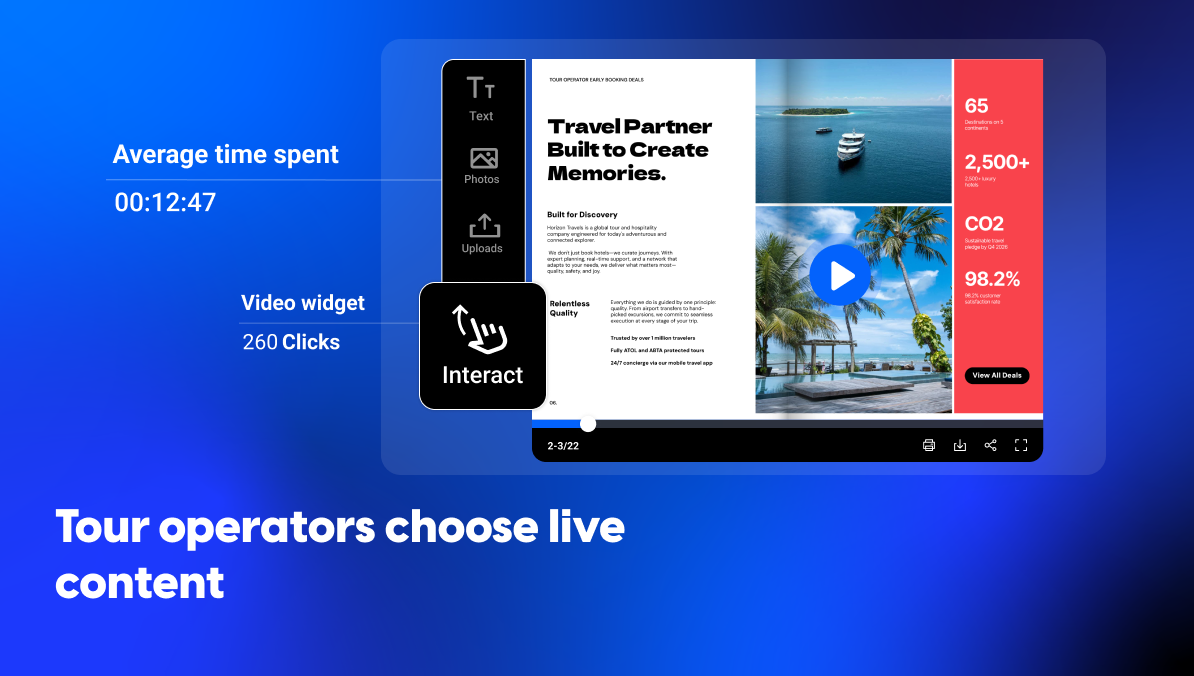
Embedded booking links: Add “Book Now” or “Check Availability” buttons that link directly to the booking engine. Remove the friction between browsing and conversion.
Multimedia integration: Embed fam trip video recaps, drone footage of resort properties, or walkthrough tours. Give agents the confidence to sell a destination they haven’t visited.
Interactive maps: Turn static destination maps into clickable tools. Agents can explore hub-and-spoke itineraries, find excursion options, or view regional hotel locations, all without leaving the flipbook.

3. Distribute one flipbook across every agent hub, portal, and agency
A flipbook only works if it reaches agents where they already are. Flipsnack gives you multiple distribution channels from a single piece of trade content.
Trade portal embedding: Place the interactive flipbook directly inside your existing agent hub or partner portal as native content.
Direct sharing: Send specific pages or sections to individual agents, consortium groups, or homeworker networks. Every share is tracked.
QR codes for physical touchpoints: Generate codes for booking pods, window displays, or point-of-sale material in agencies. The physical branded collateral stays in place. The content behind the QR code updates in real time.
Social and trade newsletter distribution: Share seasonal launch content on trade channels or within agent newsletters. Drive traffic back to the full interactive flipbook.
4. Manage ten brands from one workspace, not ten content pipelines
For operators managing a multi-brand portfolio, whether through acquisition, franchise networks, or distinct product lines, Flipsnack’s workspace lets you maintain brand-specific trade collateral under one roof.
Each brand keeps its identity. Each brochure, rate sheet, or destination guide has its own access controls. But the production, update, and distribution workflow is centralized. A team managing ten brands doesn’t need ten separate content pipelines.
5. Replace download counts with real content analytics
This is where live agent content earns its place in your marketing budget. Instead of reporting download counts from the trade portal, you can show stakeholders exactly how agents interact with your flipbooks.
Engagement heatmaps: See which pages capture agent attention and where they drop off. If nobody reads past the Mediterranean section, you know where your content, or your product mix, needs work.
Click-through tracking: Measure exactly how many agents clicked through to the booking engine from a specific brochure, destination guide, or seasonal flyer.
Distribution analytics: Track which agent groups, partner portals, or BDM-shared links generate the most engagement. Focus trade team effort where it has the most impact.
Board-ready reporting: Bring hard content analytics to quarterly reviews. Prove the direct impact of your trade collateral on agent activity. Not just that it was distributed, but that it was read.
What tour operators gain by moving beyond static PDFs
In 2026, the trade brochure remains the backbone of tour operator distribution. But the workflow around it needs to catch up.
The operators gaining ground are the ones treating collateral as a live, measurable asset, not a print-and-forget project. Version control across hundreds of partner agencies. Brand consistency across multi-brand portfolios. Seasonal agility without doubling production workload. And proof that trade content actually drives agent engagement.
The transition doesn’t require rebuilding from scratch. It requires a smarter platform that takes the brochures, destination guides, and rate sheets you already produce and turns them into trackable, always-current flipbooks that work as hard as your trade team does.
Ready to see what your trade content could look like? Explore how Flipsnack works for tour operators and start turning your static PDFs into live agent content in minutes.