Crisis Communication Templates Every Business Needs in an Emergency
Published on: March 18, 2025
Last updated: April 21, 2026
What is a crisis communication plan?
A crisis communication plan is a structured document that defines how an organization responds to emergencies, PR incidents, security breaches, or any situation that threatens its reputation or operations. It outlines who communicates, what they say, to whom, and through which channels, ensuring that when something goes wrong, the response is coordinated rather than reactive.
Without one, even a manageable situation can escalate quickly. In 2017, United Airlines learned this the hard way when a poorly handled passenger removal incident cost the company $1 billion in market value in a single day — not because of the incident itself, but because of the communication that followed.
Table of contents
- What is a crisis communication plan?
- Find how to build a crisis communication plan that actually works
- Quick comparison: Choose your ideal crisis communication template
- What customers say about Flipsnack
- Essential crisis communication templates
- 1. Crisis Communication Plan Template
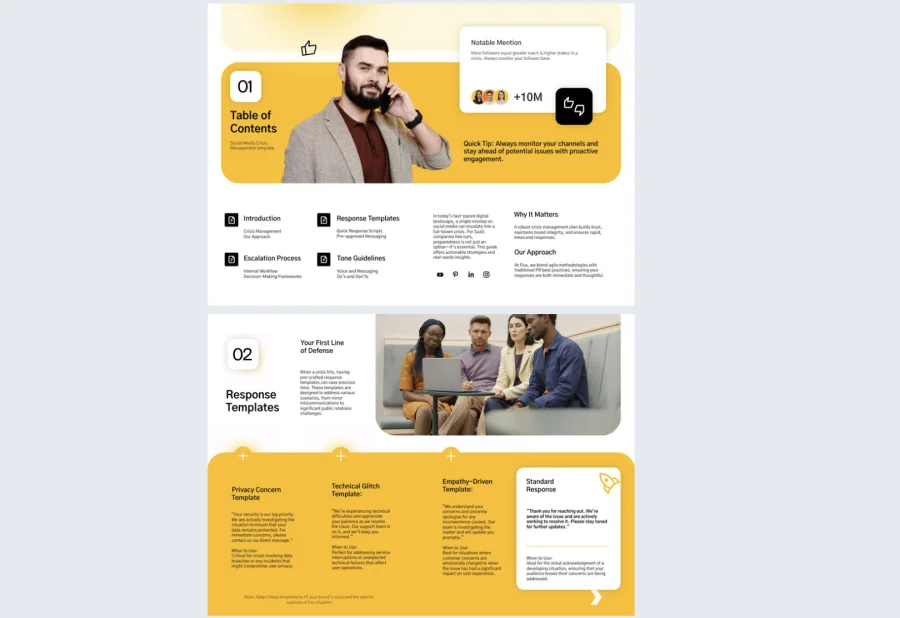
- 2. Social Media Crisis Management Template
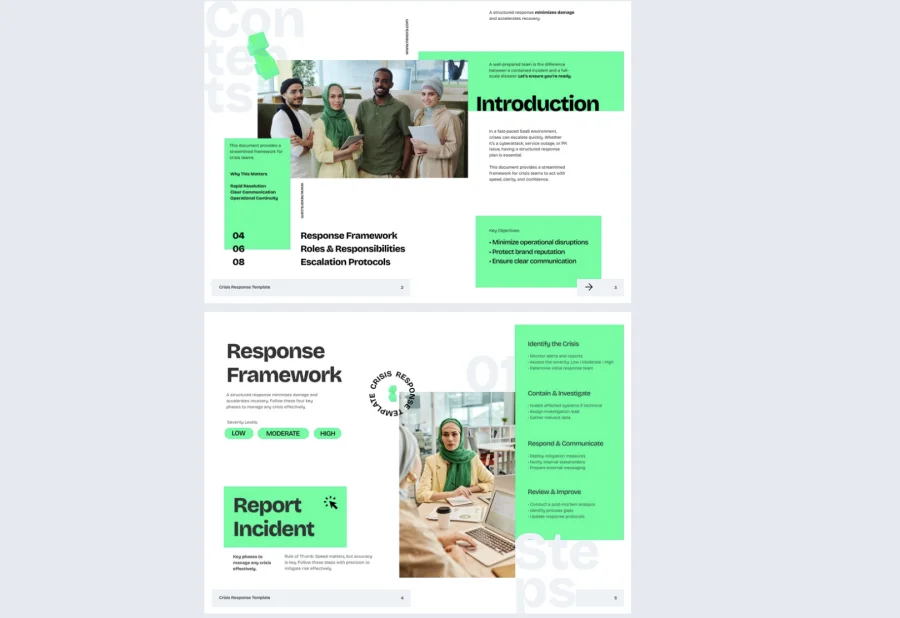
- 3. Crisis Response Template
- 4. Stakeholder Communication Template
- 5. Media Statement Template
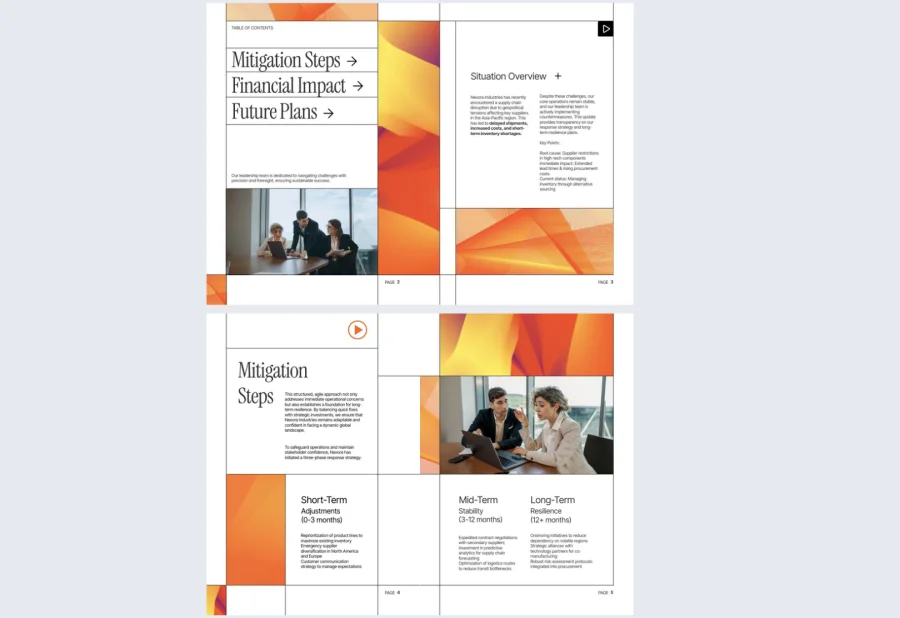
- 6. Crisis Press Release Template
- 7. Crisis Communication Plan Template
- 8. Incident Report Template
- 9. Crisis Communication Budget Template
- 10. Reputation Management Plan Template
- How to create a crisis communication plan with Flipsnack
- When a crisis hits, clarity wins
- Frequently asked questions
Find how to build a crisis communication plan that actually works
Research by PwC found that 69% of business leaders have experienced a corporate crisis, yet fewer than half feel their organization was well prepared to handle one. And we, at Flipsnack, can confirm that with our own data. The most common failure isn’t a lack of planning — it’s a lack of accessible, current documentation when the pressure is on.
The difference between a crisis that damages your brand and one your organization weathers well comes down to how quickly and consistently your team can communicate. Outdated plans sitting in shared drives, inconsistent messaging across teams, and no clear escalation path are what turn manageable incidents into reputational disasters.
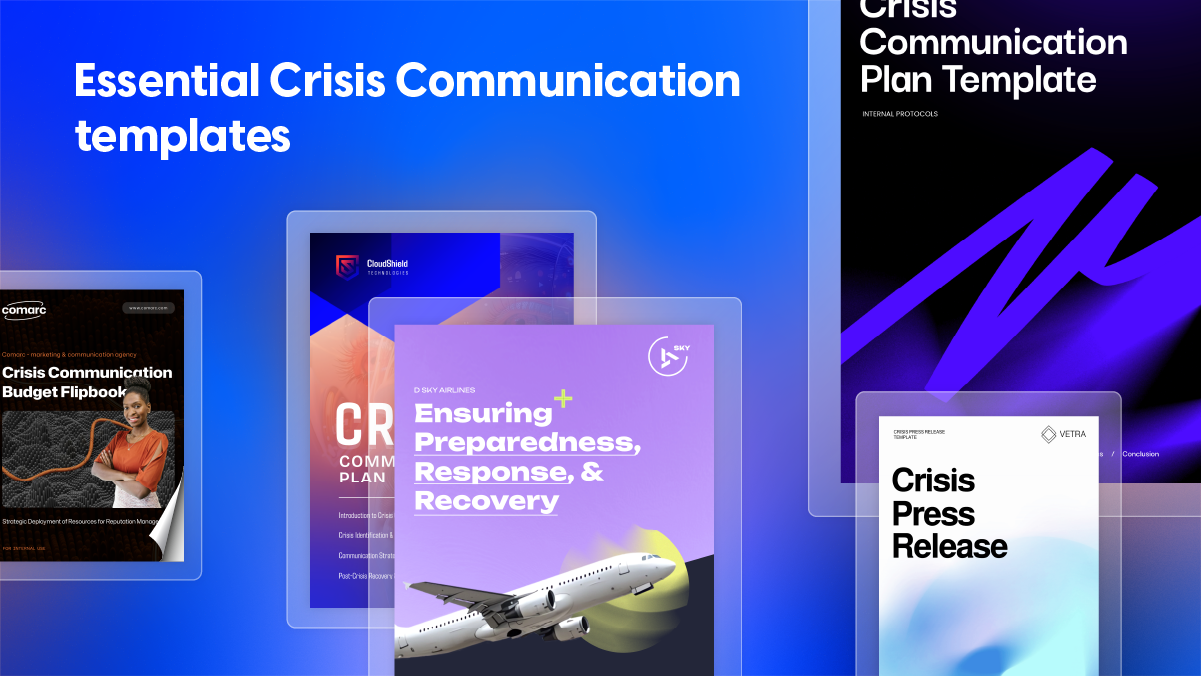
In this guide, you’ll find professionally designed crisis communication templates covering everything from press releases and media statements to incident reports and reputation management plans, each fully customizable in Flipsnack.
Quick comparison: Choose your ideal crisis communication template
| Template name | Best for | Main focus | Key benefits |
|---|---|---|---|
| Crisis Communication Plan Template | Corporate comms and PR teams | Response strategies, stakeholder messaging, escalation protocols | Structured response timeline; defined roles; real-time updates via same link |
| Social Media Crisis Management Template | Social media and comms teams | Pre-approved messaging, escalation workflows, tone guidelines | Ready-to-use response templates; embeds video statements; always current |
| Crisis Response Template | Leadership and crisis management teams | Risk assessment, stakeholder coordination, response protocols | High-contrast layout; decision-making framework; instant search for critical info |
| Stakeholder Communication Template | Executives, investor relations, legal teams | Situation overview, mitigation steps, financial transparency | SSO-controlled access; secure stakeholder updates; version controlled |
| Media Statement Template | PR and communications teams | Spokesperson guidelines, message framework, media distribution | Embed CEO video statements; real-time updates; collaborative editing |
| Crisis Press Release Template | PR agencies and corporate comms | Public-facing messaging, crisis response, media alignment | Organized in bookshelves for instant access; secure SSO sharing; no outdated versions |
| Crisis Communication Plan | Corporate comms, PR specialists, crisis managers | Response timeline, team roles, messaging guidelines | Effortless PDF replacement; same link always reflects latest version; instant search |
| Incident Report Template | DevOps, IT security, and operations teams | Incident documentation, impact assessment, containment protocols | Real-time updates; embed security briefing videos; hyperlinks to forensic analyses |
| Crisis Communication Budget Template | PR, finance, and crisis management teams | Resource allocation, expense tracking, impact measurement | Multi-team collaboration; organized bookshelves; SSO-secured access |
| Reputation Management Plan Template | PR agencies and internal comms teams | Risk identification, messaging framework, social media response | Private sharing; real-time messaging updates; crisis escalation strategy |
What customers say about Flipsnack
The best flipbook tool I have used
Flipsnack is easy to use and offers all the features a small business needs, at a very affordable price. There are plenty of templates to choose from to speed up the project. Each template is easily tailored to your needs. The support is good and fast through the chat function, and they also provide a phone number (infrequently these days) in case you prefer a phone call.
Leonardo Soto, President of SotoNets Cloud Solutions
Reviewed on G2
One of the standout features is their exceptional customer service. I had multiple questions while building my book, and the team was fantastic in providing bespoke support tailored to my needs. They responded quickly, patiently guided me through the process, and ensured I had all the information necessary to create a professional-looking e-book.
Ryan Akram, Administrator
Essential crisis communication templates
A crisis does not announce itself. The organizations that come out of one with their reputation intact are the ones that had the right documents ready before anything went wrong. The templates below cover the full range of crisis communication needs, from internal response frameworks to public-facing press releases, each fully customizable in Flipsnack and built to be accessed and updated under pressure.
1. Crisis Communication Plan Template
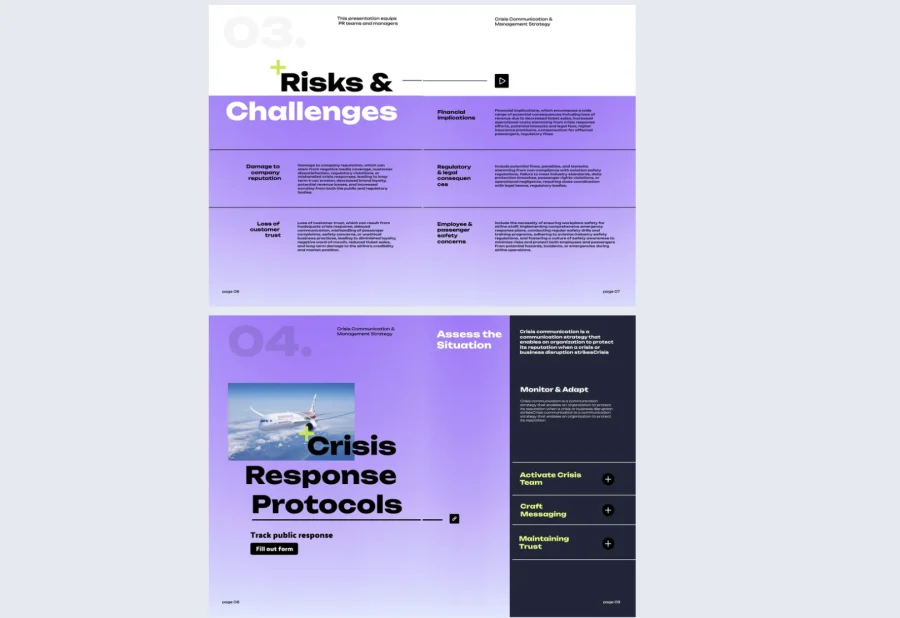
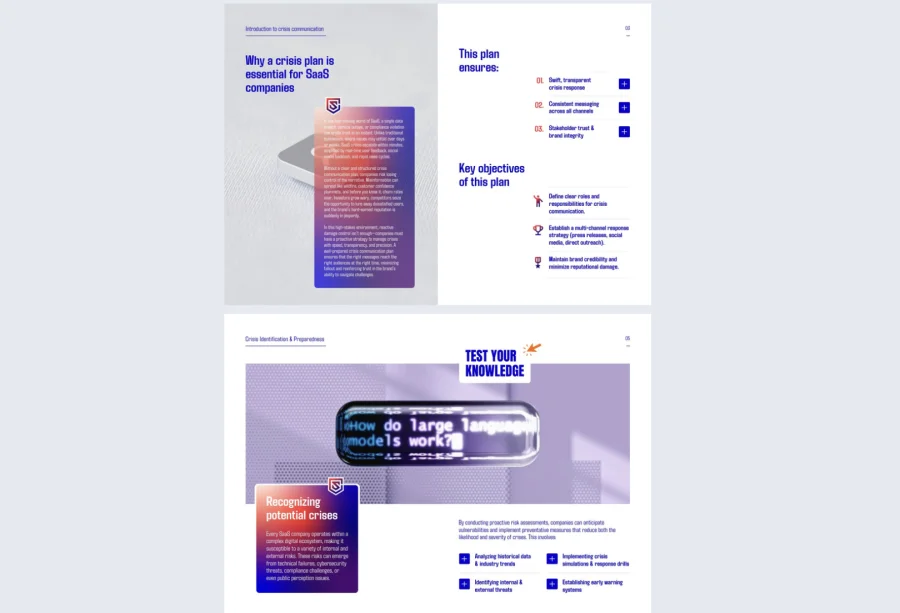
A crisis communication plan is only useful if everyone knows where it is and what version they are working from. This crisis communication plan template gives corporate communications and PR teams a structured framework covering crisis types, key risks, response strategies, and escalation paths in one centralized, always-current document.
Best for: Communications and PR teams in high-risk industries — aviation, healthcare, financial services — that need a comprehensive response framework ready before a crisis, not during one.
Real-world application: One of the latest Flipsnack customers is a corporate communications team at a large healthcare organization that used this template to replace a crisis plan that existed as a 60-page PDF nobody could find under pressure. Storing the live flipbook in a private bookshelf accessible to all relevant stakeholders meant the right document was always one click away, regardless of who needed it or when.
Embed video briefings from leadership, add links to escalation contacts, and use Flipsnack’s privacy options to share internally via SSO authentication so sensitive response protocols stay within the organization.
Common mistake to avoid: Don’t build a crisis plan and file it away. A plan that isn’t reviewed and updated regularly is often worse than no plan at all, because teams follow it with confidence even when the information is outdated. Schedule a review at least twice a year and assign clear ownership.

2. Social Media Crisis Management Template
A social media crisis can go from a single complaint to a trending hashtag in hours. This social media crisis management template gives communications and social media teams pre-approved messaging, escalation workflows, and tone guidelines so the response is consistent and on-brand from the first reply.
Best for: Social media, PR, and brand communications teams at consumer-facing organizations where a poorly worded response or a delayed reply can amplify rather than contain a developing situation.
Real-world application: One of the latest Flipsnack customers is a brand communications team at a retail company that used this template after a supplier issue triggered a wave of negative social media coverage. Having pre-approved messaging frameworks and escalation paths documented meant the team had a first response published within 20 minutes of the issue surfacing, significantly limiting the spread of misinformation.
Update messaging in real time so the team is always working from approved, current language. Use Flipsnack’s collaboration features to loop in legal, PR, and senior leadership for rapid sign-off without email chains slowing the response down.
Common mistake to avoid: Don’t try to write crisis responses from scratch under pressure. The value of this template is in the pre-approved frameworks. If the messaging still needs three rounds of approval during an active crisis, you have not prepared far enough in advance.
3. Crisis Response Template
When a crisis is unfolding, decision-making needs to be fast and coordinated. This crisis response template gives leadership and crisis management teams a clear framework for assessing risk, coordinating stakeholders, and executing response protocols with the kind of clarity that prevents conflicting messages from different parts of the organization.
Best for: Leadership teams, crisis managers, and operations leads at organizations where a slow or inconsistent internal response is as damaging as the crisis itself.
Real-world application: One of the latest Flipsnack customers is an operations director at a logistics company who used this template when a warehouse incident triggered simultaneous media, employee, and regulatory communication needs. Having defined roles, escalation paths, and stakeholder guidelines in one accessible document meant the response team could divide responsibilities immediately without a coordination meeting.
The high-contrast visual layout ensures critical information stands out under pressure. Embed video briefings for key response stages, add direct links to contact lists, and use Flipsnack’s statistics to confirm that every member of the crisis team has actually opened and reviewed the document.
Common mistake to avoid: Don’t assign crisis response roles only at the moment of a crisis. Roles and responsibilities should be defined, communicated, and rehearsed in advance. A document that introduces people to their crisis role for the first time during an emergency is not a plan.
4. Stakeholder Communication Template
In a crisis, the people with the most at stake need accurate, timely, and controlled information. This stakeholder communication template gives executive, investor relations, and legal teams a structured format for delivering situation overviews, mitigation steps, and financial or operational updates to the right people without risk of sensitive information reaching the wrong audience.
Best for: Executive and investor relations teams at mid-size to enterprise organizations managing a crisis with financial, legal, or reputational implications that require different levels of transparency for different stakeholder groups.
Real-world application: One of the latest Flipsnack customers is an IR team at a publicly listed company that used this template to manage stakeholder communication during a data breach. Using SSO authentication to restrict document access meant investors, board members, and legal counsel received consistent, controlled updates without the risk of sensitive details being forwarded beyond the intended recipients.
Structure updates by stakeholder group, include a clear timeline of actions taken and next steps, and update the document in real time so every stakeholder is always looking at the most current information through the same link.
Common mistake to avoid: Don’t send the same communication to every stakeholder group. Investors, employees, regulators, and partners all need different levels of detail and different framing. Using one message for all audiences during a crisis signals a lack of control rather than transparency.
5. Media Statement Template
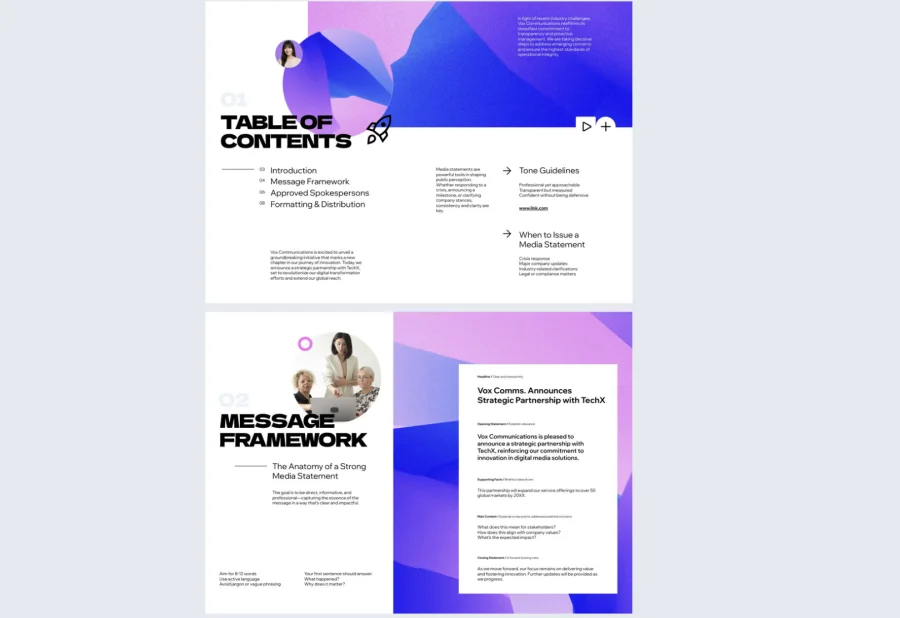
When journalists are waiting for a response, the quality and speed of your statement determines the narrative. This media statement template gives PR and communications teams a structured framework covering message development, spokesperson guidelines, and formatting and distribution standards so every public statement is clear, consistent, and on-brand.
Best for: PR teams and communications leads at organizations that interact regularly with media and need a reliable, pre-structured format for issuing statements quickly without sacrificing accuracy or tone.
Real-world application: One of the latest Flipsnack customers is a PR director at a consumer goods company who used this template to manage media response during a product recall. Having approved message frameworks and spokesperson protocols in one accessible document meant the communications team could brief the CEO and issue a first statement to media within 45 minutes of the decision being made to go public.
Embed a pre-recorded CEO video statement, link to supporting documentation, and use Flipsnack’s branding customization to ensure every statement looks and feels consistent with your organization’s public communications standards.
Common mistake to avoid: Don’t issue a media statement before aligning internally. A statement that contradicts what employees or stakeholders have already been told creates a secondary crisis around credibility. Internal alignment should always precede external communication.
6. Crisis Press Release Template
When a crisis becomes public, your press release is often the first formal statement the world sees. This crisis press release template gives PR teams a structured, ready-to-adapt format for issuing clear, confident public statements during product recalls, legal disputes, or viral controversies.
Best for: PR agencies and corporate communications teams that need to issue formal public statements quickly and consistently across multiple media channels.
Real-world application: One of the latest Flipsnack customers is a PR team at a food and beverage company that used this template during a product safety issue. Having an approved press release framework meant the team could adapt and issue a public statement in under an hour, getting ahead of media speculation before it escalated.
Store approved press release templates in organized Flipsnack bookshelves so PR teams, executives, and external agencies can access the right version instantly. Updates go live across every shared link automatically.
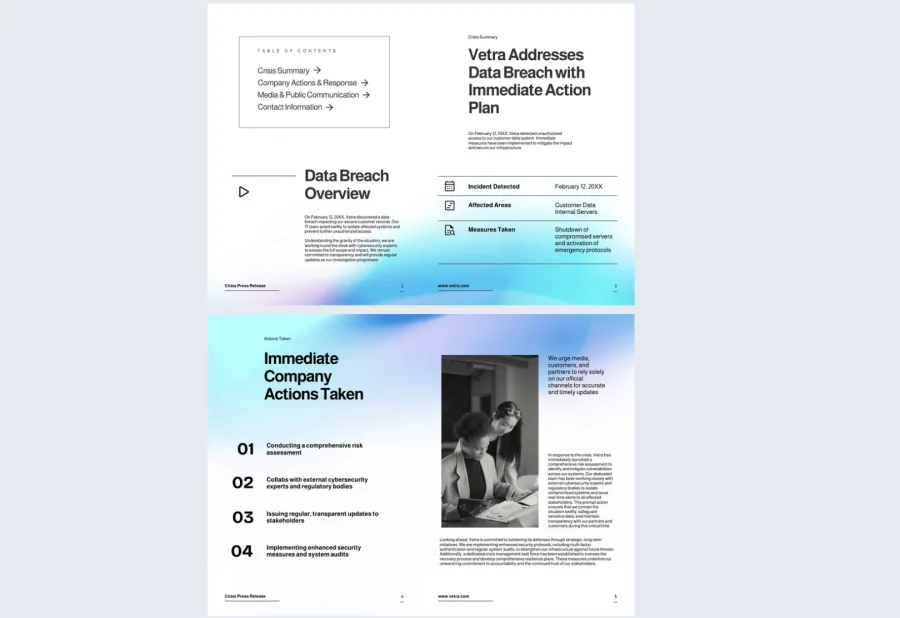
Common mistake to avoid: Don’t issue a press release that focuses on protecting the company before acknowledging the impact on those affected. Audiences read tone as much as content. Lead with accountability and follow with action.
7. Crisis Communication Plan Template
This crisis communication plan template is built for corporate communications, PR specialists, and crisis managers who need a clear, comprehensive framework covering response timelines, team roles, and messaging guidelines in one document that is easy to navigate under pressure.
Best for: Organizations that need a detailed, operational crisis plan rather than a high-level overview — one that defines exactly who does what, when, and through which channels across every stage of a crisis.
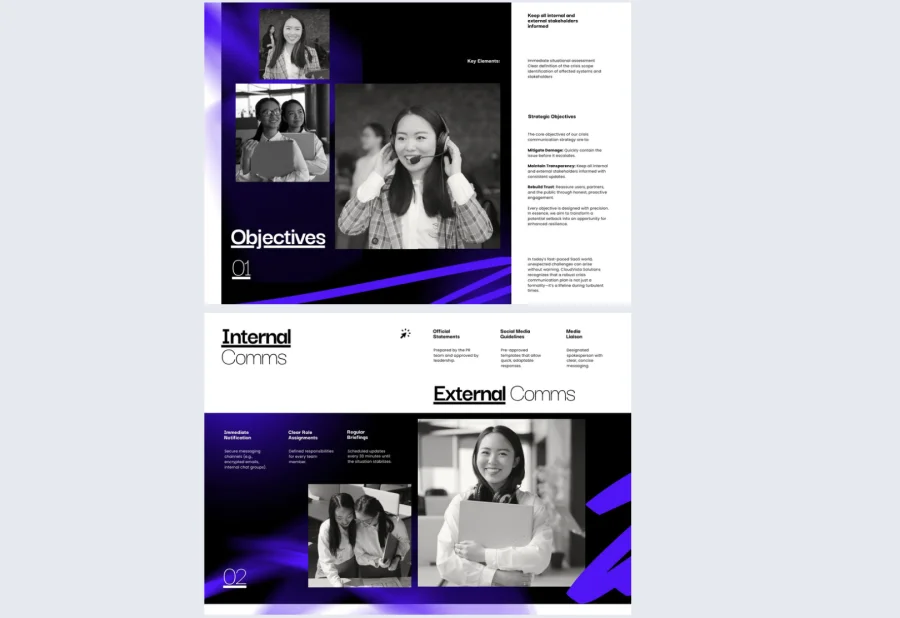
Real-world application: One of the latest Flipsnack customers is a crisis management team at a financial services firm that used this template to consolidate three separate crisis documents into one structured plan. When a regulatory investigation triggered their crisis protocol for the first time, every team member accessed the same current document through a single link, with no confusion about which version was official.
Replace the PDF content at any time and the flipbook link stays the same, so teams always access the latest approved version without any resending or version confusion. Flipsnack’s search function makes finding specific protocols fast even under pressure.
Common mistake to avoid: Don’t make the plan so comprehensive that it becomes unusable in a real crisis. Long documents with no clear navigation are abandoned under pressure. Prioritize structure and searchability over completeness.
8. Incident Report Template
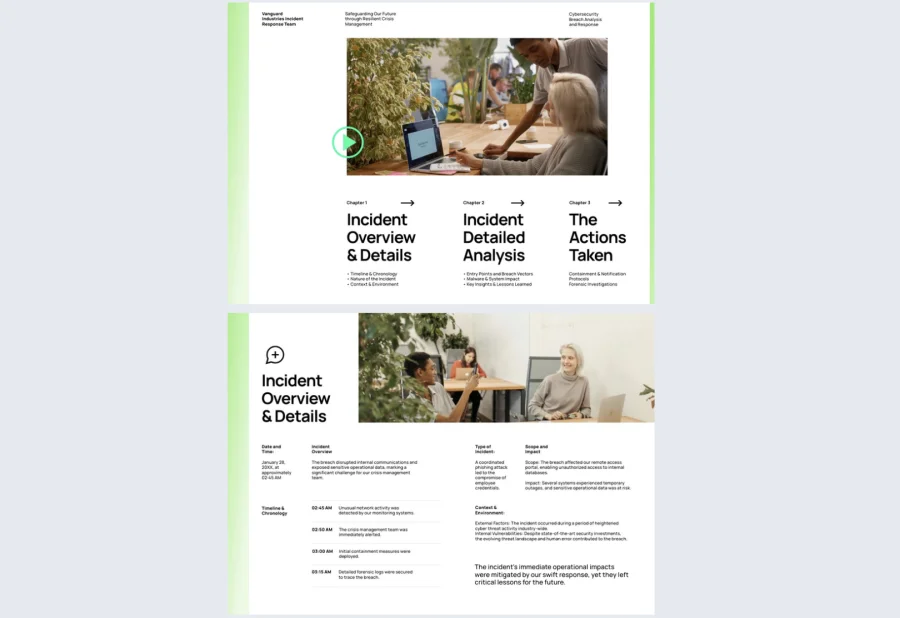
When a security breach or operational incident occurs, accurate documentation is as important as the response itself. This incident report template gives DevOps, IT security, and operations teams a structured format for capturing incident timelines, impact assessments, entry points, and containment protocols in real time.
Best for: DevOps and IT security teams at organizations handling sensitive data where thorough, timely incident documentation is required for both internal response and external regulatory compliance.
Real-world application: One of the latest Flipsnack customers is a security team at a SaaS company that used this template after a data exposure incident. Documenting the timeline and containment actions in a live flipbook meant leadership, legal, and the security team were all working from the same real-time record, significantly reducing the coordination overhead during the first 24 hours.
Embed video briefings from security leads, add hyperlinks to forensic analyses, and update the report in real time without changing the link using Flipsnack’s sharing features so every stakeholder always sees the latest version.
Common mistake to avoid: Don’t wait until the incident is resolved to start the report. Documentation should begin as the incident unfolds. Reconstructing a timeline from memory hours or days later introduces gaps and inaccuracies that can create problems during regulatory review.
9. Crisis Communication Budget Template
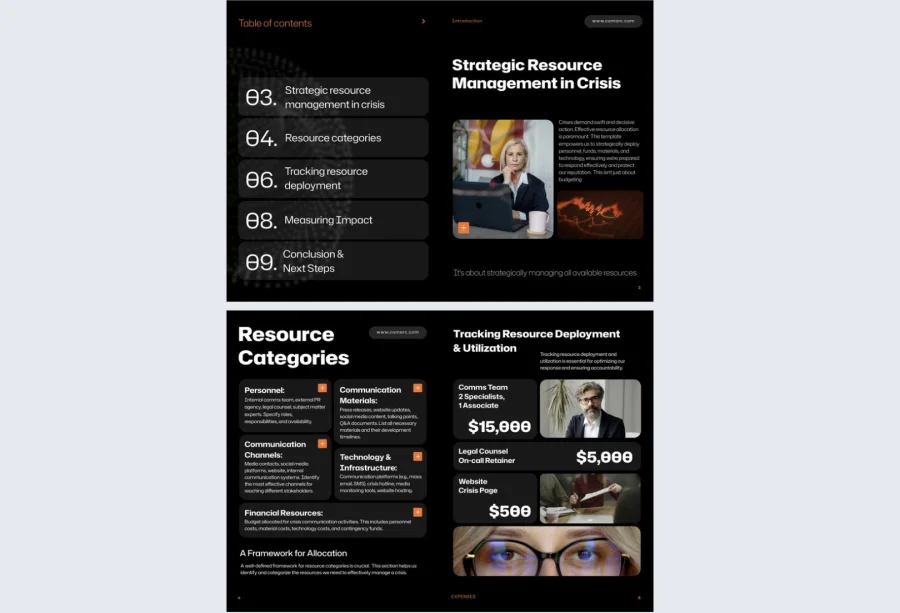
Managing crisis response resources efficiently is often an afterthought, until the invoices arrive. This crisis communication budget template gives PR, finance, and crisis management teams a structured format for allocating and tracking expenditure across personnel, communication tools, legal counsel, and emergency response activities.
Best for: Organizations managing a multi-team crisis response where PR, finance, and operations need to coordinate spending in real time without relying on email chains and spreadsheet attachments.
Real-world application: One of the latest Flipsnack customers is a crisis management team at a mid-size organization that used this template during a major operational disruption. Having PR, finance, and legal all working from the same live budget document eliminated the version conflicts that had caused overspending during a previous incident.
Use Flipsnack’s collaboration tools to let multiple departments update their sections simultaneously, and store the document in a private bookshelf accessible only to authorized stakeholders via SSO.
Common mistake to avoid: Don’t build a crisis budget only after a crisis starts. Pre-approved spending frameworks and vendor contacts should already be in place so the team can act without waiting for financial sign-off on every decision during an active response.
10. Reputation Management Plan Template
A reputation crisis rarely resolves itself. This reputation management plan template gives PR agencies and internal communications teams a structured framework for identifying risks, managing social media backlash, and aligning messaging across every channel before misinformation has time to take hold.
Best for: PR agencies handling crisis control and internal corporate communications teams responsible for protecting brand trust across public, media, and social channels simultaneously.
Real-world application: One of the latest Flipsnack customers is a PR agency that used this template to manage a reputational crisis for a client following a senior leadership controversy. Having escalation strategies, messaging frameworks, and social media response protocols in one document meant the agency could brief the client’s internal team and begin executing a response strategy within hours of the story breaking.
Because reputation management plans contain highly sensitive strategic information, use Flipsnack’s privacy options to restrict access to approved stakeholders only. Update messaging in real time as the situation evolves so every team member is always aligned on the latest approved response.
Common mistake to avoid: Don’t treat reputation management as purely reactive. The most effective plans include early warning systems and proactive monitoring protocols that identify risk signals before they become crises. Build those into the document from the start.
How to create a crisis communication plan with Flipsnack
A crisis communication plan is only as effective as it is accessible. Here’s how to build one in Flipsnack that your team can find, use, and update when it matters most.
Note: You can start with a free trial to explore most premium features. We also have a free plan if you only need basic PDF interactivity and up to three flipbooks.
1. Choose a template that matches your crisis scenario
Start by identifying which type of crisis communication document you need. A stakeholder update requires a different structure than a press release or an incident report. Browse the templates above and select the one that best fits your organization’s risk profile and communication needs.
If you need multiple documents, build them as a suite and organize them together in a Flipsnack bookshelf for instant access.
2. Customize with your team, protocols, and brand
Open your chosen template in Flipsnack’s Design Studio and replace placeholder content with your actual response protocols, contact lists, escalation paths, and messaging guidelines.
Apply your brand colors, fonts, and logo so every document looks official and consistent.
Add embedded videos for spokesperson briefings, links to supporting documentation, and go-to-page buttons for fast navigation under pressure.
3. Define roles and collaborate before a crisis hits
Use Flipsnack’s collaboration tools to involve the right people in building and reviewing each document before it is needed.
Assign roles based on involvement: owners control publishing rights, editors update content, and contributors leave comments without altering the core document.
Getting sign-off from legal, PR, and leadership in advance means the plan is approved and ready, not still in review when something goes wrong.
4. Publish and share with controlled access
Once finalized, publish each document and share it through the appropriate channel for its audience. Use SSO authentication for internal documents that should only be accessible to specific teams. Use password-protected links for external stakeholder updates that need controlled distribution.
Organize your full crisis communication suite in a private bookshelf so every relevant team member knows exactly where to find what they need.
5. Update in real time and track who has accessed it
When a crisis evolves, your communication documents need to evolve with it. Update any Flipsnack document and every shared link reflects the change instantly, with no resending and no version confusion.
Use Flipsnack’s statistics to confirm that key team members have opened and reviewed critical documents, and identify any gaps in access before they become gaps in response.
When a crisis hits, clarity wins
The organizations that protect their reputation in a crisis are not the ones with the best instincts in the moment. They are the ones that prepared the right documents, assigned the right roles, and made sure everything was accessible before anything went wrong.
Flipsnack gives your crisis communication team a platform to build, maintain, and deploy every document in this guide — updated in real time, shared securely, and always available to the right people at the right moment.
The next crisis will not announce itself. Build the plan now.
Frequently asked questions
At minimum, a crisis communication plan should cover the types of crises your organization is most likely to face, defined roles and decision-making authority, escalation paths, pre-approved messaging frameworks for different audiences, and a clear process for updating and distributing information as a situation develops. The more operational detail it includes, the less your team has to improvise under pressure.
A crisis response plan focuses on the operational actions an organization takes during an emergency, containing the incident, restoring systems, managing safety. A crisis communication plan focuses specifically on how information is managed and distributed during and after that response, to employees, media, stakeholders, and the public. Both are necessary, and they should be built to work together.
Run a tabletop exercise. Present your team with a realistic crisis scenario and walk through the plan as if it were real. This surfaces gaps in role clarity, outdated contact information, missing message frameworks, and documents nobody can find. Most organizations discover their plan needs significant revision the first time they test it. Better to find that out in a drill than during an actual crisis.