How to Create a B2B Digital Catalog with Build-In Ordering
Published on: December 18, 2025
Over the past few years, one message has dominated conversations about B2B digital transformation: you need e-commerce. As B2B buyers adopt more self-service behaviors, many organizations assume the only way forward is to replicate B2C-style online stores.
In reality, that assumption often creates more problems than it solves.
Most B2B sales environments are not transactional by nature. They are negotiated, relationship-driven, and shaped by complex products, volume constraints, and sales involvement. For manufacturers, wholesalers, and distributors, forcing these realities into a traditional e-commerce model frequently introduces rigidity, operational overhead, and buyer frustration.
At the same time, many B2B teams still rely on static catalogs and PDFs. These are easy to share but difficult to maintain, disconnected from ordering, and invisible once sent. Every update requires a new file, every order requires clarification, and every buyer interaction happens outside the catalog itself.
Between these two extremes lies a more realistic and effective model: the digital B2B catalog with built-in ordering. This approach is ideal for companies that sell complex products, rely on quotes or negotiated pricing, and want to digitize ordering while keeping sales in control and enjoying the advantages of a B2B eCommerce platform without the overhead of a full launch.
Also, it doesn’t aim to replace sales teams or recreate checkout experiences. Instead, it turns the catalog into an active sales interface, one that supports how B2B buyers actually discover products, evaluate options, and submit purchase intent.
This is the category Flipsnack has been building toward: not ecommerce, but self-service ordering embedded directly into the catalog experience.
Why B2B doesn’t need e-commerce to sell digitally
Modern B2B buyers want autonomy. Research shows they prefer to research, compare, and start purchases on their own. They don’t want endless emails or constant sales calls.
But where does that autonomy need to exist? That’s the key question.
E-commerce platforms assume:
- Fixed pricing
- Simple products
- Instant transactions
B2B doesn’t work that way. Pricing changes based on context. Products come in many configurations. Multiple people are involved in buying decisions.
Buyers often want to:
- Check availability
- Confirm quantities
- Request a quote before they commit
This is especially true for high-value or recurring orders.
This is why many B2B e-commerce projects fail. They become too customized and expensive to maintain. Or sales teams quietly abandon them and go back to spreadsheets and manual processes.
A digital catalog with built-in ordering recognizes a different truth: self-service doesn’t have to mean a trip to the checkout. It means giving buyers the power to explore products on their own, build a structured selection, and submit it with confidence. There’s no need to force them into a payment flow that doesn’t align with their reality.
Ordering without checkout: Built for B2B reality
One of the most important distinctions in B2B digital selling is the difference between ordering and paying. In many scenarios, the goal isn’t to complete a transaction instantly; it’s to formalize intent.
Depending on how you sell, Flipsnack supports the following checkout and order submission flows:
- Shopping list or wishlist submission — buyers build a list in the catalog and finalize details with sales later
- Purchase order or request for quote — buyers submit selected products and quantities directly from the catalog
- Email-based order submission — orders are sent via customizable forms that collect the exact details your sales team needs
- WhatsApp or Slack order sharing — buyers can send orders instantly to internal teams or distributors for faster alignment
These options preserve the flexibility B2B sales require. Pricing discussions, approvals, and negotiations remain with the sales team, while the catalog removes the inefficiencies of manual order collection. Instead of replacing sales workflows, the catalog strengthens them by structuring demand and reducing friction at the moment of intent.
This approach is especially effective in sales environments where the goal is understanding and alignment before any transaction happens.
How Radioshuttle replaces checkout with structured sales conversations
Radioshuttle®, a global provider of automated pallet handling systems, uses Flipsnack as a central sales interface rather than a checkout replacement. Their sales teams rely on interactive digital brochures during meetings, trade shows, and distributor conversations to explain complex warehouse systems, showcase use cases, and guide buyers through options.
Instead of pushing buyers toward immediate purchase, the catalog helps formalize interest. Prospects can explore products at their own pace, review videos and case studies, and leave meetings with a single, shareable link that captures the full context of the conversation. This allows internal stakeholders on the buyer side to review materials, align internally, and continue discussions without restarting the process.
As Gabrielle McCarthy, Digital Marketing Manager at Radioshuttle®, explains:
“In the small window of time you have to talk to a customer, they immediately understand the story. And afterward, it’s just a link. They can revisit it, share it internally, and come back with better questions.”
For Radioshuttle®, this model has proven far more effective than forcing transactions upfront. Their interactive catalogs are now used across sales, distributors, and training teams, helping close major deals by improving clarity, confidence, and follow-through, not by accelerating checkout.
The catalog as a decision-making interface
Historically, catalogs were designed to be read. In modern B2B sales, that is no longer enough. A catalog must help buyers make decisions.
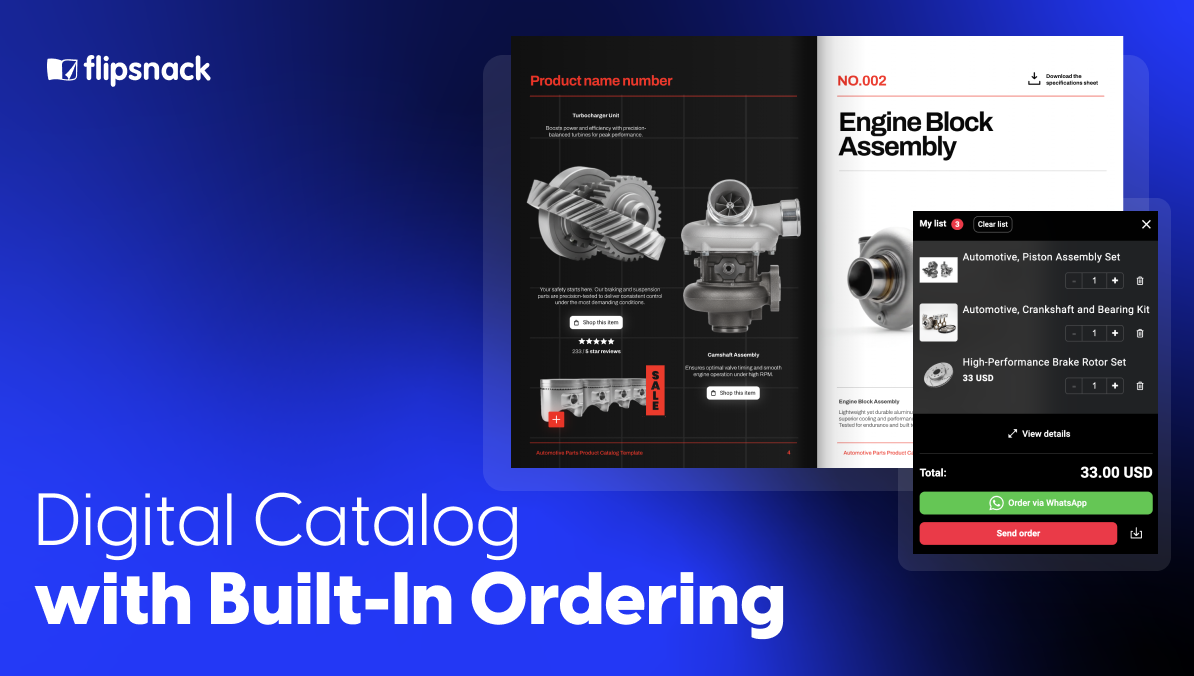
With Flipsnack, the catalog becomes an interactive environment where buyers can browse products visually and select them directly as they read. Product details open in context, selections happen without leaving the page, and products can be added to a shopping list or Wishlist throughout the browsing experience.
This matters because B2B buying is rarely linear. Buyers compare products across sections, revisit options, and validate choices internally before submitting a request. When selection happens inside the catalog, there’s no need for external notes, emails, or spreadsheets. The catalog itself becomes the single source of truth for both buyer and seller.
Rather than optimizing what happens after a decision, this approach focuses on improving how decisions are made in the first place.
How to create and run a B2B digital catalog with ordering
1. Start with your product data
Gather and organize your product information in Excel, CSV, or Google Sheets. This becomes the single source of truth for your catalog including product names, descriptions, SKUs, variants, prices, images, and availability.
2. Generate your catalog automatically
Use Flipsnack’s Product Catalog Generator to transform that data into a professional, interactive B2B catalog. Products are placed into structured layouts, variants are handled automatically, and branding stays consistent across pages, without relying on manual design or specialized skills.
3. Add interactive ordering and selection options
Inside the catalog, you can add interactive buttons that allow buyers to select products, choose variants, set quantities, and add items to a shopping list or wishlist as they browse. This keeps product selection contextual and eliminates the need for external order forms or spreadsheets.
4. Manage updates without redesigns
When product data changes, you simply update the spreadsheet and sync. All changes are reflected instantly across the catalog, under the same link. There’s no need to recreate files, resend PDFs, or depend on a specific designer to keep catalogs up to date.
5. Share catalogs and start receiving orders
Share catalogs securely via private links, email, one-time passcodes, or SSO. Buyers can browse products, select variants, add quantities, and submit orders or quote requests directly from the catalog, all without leaving the experience.
Privacy, access, and accountability in B2B sharing
In B2B, catalogs are rarely public. Pricing, product ranges, and availability often need to be shared only with specific customers, partners, or internal teams. A digital catalog must be easy to access for the right people and locked down for everyone else.
Flipsnack offers several secure sharing options so companies can control exactly who sees each catalog.
How you can share B2B catalogs securely
With Flipsnack, you can:
- Publish catalogs as unlisted, so they’re hidden from search engines and public pages
- Password-protect catalogs to limit access to approved viewers
- Share via one-time passcodes (OTP) sent by email, without requiring accounts
- Send catalogs to specific people by email, including large lists uploaded via CSV
- Revoke access at any time when a catalog should no longer be available
For enterprise or internal use, Flipsnack also supports Single Sign-On (SSO), allowing access through your company’s existing identity system.
Visibility without friction
Even with private sharing, vendors keep full visibility. Orders are linked to identifiable customer information, and tracking links show how different clients or partners interact with the catalog. This ensures accountability, without adding steps or complexity for buyers.
From orders to insight, not just transactions
Collecting orders is only part of the value. In B2B, what matters more is understanding what drives buyers to order and where interest drops before they do.
Flipsnack shows how buyers interact with your catalog, so teams can quickly see what works and what needs improvement.
At a catalog level, you can understand:
- How many people viewed the catalog
- How engaged they were and how long they stayed
- Where traffic comes from (sales links, campaigns, shared URLs)
At a product and order level, you can see:
- Which products are selected and added to shopping lists most often
- How quantities are chosen
- Which products generate orders and revenue
At a customer and sharing level, you can track:
- Who submitted each order
- Which shared links or clients drive engagement
- How do different customers interact with the same catalog
Flipsnack helps teams understand which products perform, which pages influence decisions, and which catalogs help sales move faster. These insights can be reviewed, exported, or sent to other systems, so teams can act on them, not just report on them.
Brand your catalogs so that buyers recognize you
B2B buyers may be purchasing on behalf of organizations, but their expectations are shaped by everyday digital experiences. A catalog that feels outdated or generic undermines trust, regardless of product quality.
Flipsnack allows companies to apply branding consistently, customize interface elements ( logo, fonts, color, etc), and deliver a mobile-optimized experience that works just as well on tablets and phones. For sales teams, this means sharing materials that feel credible, current, and aligned with the brand they represent.
A more realistic model for B2B digital sales with Flipsnack
In B2B, success isn’t defined by how quickly someone clicks “Buy now.” It’s defined by how confidently buyers make decisions and how efficiently sales teams turn that intent into revenue.
A digital catalog with built-in ordering reflects how B2B selling actually works. Buyers want independence, but not rigidity. Sales teams need structure, not replacement. And businesses need visibility into what drives demand before an order is ever placed.
With Flipsnack, catalogs stop being static documents and start working as active sales assets. Buyers can explore products, make selections, and submit structured requests on their own terms. Sales teams receive clear, complete orders instead of fragmented emails. And leadership gains insight into which products perform, which catalogs influence decisions, and where deals accelerate or stall.