Digital Catalog Examples: Real Catalogs, Real Results and What to Borrow
Last updated: November 18, 2026
You’ve decided your catalog should go digital. Then someone on the team asks the fair question: what does a good one look like, and did it work for anyone?
Template galleries answer the first half. They show empty layouts. They can’t show a catalog program running in 17 countries, or one that brought in half a boutique’s monthly revenue.
This guide shows both. Below are real digital catalog examples, published by real companies and grouped by industry. Where a company has shared results, you’ll see the numbers. Where it hasn’t, you’ll see what its catalog does well and what you can borrow.
New to the format? Start with what a digital catalog is, then come back and see what you can achieve.
Table of contents
- What counts as a digital catalog example?
- 1. Appliances Manufacturing – Electrolux: 345 catalogs across 17 European countries
- 2. Wholesale – Pot Factory Connect: catalogs live in under 24 hours instead of 5 to 10 days
- 3. Melissa & Doug: 700 products in one shoppable wholesale catalog
- What do digital catalog examples look like in retail?
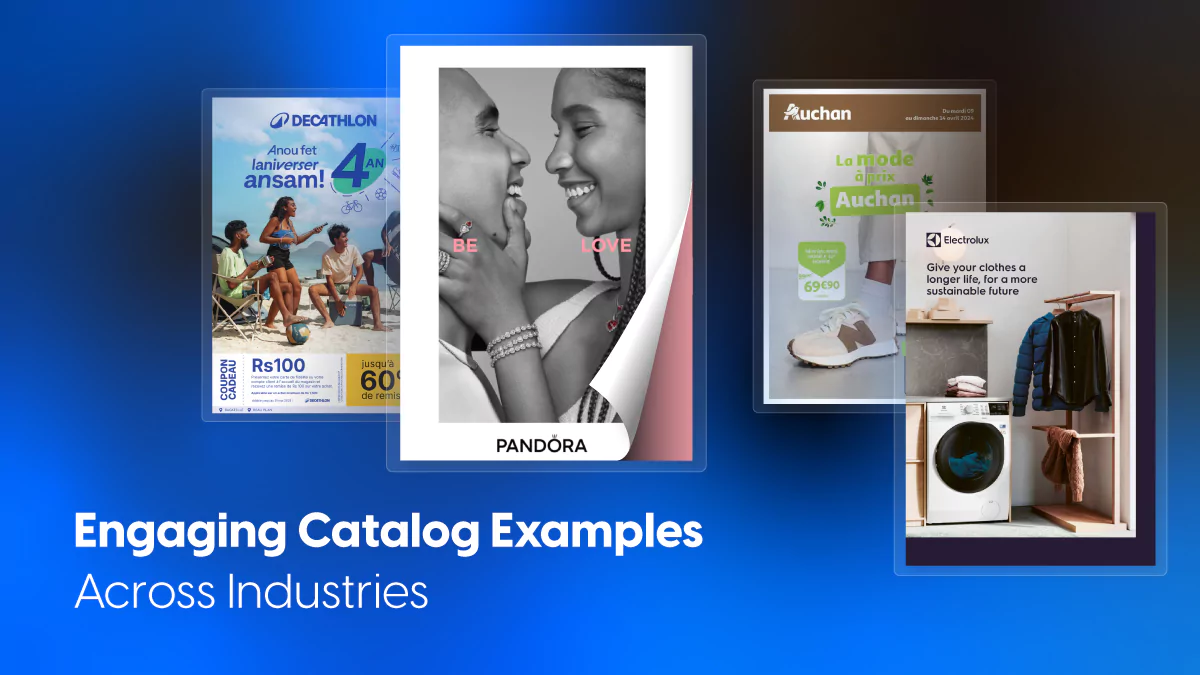
- 4. Jewelry Retail – Pandora: 3x faster store operations across 130 stores
- 5. Retail Sporting Goods – Decathlon: seasonal campaigns in one browsable catalog
- 6. Supermarket – Auchan: weekly deals published as a digital catalog
- What do digital catalog examples look like for home and furniture brands?
- 7. Home Furniture – Chez Pluie : half a month’s revenue from one catalog
- 8. Furniture & Home Furnishings Manufacturing – Cantia: an in-store catalog that updates itself
- What do digital catalog examples look like for technical and industrial supplies?
- 9. Construction Products – Kishigo : a spec-heavy PPE catalog built for quick navigation
- 10. B2B supplier – Ellemental: 10% higher order value in two weeks
- What the best digital catalog examples have in common
- Where should you start with your own digital catalog?
What counts as a digital catalog example?
A digital catalog example is a product catalog a real company has published online, with interactive features such as links, video, search or ordering, that anyone can open and browse in a browser.
Every example below is live and public. We sorted them into two kinds: catalogs whose owners have published results, and catalogs worth studying for one design or feature choice you can copy.
1. Appliances Manufacturing – Electrolux: 345 catalogs across 17 European countries
- The challenge: The headquarters team in Sweden mainly printed its catalogs, while trade partners needed every novelty fast, on any device and in several market versions.
- What they built: Interactive catalogs with product tags, installation videos, photo slideshows, and a service-center map, sent as separate versions to each trade partner and market.
- What it took: The Marketing & Communications team at headquarters set clear requirements (interactive, mobile-friendly, easy to update, many versions on time) and digitized its existing printed catalogs. The team describes onboarding as easy, helped by support guides.
- The result: 17 European countries onboarded; 345 flipbooks; 104,400 impressions; 76,300 views; 8,800 downloads.
- What happened next: Catalogs grew beyond trade partners into installation tutorials and in-store tablet showcases, with catalog automation for larger product volumes. Electrolux plans to keep building on the setup.
Flipsnack is a catalyst in our transition to a more sustainable business… combining the feel of a paper catalog with interactive features that take user experience to the next level.
Fabiola Vidal, Digital Marketing Product Owner at Electrolux.
What to borrow: Build one brand system, then publish a version per market from it. Partners stop asking which file is current.
2. Wholesale – Pot Factory Connect: catalogs live in under 24 hours instead of 5 to 10 days
- The challenge: The company launched with no warehouse and no showroom, so the catalog had to replace the showroom. Supplier data arrived as PDFs, and rebuilding a catalog by hand took five to ten days.
- What they built: AI turns supplier PDFs into spreadsheets, and Catalog Generator fills designed templates with 900+ products. Buyers choose colors and sizes and order from a shopping list at any hour, guided by a 20-second walkthrough video inside the catalog.
- What it took: Several weeks of work with Flipsnack’s Customer Success team to set up the feed workflow. After that, the team ran it alone, within a week.
- The result: Catalog creation under 24 hours, down from 5 to 10 days; 900+ products in one automated catalog; one feed update refreshes pricing across the whole catalog; a single catalog view produced 128 clicks on the walkthrough video.
- What happened next: The team is building retail catalogs for landscapers and garden centers and premium buyer’s guides for architects, designers, and luxury hospitality, all kept under one branded bookshelf link.
- What to borrow: Let the product feed carry prices. When rates or costs move, you sync once instead of editing hundreds of pages.
For us, Flipsnack isn’t just our catalog. It’s actually our whole B2B sales system.
Mitch Burke, Pot Factory Connect
3. Melissa & Doug: 700 products in one shoppable wholesale catalog
- The challenge: The annual catalog moved from print to several digital tools during the pandemic. Retailers cross-referenced platforms for product lists, descriptions, and images, then switched to yet another tool to order.
- What they built: A 215-page template filled by catalog automation with every product’s name, description, image and links. A shopping list sends retailer orders straight to the team’s inbox.
- What it took: One Sales Administrator designed the 215-page template in Flipsnack from scratch. The team decided after a five-minute rundown of the platform.
- The result: 700 products in one 215-page catalog; 50%+ less time to build than by hand; 2,292 views; 2 h 9 min average time spent; a large share of the team’s sales in the first month and a half came from the shopping feature.
- What happened next: Reps added the catalog link to their email signatures and used its QR code at trade shows, where retailers placed orders on the spot. The template is set up to carry into the next annual catalog.
- What to borrow: Put the order form inside the catalog. Retailers who browse and order in one place don’t drift to another tool.
As retailers walked into our booth, they would ask for a printed catalog to take home with them. To their surprise, I was able to have the catalog readily available to them via the QR code. Every single customer was so impressed by how quickly & easily we were able to share our new catalog and even placed orders on the spot!
Jennifer Sarmiento, Commercial Analytics Manager, Melissa & Doug
What do digital catalog examples look like in retail?
Retail catalogs serve two audiences: shoppers browsing deals or collections, and store staff looking up products. The best ones update every store at once, open from a QR code or link, and let a shopper go from a product page to a list or cart in one tap.
4. Jewelry Retail – Pandora: 3x faster store operations across 130 stores
- The challenge: Catalogs were built in PowerPoint and printed for 130 stores. Staff searched 1,500+ engraving variations on paper, and every collection change meant new stickers, six times a year.
- What they built: Engraving and collection catalogs for shoppers, opened from multi-language QR codes on trays and store stickers. Barcode-enabled catalogs and ring size guides for staff. The catalogs are generated with Catalog Generator from Google Sheets, and one QR code opens a bookshelf with all of them.
- What it took: The Retail Excellence Team led the change. Branded cover and page templates were built with the design team for each product category before the catalogs were automated.
- The result: Staff find product details at least 3x faster; a Valentine’s Day catalog drew 2,750 QR scans in a few days, with 2.5 minutes of average browsing; all 130 stores see the latest version.
- What happened next: Pandora started on Flipsnack with company newsletters, moved to store catalogs, then to fully automated catalogs. After the Valentine’s results, the team planned to extend QR catalogs to all regular collections.
The catalog generator solution provided by Flipsnack has allowed us to significantly reduce non-sales tasks in our stores, saving valuable time on a daily basis. Our store teams are absolutely delighted. At the headquarters level, we truly appreciate the responsiveness of the Flipsnack teams and our shared motivation to further develop and enhance our catalogs.
Carla Michel d’Annoville, Pandora’s Retail Excellence Team
What to borrow: Print one QR code, never the catalog. Everything behind the code can change without new signage, and you can easily generate as many catalogs as you need.
5. Retail Sporting Goods – Decathlon: seasonal campaigns in one browsable catalog
Decathlon is a major retailer of sporting goods with a broad catalog of equipment, apparel, and accessories. Decathlon uses Flipsnack to publish catalogs, enabling customers (and internal teams) to access seasonal or promotional offerings in a clean, digital format.
Physical promos and printed catalogs are slow and expensive to produce, and once they’re out in the world, any update, whether it’s a price change, stock adjustment, or design correction, is impossible without starting over. Errors persist, customers end up with outdated information, and internal teams are left scrambling to fix problems across multiple locations. For a retailer like Decathlon, where promotions move fast and product availability changes daily, the inability to update catalogs in real time was the biggest roadblock to keeping both customers and staff aligned.
Flipsnack was the solution Decathlon adopted. Their flipbook catalog is visually rich, shows product images clearly, and is well organized into sections, enabling quick browsing of featured offers. The digital format allows Decathlon to share promotions faster, avoiding delays of print, and ensures that customers everywhere see the same up-to-date information.
Creating their product catalogs with Flipsnack, Decathlon had the following results:
- Operational efficiency & collaboration – Marketing teams spend less time managing static files and more time focusing on creative and campaign work. Flipsnack’s collaborative features also make it easier for teams across regions to co-create, edit, and approve catalogs, ensuring faster turnaround and brand consistency.
- Faster update capability: Price changes, product availability, or promotional content can be refreshed more rapidly.
- Enhanced customer experience: The visually clean layout helps customers find what they want faster and see the products more clearly (images, specs).
- Brand consistency and savings: Decathlon maintains a consistent presentation across locations, reduces printing costs, and reduces waste from outdated print runs.
Decathlon demonstrates how a major retailer can modernize promotional catalogs: delivering visual impact, operational agility, and cost efficiencies through a digital catalog tool. It’s a strong example for companies looking to blend strong visuals with practical promotion management, giving both customers and teams what they need: access, clarity, and relevance.
6. Supermarket – Auchan: weekly deals published as a digital catalog
Large retailers and supermarkets are also transforming their weekly flyers and product brochures into digital catalogs. Auchan, a global retail chain known for its hypermarkets, is one such company using Flipsnack to power its online catalogs. Traditionally, stores like Auchan print weekly deal circulars or seasonal catalogs (toys at Christmas, outdoor gear in summer, etc.).
By moving these publications online, Auchan can reach a wider audience instantly and update content as needed (for example, if a promotion sells out or a price changes, the digital catalog can be edited on the fly).
Auchan’s digital catalogs likely highlight weekly specials with interactive elements. A customer reading an Auchan flyer online could click a product to see more details, add it to a shopping list, or, if the catalog is embedded on the store’s website, send it straight to the store’s cart. Browsing and buying happen on the same page, closing the gap between them. Emailing these catalogs or sharing them on social media also becomes easier than distributing paper flyers.
If you operate in retail (whether grocery, apparel, or department store), Auchan demonstrates the value of an online catalog for promotional content.
First, it reduces print and distribution costs, no longer relying solely on newspaper inserts or direct mail. Second, it offers a more engaging customer experience: digital pages can include recipe videos, product demos, or an Add button linked to your website’s cart, which a paper flyer could never provide. Third, you can measure engagement, knowing which pages or deals customers interacted with most.
Auchan trusting Flipsnack for its catalogs signals that even at a massive scale, digital catalogs are reliable and scalable. The move online can also support sustainability goals by cutting paper waste, something many large retailers, including those in construction/DIY retail, are keen on.

What do digital catalog examples look like for home and furniture brands?
Furniture and decor sell on atmosphere and scale, which flat product grids don’t show. The strongest catalogs in this category combine room shots, video and slideshows with product details, and they show the full range, including what doesn’t fit in a showroom.
7. Home Furniture – Chez Pluie: half a month’s revenue from one catalog
- The challenge: A team selling French Country antiques worldwide, with e-commerce layouts that made each piece feel like a listing instead of a story.
- What they built: A 30-page catalog combining video, image slideshows and interactive product information in a single view.
- What it took: The 8-person team builds its catalogs in-house. The first 30-page catalog was tested with a select group before launch.
- The result: The launch month was their biggest revenue month to date, with the catalog behind about half of it; readers spent 9 minutes per catalog visit vs 2 on the website; newsletter subscribers doubled in the first month.
- What happened next: A catalog for Patricia Wells’ antique collection, told through video, led to a New York Times feature. Seasonal campaigns and special collections are planned in the same format.
- What to borrow: If your product needs a story, put the video next to the product, not on a separate page.
Flipsnack transformed the way we present our antiques. It allows us to combine videos, image slideshows, and interactive product information in a single view, significantly enriching the user experience. It’s a revenue-generating tool, which for us is way more valuable than a cost-saving tool.
Hugh Cameron, Founder of Chez Pluie
8. Furniture & Home Furnishings Manufacturing – Cantia: an in-store catalog that updates itself
Cantia is a Mexican furniture and home décor brand known for its wide range of products across living, bedroom, and decorative categories. Many of their items aren’t displayed physically in stores, so showcasing the full collection digitally became essential to improving the in-store experience and streamlining product discovery.
Store staff struggled to keep 100+ page catalogs updated, and customers browsing in-store often had limited visibility into items not physically on display. Cantia needed a scalable way to showcase its complete offering in real time, while also making catalog management more efficient for the marketing team.
Flipsnack was the solution Cantia needed. Their interactive digital catalog was built with Flipsnack and displayed on digital screens throughout Cantia Decoración branches. It bridges the gap between limited showroom space and the full product range, allowing customers to explore detailed product information and place orders directly from the interface.
To simplify management, Cantia connected Flipsnack’s SKU tagging to a Google Sheets database, automating catalog updates and reducing manual work. Branded templates keep everything consistent, while the interactive format makes browsing more engaging for customers.
Creating their product catalogs with Flipsnack, Cantia had the following results:
- In-store engagement: Customers can browse the entire product range, including items not on display, and make more informed purchase decisions.
- Operational efficiency: Updates are automated via Google Sheets, significantly reducing catalog maintenance time.
- Interactive experience: Rich visuals, specs, and easy navigation create a more immersive shopping journey.
- Stronger brand presence: Consistent branding across every catalog reinforces Cantia’s identity and professionalism.
Cantia’s move to an interactive, visually rich flipbook catalog raises the bar for furniture and home décor marketing in its market. By combining beautiful imagery, strong branding, and easier navigation, they transform what was once a heavy, inflexible product catalogue into a customer-friendly experience that inspires and converts. For other manufacturers of furniture and home decor, Cantia’s catalog is a model: one that balances aesthetics, information, and operational efficiency.
What do digital catalog examples look like for technical and industrial supplies?
Technical buyers open a catalog to compare specs, sizes, and compatible products before they order. The best catalogs in this category group products the way they’re used together and put navigation first, so buyers find the right item and the parts that go with it.
9. Construction Products – Kishigo: a spec-heavy PPE catalog built for quick navigation
Kishigo is a specialist in high-visibility safety apparel and personal protective equipment for workers in construction, road, and industrial environments. Their 2024 digital catalog showcases their commitment to safety, quality, and clarity in product communication.
Kishigo needed a clear, easy-to-navigate format to present many product lines, technical specifications, fabrics, and safety standards. Their customers (contractors, safety managers, industrial buyers) require instant access to detailed specs, size charts, and compliance information. A static PDF or print catalog risked being difficult to update quickly, confusing for users to navigate, and not ideal for digital or remote access.
By publishing their catalog via Flipsnack, Kishigo built an interactive digital version that opens with branding and is better organized, making it immediately clear and professional. The catalog is organized with an open-by-default table of contents so users can jump directly to categories, products, or safety compliance sections. High-quality images, consistent branding, and logical structure help make the product lines accessible and authoritative.
Creating their product catalogs with Flipsnack, Kishigo had the following results:
- Better first impressions & clarity: Having the table of contents open by default improves navigation, helping users find sections (e.g., high-visibility shirts, outerwear, accessories) immediately without flipping through irrelevant pages.
- Quicker access to technical details: Customers can quickly locate size charts, safety ratings, and fabric information, increasing trust and reducing product-misfit risk.
- Improved digital reach: The interactive catalog can be accessed anywhere—on desktop, mobile, in the field – giving sales teams and customers immediate access to the latest product info.
- Brand consistency: Branding is front and center; every page follows consistent visual styling, reinforcing Kishigo’s image as a safety products authority.
For companies like Kishigo in safety construction products, where technical detail, compliance, and clarity matter as much as appearance, an interactive, well-structured digital catalog delivers real value. Kishigo’s online catalog shows how an intuitive layout, immediate access to content, and strong branding help turn product specifications from a barrier into a feature, empowering both sales teams and customers, improving confidence, reducing confusion, and creating better buying experiences.
10. B2B supplier – Ellemental: 10% higher order value in two weeks
- The challenge: As the range grew, most customers explored only the part tied to their own niche. Someone buying emulsifiers never looked at packaging, because ecommerce search didn’t show how ingredients, packaging and tools connect.
- What they built: One visual catalog for the whole product ecosystem, with ingredient families, packaging ranges and formulation materials side by side. Interactive navigation replaces menus, filters and search alone, so customers move into categories they used to skip.
- The result: Average order value up 10% in the first two weeks, as customers added complementary products; 60% engagement rate; 28 minutes of average reading time.
- What happened next: The catalog now supports consultations and workshops as well as cross-selling, and low-search categories customers used to overlook gained visibility.
- What to borrow: Group products the way customers use them together, not the way your warehouse lists them. That’s where cross-selling happens.
We wanted the catalog to feel less like a product dump and more like a place where people can actually understand what they are working with.
Alice Gallovics, Founder, Ellemental
What the best digital catalog examples have in common
The strongest digital catalogs live at one link that’s updated in place, pull product data instead of retyping it, let buyers act without leaving the page, use video only where the product needs explaining, and track what readers do so the next edition improves.
Five points, each tied to an example above:
- One live link. Electrolux partners and Pandora shoppers always open the current version, so nobody sells from an outdated price.
- Product data drives the pages. Pandora, Melissa & Doug and Pot Factory Connect generate pages from a sheet or feed, so a price change is a sync, not a redesign.
- Buyers act inside the catalog. Pot Factory Connect buyers send orders from a shopping list, and Melissa & Doug retailers send orders straight to the sales team’s inbox. Embedded on your own site, the catalog can also send Add clicks to your store’s cart (how it works).
- Media only where it explains. Chez Pluie uses video to sell atmosphere; Kishigo keeps pages lean because buyers want specs.
- They measure. Electrolux counts views and downloads per market, and Pandora knows how often its QR code is scanned. The next edition is planned from that data.
Want the data behind these patterns? See our digital catalog benchmarks.
Where should you start with your own digital catalog?
If you’ve made it this far, you probably recognize some of the same struggles these companies once faced: outdated print runs, endless PDF updates, clunky tools, and sales teams left guessing which version is current. These aren’t just minor inconveniences; they drain time, budget, and credibility.
The good news? You don’t have to keep working this way. Flipsnack has helped brands like Electrolux, Pandora, and others to turn their catalogs into modern sales tools that are always up to date, easy to share, and proven to drive engagement and revenue. More importantly, these companies have improved both the customer and employee experience: catalogs that are shoppable, accurate, and simple to update reduce lost sales, eliminate confusion, and build trust.
And here’s the best part: it doesn’t take a huge team or budget to see the same results.
With Flipsnack, you can:
- Cut production costs by reducing print runs and manual updates.
- Save hours of work by automating updates directly from your product data.
- Equip sales teams instantly with the latest, branded materials they can trust.
- Track what works with built-in analytics to see what customers engage with most.
What once felt like a burden can quickly become your most powerful sales asset. Your catalogs can move from slowing you down to driving growth, alignment, and confidence across your organization.
So, ask yourself: are you ready to turn the page on outdated catalogs? If the answer is yes, the next success story could be your own, joining the ranks of innovative companies already proving that catalogs can be as dynamic and modern as the products they showcase.