How to Make a Business Presentation: The Complete Guide
Published on: March 3, 2020
Last updated: October 28, 2026
Sales and marketing teams build presentations every week: a pitch for Tuesday, a quarterly business review for Thursday and a client proposal that was due yesterday. Most of those decks get rebuilt from scratch, even when last month’s version was nearly right.
Effort isn’t what’s missing. Process is. Teams that present well work from one repeatable structure, one brand template and one source of approved numbers, so every new deck starts halfway done. Turning the deck into a digital presentation adds a bonus: you see who opened it and which pages held their attention.
This guide shows you how to make a business presentation step by step, how to build one quickly as a team and how to adapt the process for a sales pitch, a QBR and a client proposal. You’ll also find business presentation examples worth borrowing from.

How do you make a business presentation?
To make a business presentation, define one goal, learn what your audience needs to decide, then outline the deck as an opening, context, core points and a clear ask. Write each slide headline as the takeaway, design inside your brand template, rehearse out loud twice and share the final deck as a trackable link.
Table of contents
- How do you make a business presentation?
- Business presentation fundamentals
- How to make a business presentation step by step
- Which business presentation structure fits your meeting?
- Make a presentation quickly with a team checklist
- Adapt your business presentation for sales and marketing meetings
- Which tool should you use to make a business presentation?
- Create a business presentation in Flipsnack in 5 steps
- Best practices for effective business presentations
- Virtual vs in-person business presentation strategies
- How to start and close a business presentation
- Measuring success and continuous improvement
- Start designing business presentations with Flipsnack
- Frequently asked questions about business presentations
Business presentation fundamentals
What makes a business presentation effective?
Effective business presentations share four key characteristics: they’re professional, clear, persuasive, and impactful. Unlike casual presentations, corporate presentations must maintain credibility while driving specific business outcomes. Leveraging an ai presentation maker can help streamline the design process while maintaining consistency and clarity across slides.
A professional business presentation demonstrates expertise through polished design, coherent structure, and confident delivery. Clear presentations distill complex information into digestible insights that stakeholders can quickly understand and act upon. Persuasive presentations don’t just inform. They influence decision-making by addressing audience needs and concerns. Impactful presentations create lasting impressions that drive real business results.
Every successful corporate presentation includes essential elements: a compelling opening, well-structured content, supporting data, visual aids that enhance rather than distract, and a clear call to action. The difference between good and great presentations often lies in how these elements work together to create a cohesive narrative.
Making sure you know your audience and stakeholders
Before creating any business presentation, identify your audience’s priorities, concerns, and decision-making authority. Are you presenting to executives who need high-level strategic insights, or technical teams requiring detailed implementation plans?
Consider the difference between decision-makers and influencers. CEOs and department heads typically have final approval authority, while managers and specialists provide recommendations. Tailor your message, level of detail, and supporting evidence accordingly.
Pay attention to feedback and engagement cues during your presentation. Watch for body language, questions, and participation levels. These signals help you adjust your pacing, dive deeper into relevant topics, or address concerns in real-time. Understanding your stakeholders’ perspectives enables you to craft presentations that resonate and drive the outcomes you need.
How to make a business presentation step by step
Whether you’re preparing a sales pitch or a corporate presentation for leadership, the process stays the same. These steps cover how to make a presentation step by step, from the first goal to the follow-up.
1. Define your goal and plan around the audience
Write down the single decision you want from the room. Budget approval, a signed scope and a second meeting are all good goals. “Inform the team” isn’t, because nobody can act on it. Keep that sentence visible while you build, and cut any slide that doesn’t move the audience toward it.
Creating an effective business presentation starts long before you open any software. Begin by defining your core message and objectives. What specific outcome do you want? Are you seeking approval for a budget, buy-in for a strategy, or investment in a project? Your objective shapes every other decision.
Research your audience thoroughly. Understanding these key elements helps you anticipate needs:
- What challenges do they currently face?
- What metrics matter most to them?
- What questions will they likely ask?
- Who has decision-making authority vs. influence?
Gather supporting data and evidence early. Having comprehensive information, including projected business outcomes, allows you to answer questions confidently and adapt your presentation based on audience feedback:
- Financial projections and ROI analysis
- Market research and industry trends
- Case studies and customer testimonials
- Competitive analysis and benchmarks
Create your presentation outline before touching design elements. This structure becomes your roadmap and ensures logical flow from opening hook to final call to action.
2. Outline the opening, context, core points and ask
Before you write any slides, sketch the deck in four blocks. The opening tells people why this meeting matters to them. Context gives everyone the same starting point. Core points carry your evidence in order of importance, and the ask closes with the decision you need.
Start with a compelling opening that immediately addresses your audience’s primary concern or opportunity. Avoid generic introductions and dive straight into value within the first 30 seconds.
Build your narrative around a clear problem-solution framework:
- Present the challenge – What problem needs solving?
- Introduce your solution – How does your approach address this?
- Provide evidence – What data supports your recommendation?
- Outline implementation – What are the specific next steps?
This logical progression helps audiences follow your reasoning and builds toward your desired outcome.
Integrate data visualization strategically. Charts and graphs should illuminate key points, not overwhelm. Each visual element should support your narrative and be immediately understandable. Complex data requires simple, clear presentation.
Then write every slide headline as the takeaway. A headline like “Q3 revenue” makes your audience do the work. A headline like “Q3 revenue grew in every region” hands them the conclusion before they read a single bullet. Read only your headlines in sequence. If they tell the whole story, your structure works.
3. Design inside your brand template
Choose templates and branding elements that reflect your company’s professional standards. Consistency in fonts, colors, and imagery creates credibility and reinforces your brand identity.
Ensure visual balance on every slide. Key design principles include:
- White space allows important information to stand out
- One clear idea per slide keeps audiences focused
- High-quality graphics enhance credibility
- Consistent formatting maintains professionalism
Test all technology before your presentation:
- Check projectors and screen compatibility
- Verify internet connections for online content
- Prepare offline backup versions
- Have technical support contacts ready
Create supporting materials like handouts or digital resources that audience members can reference later. These materials extend your presentation’s impact beyond the meeting room. Alternatively, you can hire a presentation design firm where a group of professionals do their best to take care of your presentation and make it a fit for your brand identity.
4. Rehearse out loud and time it
Reading slides silently isn’t rehearsing. Say the whole presentation out loud at least twice and time each run, because spoken pacing always runs longer than you expect. Mark the slides where you stumble, then simplify them rather than memorizing your way around them.
5. Share the presentation and plan the follow-up
Send one link instead of a heavy attachment, so you can fix a typo or a price after the meeting, and check who opened it before your follow-up call.
Which business presentation structure fits your meeting?
The right length and structure depend on what the meeting needs to decide. Use this table as a starting point.
| Presentation type | Goal | What to include | Length guide |
| Sales pitch | Win a decision or a next meeting | Buyer’s problem, your solution, proof, pricing, next step | About 10 slides in 20 minutes, following the 10/20/30 rule |
| Quarterly business review | Agree on next quarter’s priorities | Goals vs. results, wins, misses, next quarter plan | One slide per KPI or initiative, plus a summary |
| Client proposal | Get a signed scope | Client’s challenge, approach, timeline, team, investment | Short enough to read without you in the room |
| Corporate presentation for leadership | Secure approval or budget | Recommendation first, evidence, risks, the ask | Put the decision in the first two slides |
| Team update | Align on next steps | Progress, blockers, decisions needed | Five minutes of talking, a handful of slides |
Guy Kawasaki built the 10/20/30 rule for investor pitches, so treat it as a ceiling for persuasive decks rather than a law. Reports like a QBR can run longer, as long as each slide still carries one idea.
Make a presentation quickly with a team checklist
Speed doesn’t come from designing faster. It comes from never starting from a blank slide. Before your next deadline, check that your team has these five things in place.
- A locked brand template. Fonts, colors and logo placement stay fixed, so nobody spends an hour rebuilding the cover slide. Branded template locking keeps every edit inside the guidelines.
- A library of reusable slides. Company overview, team bios, case studies and pricing get approved once, then dropped into any deck.
- One approved data source. Numbers come from a single file that finance or ops signs off on, so no rep presents last quarter’s figures.
- One named reviewer. A single owner signs off on the final version, which beats six people editing at once.
- One shareable link. You update the deck under the same shareable link, so the version your client opens is always the current one.
If you present twice a year, a blank PowerPoint file is fine. The checklist pays off once your team ships several decks a month.
Adapt your business presentation for sales and marketing meetings
The five steps stay the same across meetings, but the emphasis shifts. Here’s how to adapt them for the three presentations sales and marketing teams build most often. For finished decks to learn from, browse these business presentation examples.
Sales pitch presentation
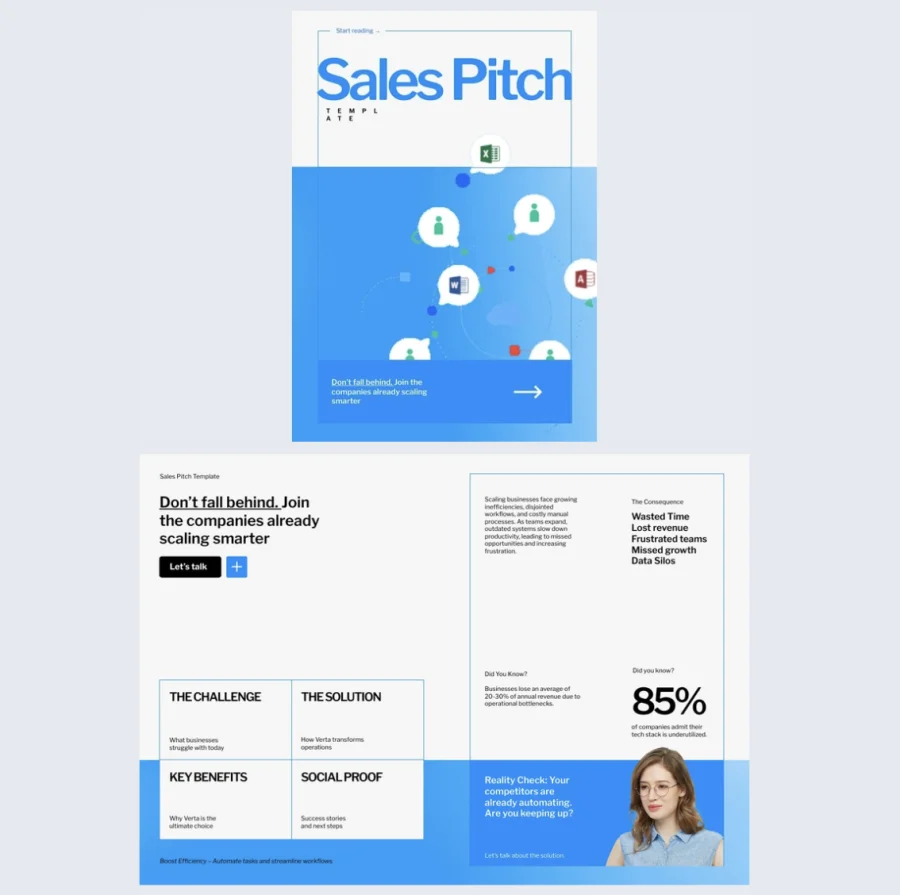
A sales pitch earns a next step by proving you understand the buyer’s problem better than the competition does. Open with their situation, not your company history, and build the deck as a sales presentation the buyer can revisit and forward after the call. For a deeper walkthrough, learn how to create interactive sales presentations that buyers can explore later.

- Best for: first meetings, demos and competitive bake-offs
- Real-world application: put a short product video on the solution slide so the buyer can replay it when briefing their team
- Common mistake to avoid: spending three slides on “About us” before the buyer hears anything about their own problem
Quarterly business review (QBR) presentation
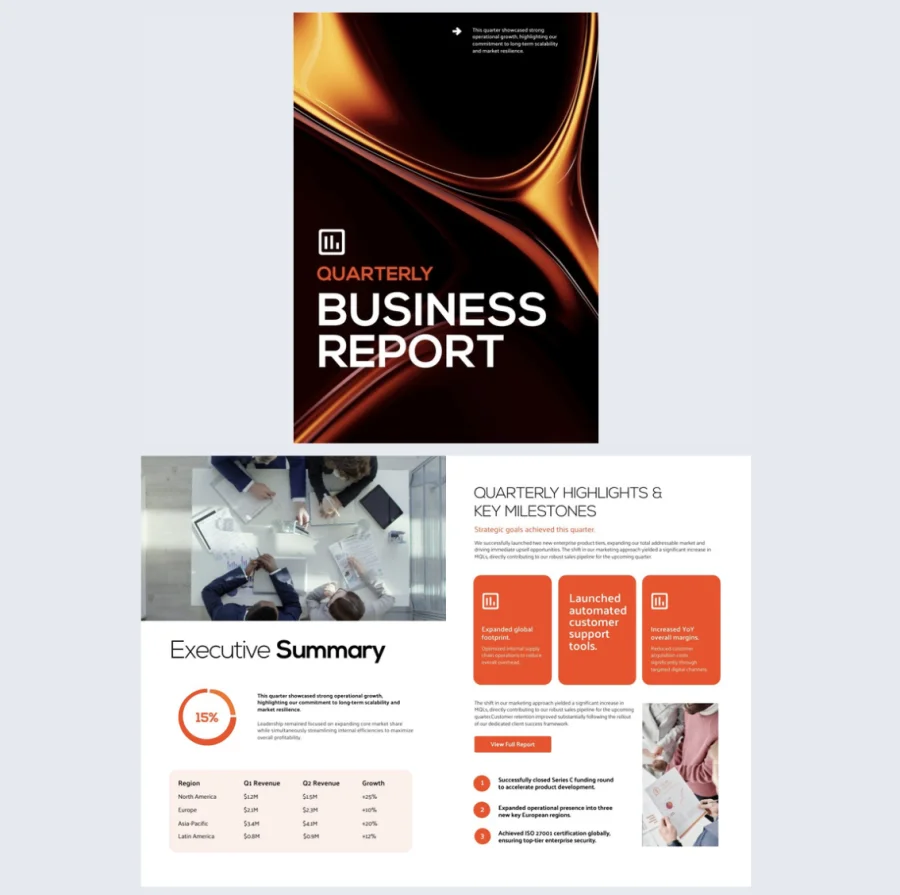
A QBR shows a client or leadership team what happened, why it happened and what comes next. Lead with results against the goals you agreed on last quarter, then move to the plan.
- Best for: account reviews, renewals and internal leadership updates
- Real-world application: use one chart per KPI and write the headline as the verdict, such as “Onboarding time dropped two quarters in a row”
- Common mistake to avoid: hiding a missed target on slide 14; naming it early builds more trust than any win
Client proposal presentation
A client proposal often gets forwarded to people who weren’t in the meeting, so it needs to make sense without you narrating it. Spell out the scope, timeline and investment in plain language. Business proposal templates give you a tested starting structure.
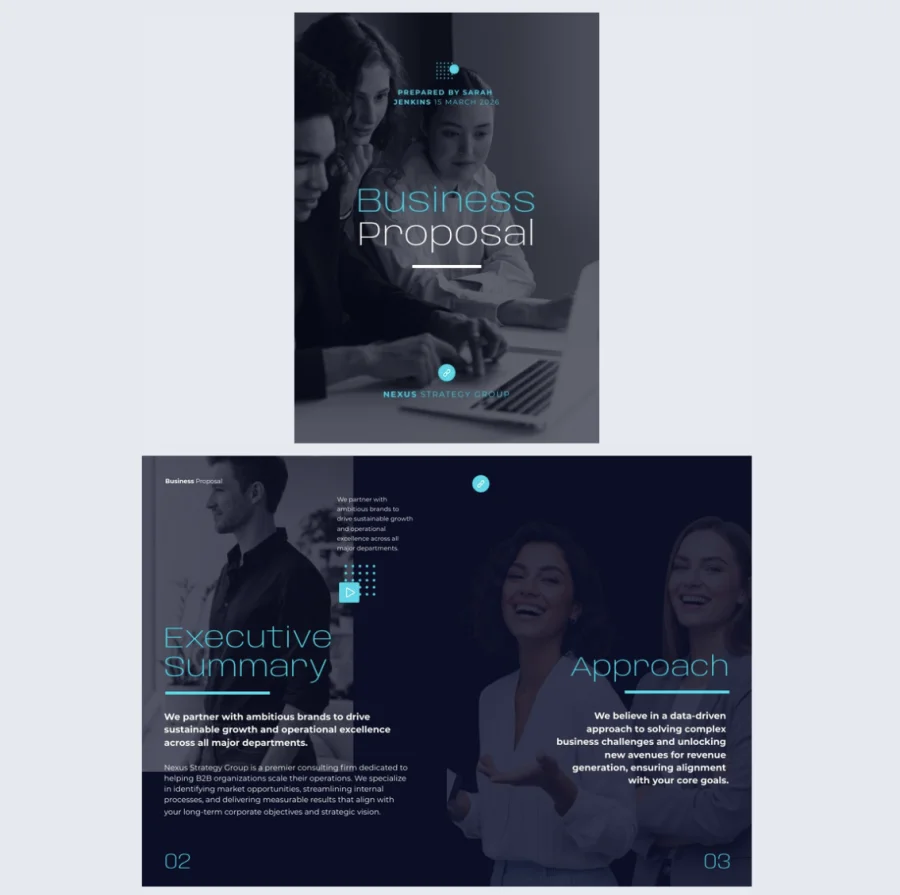
- Best for: agencies, consultants and B2B sales teams sending a formal offer
- Real-world application: add a form or a “Book a call” button on the last page so the reader can act without hunting for your email
- Common mistake to avoid: a generic proposal with the client’s name swapped in; reviewers spot it on page two
Which tool should you use to make a business presentation?
The right tool depends on where your presentation lives after the meeting. Here’s how the most common options compare for business teams.
| Tool | Best for | Limitations |
| PowerPoint | Windows workplaces that present live and need offline access | Decks travel as attachments, so versions multiply and you can’t see who opened them |
| Keynote | Mac users building design-heavy, animated decks | Works best inside the Apple ecosystem; sharing with Windows teams takes extra steps |
| Google Slides | Remote teams that co-edit in real time on a tight budget | Fewer design options and no page-level engagement data |
| Flipsnack | Teams that share decks as links and want to track who reads them | Steeper learning curve than slide tools; some team and security features are Enterprise only |
If your deck lives only in the meeting room, a slide tool is enough. If it gets forwarded, updated and followed up on, a link-based format pays off.
Why choose Flipsnack for business presentations
Flipsnack transforms static presentations into interactive experiences that engage stakeholders and drive measurable results. Unlike traditional tools, Flipsnack combines professional design capabilities with modern interactive features specifically designed for today’s digital business environment.
Key advantages include:
- Professional templates: Extensive library of business-focused templates designed for corporate presentations
- Interactive elements: Add clickable buttons, embedded videos, and interactive content that engages audiences
- Digital publishing: Create presentations that work seamlessly across all devices and platforms
- Brand consistency: Easy customization tools to match your corporate branding and visual identity
- Analytics and tracking: Monitor how stakeholders engage with your presentation content
- Collaboration features: Team-friendly workflow for creating and reviewing presentations
Choose the right presentation tool for your team
Choose Flipsnack for:
- Interactive presentations with analytics tracking
- Multi-device viewing and engagement measurement
- Professional branding with memorable impact
Choose traditional tools for:
- Existing corporate software ecosystems
- Offline presentation requirements
- Simple, static presentation needs
Can you use AI to make a business presentation?
Yes, and AI handles the slow parts well: a first outline, layout suggestions and a cleaner version of your bullet points. What it can’t do is decide your goal, check your numbers or know what your buyer objected to last week. Use AI for the first draft, then spend the saved time rehearsing. Flipsnack’s AI presentation maker works inside your brand template, so the draft already looks on brand.
Create a business presentation in Flipsnack in 5 steps
Once your outline and content are ready, here’s how to turn them into an interactive deck in Flipsnack.

Step 1: Choose your starting point
Flipsnack offers four flexible options to begin your presentation:
- Upload PDF: Transform existing documents into interactive presentations
- Upload PowerPoint: Convert PPT files while adding interactive features
- Create from scratch: Use Design Studio for complete customization
- Choose a template: Start with professional business templates
Step 2: Customize your design
Once you’ve selected your starting point:
- Upload your company logo and brand assets
- Adjust colors to match your brand guidelines
- Modify fonts and typography for professional consistency
- Add your content while maintaining visual balance
Step 3: Add interactive content
Enhance engagement with interactive features:
- Embed videos for product demonstrations or testimonials
- Include clickable links to supporting resources
- Add interactive buttons for calls to action
- Integrate forms for lead capture or feedback
Step 4: Optimize for digital delivery
Ensure your presentation works flawlessly across all platforms:
- Preview your presentation on different devices
- Test all interactive elements and links
- Ensure fast loading times and smooth navigation
- Set up analytics tracking for engagement metrics
Step 5: Share and Distribute
Flipsnack provides multiple sharing options:
- Generate shareable links for stakeholder access
- Embed presentations in websites or emails
- Download for offline presentations when needed
- Track viewer engagement with page-level statistics
Best practices for effective business presentations
I. Content best practices
A. Keep slides concise and focused
Apply the “one idea per slide” rule to maintain audience attention and comprehension. Each slide should communicate a single, clear concept that supports your overall narrative. Avoid cramming multiple points onto one slide, which creates cognitive overload and reduces retention.
Effective slides typically contain:
- Maximum 6-8 bullet points
- Brief, punchy headlines that summarize the main idea
- Supporting details that can be explained verbally
- Clear takeaways that advance your argument
B. Use compelling storytelling techniques
Transform dry business data into engaging narratives that resonate with your audience. Structure your content using proven storytelling frameworks:
- The Challenge-Solution Arc: Present a problem your audience faces, then reveal how your proposal solves it
- Before-and-After Scenarios: Show the current state versus the improved future state
- Customer Success Stories: Use real examples to demonstrate value and build credibility
C. Incorporate relevant data visualization
Turn complex information into digestible visual insights. Choose chart types that best represent your data:
- Bar charts for comparisons between categories
- Line graphs for trends over time
- Pie charts for showing proportions (use sparingly)
- Infographics for process flows and relationships
Ensure every visual element directly supports your message and can be understood within 5-10 seconds.
D. Maintain consistent voice and branding
Your presentation should reflect your organization’s professional identity throughout. This includes:
- Using brand colors, fonts, and logo placement consistently
- Maintaining the same tone and terminology across all slides
- Aligning messaging with company values and positioning
- Ensuring visual elements reinforce rather than distract from your brand
II. Design best practices
A. Follow professional design principles
Effective business presentation design prioritizes clarity and credibility over flashy effects. Apply these fundamental principles:
- Contrast: Use color and size differences to highlight important information
- Alignment: Keep elements organized and visually connected
- Repetition: Maintain consistent formatting throughout your presentation
- Proximity: Group related information together
B. Ensure readability and visual hierarchy
Your slides must be easily readable from the back of the room or on small screens. Key considerations include:
- Font size: Minimum 24pt for body text, 36pt+ for headlines
- Font choice: Sans-serif fonts (Arial, Calibri) for better screen readability
- Color contrast: Dark text on light backgrounds or vice versa
- White space: Allow breathing room around text and graphics\
C. Optimize for different screen sizes
Your presentation may be viewed on laptops, tablets, projectors, or large monitors. Design with flexibility in mind:
- Test your presentation on various devices before presenting
- Use scalable fonts and graphics that remain clear at different sizes
- Ensure important information isn’t placed too close to slide edges
- Consider how interactive elements will function across platforms
III. Delivery best practices
A. Practice body language and voice projection
Your physical presence significantly impacts how audiences receive your message. Focus on:
- Voice: Vary your pace, tone, and volume to maintain engagement
- Posture: Stand tall with shoulders back to project confidence
- Eye contact: Connect with different sections of your audience
- Gestures: Use purposeful hand movements to emphasize key points
B. Engage audience with interactive elements
Modern audiences expect participation beyond passive listening. Incorporate engagement strategies:
- Polling questions: Use real-time polls to gauge opinions or knowledge
- Discussion breaks: Pause for brief audience conversations
- Q&A integration: Address questions throughout rather than only at the end
- Interactive demos: Let audience members try products or features
C. Handle questions professionally
Questions are opportunities to demonstrate expertise and address concerns:
- Listen completely before responding
- Repeat or paraphrase questions for the entire audience
- Provide concise, direct answers without unnecessary detail
- Acknowledge when you don’t know something and offer to follow up
- Bridge back to your main message when appropriate
Virtual vs in-person business presentation strategies
In-person presentation strategies: advantages and best practices
In-person presentations excel at building trust through direct eye contact, reading body language cues, and facilitating spontaneous interactions. Physical presence eliminates technical barriers and creates natural engagement that drives decision-making.
Key strategies for in-person success:
- Position yourself strategically and move around the room to engage all sections
- Use proximity during key moments to create emphasis
- Leverage physical props and handouts effectively
- Facilitate organic networking before and after presentations
- Read audience body language to adapt your delivery in real-time
Virtual presentation strategies: advantages and best practices
Virtual presentations reach broader audiences cost-effectively while offering screen sharing for detailed demonstrations and built-in collaboration tools like polls and chat functions.
Essential virtual presentation elements include professional lighting, eye-level camera positioning, and quality audio equipment. Increase vocal variety to compensate for reduced physical presence, and plan for shorter attention spans with frequent interaction points.
Using Flipsnack for virtual presentations
Flipsnack turns passive screen sharing into an interactive experience that keeps working after the meeting ends.
Enhanced virtual engagement
Share digital presentations via direct links during video calls, allowing participants to navigate independently while you guide the discussion. Unlike static screen sharing, attendees can interact with clickable elements, access embedded resources, and bookmark sections for later review, all while remaining engaged in your live presentation.
This dual-screen approach means participants can follow along on their devices while maintaining video call connection, creating a more immersive and personalized experience that traditional virtual presentations cannot match.
Real-time analytics and insights
Track which stakeholders engage with content during and after meetings through comprehensive analytics. Monitor participation patterns to understand which sections generate the most interest, identify highly engaged participants for targeted follow-up, and measure actual attention spans rather than guessing based on video cues.
These insights enable data-driven improvements to future presentations and provide concrete metrics to demonstrate presentation effectiveness to leadership teams.
Persistent access and follow-up optimization
Virtual presentations often end when the meeting ends, but Flipsnack presentations continue working. Provide persistent access for follow-up review without requiring file downloads or email attachments. Participants can revisit complex sections, share specific pages with colleagues, and access updated versions automatically.
Multi-device accessibility for global teams
Ensure consistent experiences across desktop, tablet, and mobile platforms, crucial for international teams joining from various devices. Support offline access for participants with connectivity challenges, and provide seamless integration with popular video conferencing platforms like Zoom, Teams, and Google Meet.
How to start and close a business presentation
Start a business presentation with a strong opening
Your first 30 seconds decide whether people lean in or reach for their phones. Skip the agenda slide and open with why this meeting matters to the people in it. Then state your goal in one sentence, so everyone knows what you’ll ask for at the end.
Two openings that work in business settings:
- “Last quarter, onboarding took 30 days. Today I’ll show you how we get it to 20, and what I need from this room to do it.”
- “You told us renewals are your biggest risk this year. This proposal is built around that.”
Powerful closing strategies
Your presentation’s final moments determine whether audiences take action or forget your message entirely. Effective closings reinforce key takeaways and create lasting impressions that drive results.
Strong closing techniques include:
- Summarize key points in 2-3 concise statements that reinforce your main message
- Circle back to your opening to create narrative closure and memorable impact
- End with a compelling quote or story that encapsulates your vision
- Create urgency by highlighting time-sensitive opportunities or consequences of inaction
Avoid weak endings like “Any questions?” or trailing off with “So, that’s it.” Instead, finish with confidence and clear direction.
Call to action best practices
Transform audience interest into concrete next steps with specific, actionable requests. Vague conclusions kill momentum and leave stakeholders uncertain about how to proceed.
Effective calls to action include:
- Specific timelines and deadlines for decision-making or implementation
- Clear responsibilities with named individuals accountable for next steps
- Multiple engagement options to accommodate different stakeholder preferences
- Immediate next steps that can be accomplished within 24-48 hours
For example: “I need approval for this budget by Friday so we can begin implementation next month. Sarah will send the detailed proposal tomorrow, and I’ll schedule individual meetings with each department head this week.”
Post-presentation follow-up
Strategic follow-up transforms single presentations into ongoing business relationships. Send summary materials and action items within 24 hours while your presentation remains fresh in stakeholders’ minds.
With Flipsnack: Use analytics data to personalize follow-up conversations. If a stakeholder spent significant time on pricing sections, focus your follow-up on budget discussions. If they shared specific pages with colleagues, offer to present to those additional team members.
Measuring success and continuous improvement
Presentation success metrics
Effective measurement goes beyond subjective feedback to include concrete business outcomes. Track both immediate engagement and longer-term results to understand your presentation’s true impact.
Key metrics include:
- Objective achievement rates – Did you get the approval, funding, or agreement you sought?
- Follow-up response rates – How many stakeholders engaged after your presentation?
- Decision timeline acceleration – Did your presentation speed up the decision-making process?
- Stakeholder feedback scores – Use consistent rating systems to track improvement over time
Flipsnack analytics provide additional insights:
- Time spent on each section reveals which content resonates most
- Click-through rates show which calls to action generate engagement
- Device usage data helps optimize future presentation formats
- Geographic engagement patterns inform distribution strategies
Getting and using feedback
Systematic feedback collection enables continuous improvement and builds stronger stakeholder relationships. Combine formal feedback methods with informal observation and self-assessment.
Feedback collection strategies:
- Immediate post-presentation surveys to capture fresh impressions
- One-on-one follow-up conversations for detailed insights
- Peer review sessions with colleagues who observed your presentation
- Self-assessment reflection documenting what worked and what didn’t
Using data-driven insights:
Presentation analytics reveal engagement patterns that subjective feedback often misses. Use this data to optimize content structure, identify sections that lose audience attention, and refine your messaging for maximum impact.
Regular feedback analysis helps you develop a personal presentation style that consistently delivers results while building your reputation as an effective communicator.
Start designing business presentations with Flipsnack
Creating effective business presentations requires mastering the fundamentals: understanding your audience, structuring compelling narratives, designing professional visuals, and delivering with confidence. Whether you choose traditional tools like PowerPoint or embrace interactive platforms like Flipsnack, success depends on focusing on your audience’s needs rather than just your message. The best corporate presentations combine clear storytelling with engaging visuals and measurable calls to action that drive real business results.
Great presenters aren’t born; they iterate. Use feedback and page-level analytics to improve each deck, and keep what works in your shared template so the whole team benefits. Ready to build your next one? Create your business presentation with Flipsnack and see exactly how your audience reads it.
A deck that gets read beats a deck that gets admired.
Frequently asked questions about business presentations
A business presentation is a structured talk, usually supported by slides, that a company uses to inform, persuade or align an audience around a specific decision. Common types include sales pitches, quarterly business reviews, client proposals and leadership updates.
The 5/5/5 rule is a text limit for slides: no more than five words per line, five lines per slide and five text-heavy slides in a row. It’s a rule of thumb rather than a standard, and it works best for slides you present live.
The 7/7/7 rule is a looser version of the same idea. Most versions cap each slide at seven lines and each line at seven words, and some add a limit on text-heavy slides in a row. Pick one rule and apply it consistently across the deck.
About 10 slides is a reliable starting point for a 20 minute business presentation, which matches Guy Kawasaki’s 10/20/30 rule. Data-heavy reviews can run longer, as long as each slide carries a single idea.
It depends on what happens after you present. Google Slides and Canva are strong free picks for building slides. If you need a shareable link you can update and track, Flipsnack lets you start for free and shows you who read which pages.