How to Make an Investor Pitch Deck That Gets Investors Interested
An investor pitch deck can be the difference between getting a meeting and getting passed over. For founders raising capital, it’s one of the first opportunities to show investors why the business is worth backing and why they should take a closer look.
If you want to get that funding, you’ll need more than a pitch deck filled with information. Build a clear fundraising story, support your claims with evidence, and give investors the context they need to evaluate the opportunity. How you share the deck matters, too, especially when it contains sensitive business and financial information.
In this guide, you’ll learn what to include in an investor pitch deck, what investors look for when evaluating one, how to create a deck, and how to share it securely while tracking investor engagement.
Table of contents
- What is an investor pitch deck?
- What is the goal of an investor pitch deck?
- Key investor pitch deck components
- Investor pitch deck examples
- How to create an investor pitch deck
- 1. Research your target investors
- 2. Define your fundraising story
- 3. Gather the evidence behind your claims
- 4. Structure the deck around investor questions
- 5. Turn important data into visuals
- 6. Tailor the deck to your fundraising stage
- 7. Review the deck from an investor’s perspective
- 8. Prepare the deck for secure sharing
- 4 steps to make an investor pitch deck with Flipsnack
- Seal the deal with an impressive investor pitch deck
- FAQs
What is an investor pitch deck?
An investor pitch deck is a short presentation founders use to introduce their company to potential investors and make a case for funding. Also called a startup pitch deck or fundraising deck, it gives investors a focused view of the business, the opportunity it is pursuing, and its potential for growth.
Unlike a sales pitch deck, which is designed to persuade customers to buy, an investor pitch deck focuses on the investment opportunity. It typically covers the problem, solution, market opportunity, business model, traction, financial outlook, team, and funding needs.
Investors might see your deck before a first meeting, during a pitch, or afterward for a closer look. It can keep circulating too, as investors share it with partners or prepare for follow-up talks.

What is the goal of an investor pitch deck?
The main goal of a pitch deck is to secure funding and move the fundraising conversation forward. To do that, it needs to build a compelling case for why the business is worth backing.
The focus can vary depending on who you’re pitching to. A pitch deck for investors should give them enough context to evaluate the business while keeping the investment opportunity clear. A VC pitch deck may focus more on market size, scalability, and growth potential, while an angel investor pitch deck may put more emphasis on the founding team, early traction, and the vision behind the company.
Investors want to see evidence that the company is viable, has room to grow, and has a credible plan for getting there. That means presenting relevant market data, traction, and financial projections alongside a clear growth strategy and funding plan.
How the goal of a funding pitch deck changes by company stage
Your deck should change as your company grows. A seed-stage fundraising pitch deck may focus on validating the problem, demonstrating early demand, and explaining the market opportunity. Once you’re raising Series A, B, or C funding, investors generally expect more evidence of how the business is performing and how new funding will accelerate growth.
| Funding stage | What the pitch deck should demonstrate |
| Pre-Seed / Seed | Validation of the problem, founder-market fit, and early signs of demand like waitlists, pilots, or early user feedback. Plus, a big enough vision to justify the market opportunity. |
| Series A | Early traction, product-market fit, and evidence that the business has the potential to grow into a sustainable company. |
| Series B | Proven growth and how new funding can help scale operations, expand the customer base, and strengthen the business. |
| Series C | Show growth opportunities, such as expanding into new markets, developing new products, or accelerating an already successful business. |
As you raise more rounds, investors expect deeper detail. That means more traction numbers, more financial data, and a clearer plan for how new capital fuels the next stage of growth. The further along you are, the less your deck needs to sell the idea and the more it needs to prove the engine already works.
Key investor pitch deck components
A strong pitch deck should persuade investors to back your vision. Give them enough information to understand your business and judge its potential, without adding too much detail.
Not every section gets equal scrutiny, though. Storydoc’s analysis of more than 1.3 million presentation sessions found that 31% of readers left within the first 10 seconds, while 82% of those who reached slide four went on to read the entire deck.
Here’s what to include in your pitch deck and why each component matters.
- Company overview: Give a quick picture of what your company does, who it serves, and where it fits in the market.
- The problem: Prove the problem is real. Use data or research to back up its size and impact.
- The solution: Walk through how your product or service solves the problem and what sets it apart.
- Market opportunity: Lay out how large the market is, who your customers are, and why it can grow. It helps to explain why now is the right time to enter it.
- Business model: Break down how your company makes money and why the model can support long-term growth.
- Traction: Show evidence that customers want your solution. This could include revenue, users, sales, retention, pilots, or other key milestones.
- Competitive landscape: Map out who your competitors are, what alternatives customers have, and why your company can stand out.
- Go-to-market strategy: Explain how you plan to reach customers and turn market demand into growth.
- Team: Highlight the experience and skills that show why your team can execute the plan.
- Financial projections: Chart where the business is heading with realistic forecasts for revenue, expenses, and other key metrics.
- Funding ask: Clearly state how much you’re raising, how you plan to use the funds, and what specific milestones or growth the investment will help you achieve.
Investor pitch deck examples
Looking at successful investor pitch decks can help you see how strong fundraising stories work in practice. The examples below from Pitch Deck Hunt, show how companies like Uber, Airbnb, and Dropbox structured their information, used visuals, and made their business opportunities easy for investors to understand.
Uber
Uber’s early pitch deck from 2008 raised $200K and stood out for its straightforward structure. It clearly moved from the problem with traditional taxis to the solution, market opportunity, business model, and product vision. The visuals used are maps, screenshots, and diagrams to make the concept easy to picture without distracting from the message. What made the pitch powerful was its ability to turn a familiar frustration into a scalable business opportunity. Investors could quickly understand both the problem and how technology could solve it. Till now, Uber had 25 rounds of funding and they managed to raise $24.7 billions in total.
Airbnb
Airbnb’s 2008 pitch deck raised $600K and is a great example of how simplicity can make an unconventional idea feel investable. The deck followed a clear problem-solution structure, supported by minimal copy, strong headlines, and visuals that made the concept easy to understand. Rather than overwhelming investors with information, it showed why the existing hotel experience had limitations, how Airbnb offered a different solution, and why the market could be much bigger than it first appeared.
Dropbox
Dropbox’s pitch deck focused heavily on showing rather than telling. Screenshots and product visuals helped investors immediately understand how the service solved a frustrating problem: keeping files synchronized across devices. The deck was relatively simple, but that was part of its strength. It explained a technically complex product in a way that felt intuitive, while also communicating the size of the opportunity and the founders’ ability to build it. Dropbox went on to raise a total of $1.7 billion in funding, showing how a clear product story can be more persuasive than an elaborate presentation.
How to create an investor pitch deck
Plenty of businesses are chasing investor attention right now. Your pitch needs to make a clear, sharp case for why yours is worth backing. Here’s how to build a deck that shows your potential and proves what the right funding can help you achieve.
1. Research your target investors
Before you write a single slide, know who you’re pitching. Research each investor’s industry focus, funding stage, typical check size, portfolio, and the types of companies they back. This will help you decide which parts of your story to emphasize.
One Flipsnack client uses decks as a modular base, swapping logos, images, examples, and pages for different audiences. You can do the same with your investor deck: keep the core story intact while adapting the details that matter most to each investor.
2. Define your fundraising story
Before you design a single slide, decide what you want investors to walk away understanding.
Your story should link the problem, the solution, the market, your traction, your business model, and your growth plan into one clear thread. Each part should build on the last and lead investors to the same conclusion: this is a real opportunity, and your company is the one to chase it.
Try summing up your investment case in a few sentences. Can you explain why the opportunity matters, why your company can win, and what the funding will unlock? If not, more slides won’t fix that.
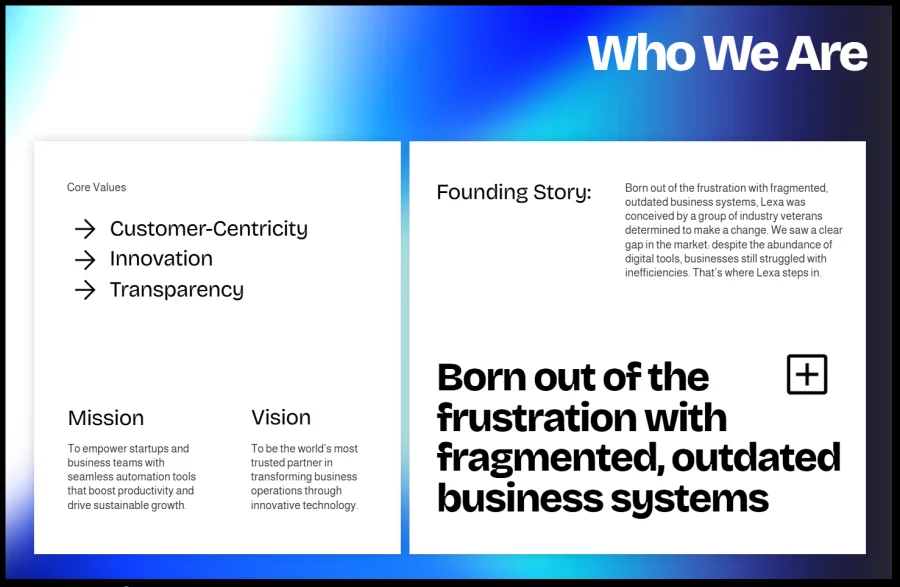
Keep your story simple and skip the jargon. Get to the point early, and explain why your business matters instead of just listing features. Investors are busy and every slide should earn its place. The example below from a Flipsnack pitch deck template, shows how you can bring key parts of your company story, such as who you are, your founding story, mission, and vision on a single slide.
3. Gather the evidence behind your claims
A pitch deck makes a case, but every important claim should have evidence behind it.
Before building your slides, collect the data you may need to support your story, including:
- Revenue and customer growth
- Customer retention and engagement
- Product adoption
- Market research
- Competitive data
- Customer feedback
- Financial performance
- Growth projections
You won’t use all of it. Use the strongest evidence to support the claims that matter most to your investment case.
For example, if you claim that customers are increasingly adopting your product, show the relevant growth trend. If you claim that the market is underserved, provide data that demonstrates the gap.
The goal is to make your pitch credible. A few strong numbers beat a slide crammed with data that doesn’t back up your point.
4. Structure the deck around investor questions
Once you’ve gathered your information, organize it into a logical sequence. Instead of asking “What slide should come next?”, ask “What does the investor need to know at this point?”
Investors are usually asking questions like these:
- What problem does this solve?
- Who needs it, and how big is the market?
- Why is this better than what’s out there?
- Do customers actually want it?
- How does the company make money?
- Why can it grow fast?
- What’s the edge over competitors?
- Do the numbers add up?
- How will funding help you hit your next milestone?
Your deck should answer these questions in a natural progression. In this way you prevent your deck from becoming a pile of random slides. Every section should have a reason for being there and should move the investment case forward.
5. Turn important data into visuals
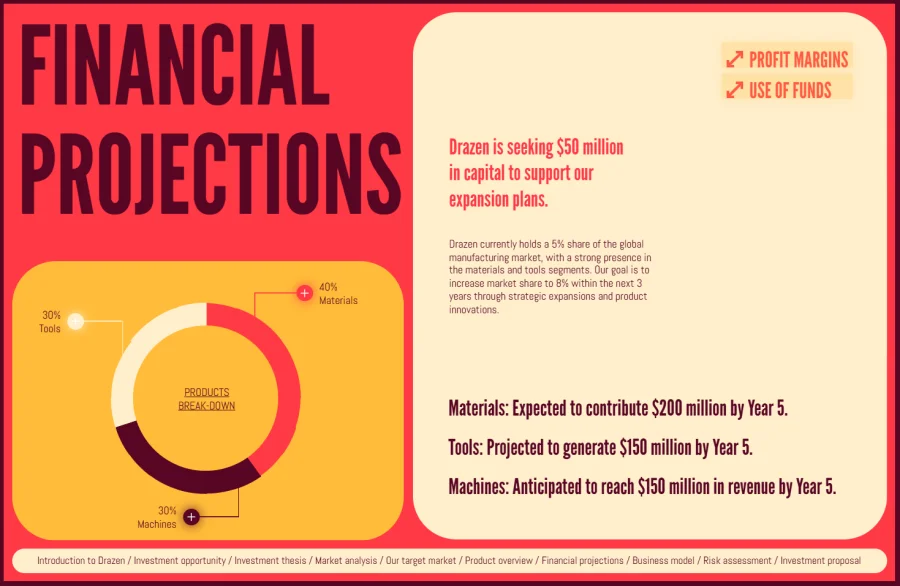
Financial projections, market data, and traction metrics can be difficult to absorb when presented as blocks of plain text.
Use charts, graphs, diagrams, and product screenshots to make the important stuff easy to grasp like in the example below. Highlight the numbers that matter most, and give every visual one clear job.
If you’re not sure how to structure your slides, start with one of these pitch deck templates, then adapt the layout, content, and visuals to your company, stage, and audience.
Keep each slide easy to scan. Ask yourself what investors should notice first, and make that the visual focus.
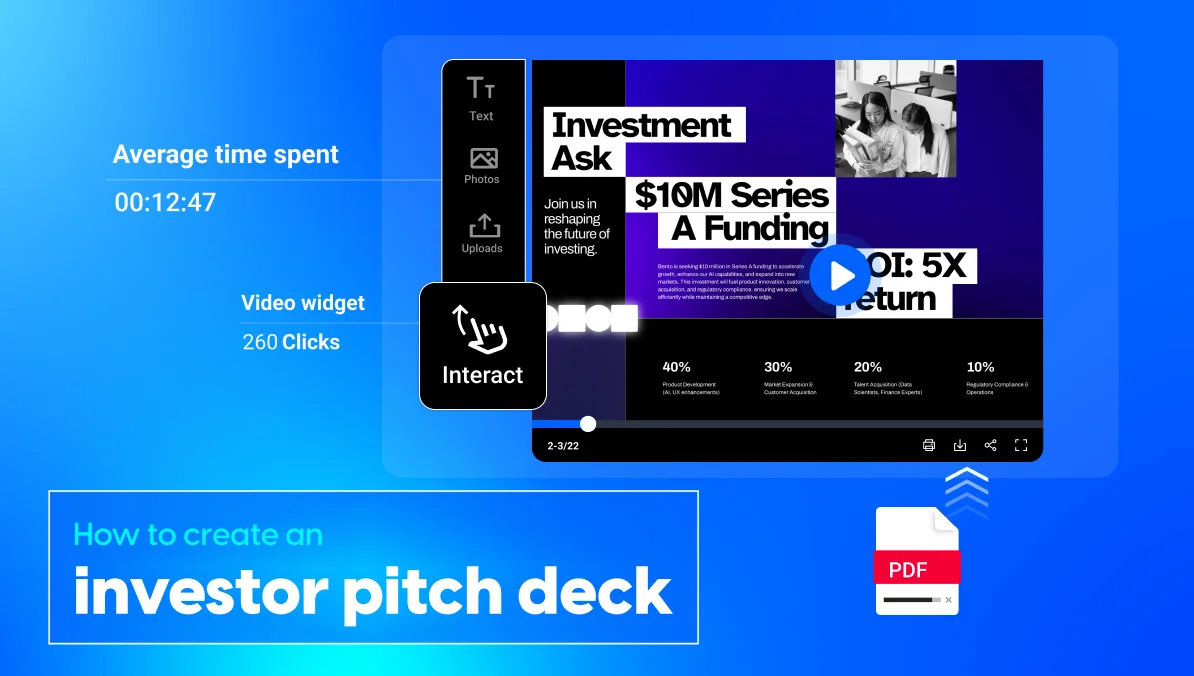
You can also add interactive elements for extra context without crowding your slides. In Flipsnack, for example, you can drop in clickable links and videos so investors can dig deeper when they want to.
6. Tailor the deck to your fundraising stage
When creating a pitch deck for investors, think about the questions they need answered before deciding whether to explore the opportunity further.
Don’t paper over missing data with information that doesn’t fit your stage. Focus on the evidence you actually have, and explain what it says about your potential.
The same principle applies to your funding ask. Make sure the amount and how you’ll use it fit your current stage and the milestones ahead.
7. Review the deck from an investor’s perspective
Before you send your deck, read it like you’re seeing the company for the first time. Run it against this checklist:
- Can a stranger tell what you do within the first 3 slides?
- Is the market size clear and credible, not just big?
- Does your traction back up the growth story you’re telling?
- Do the financial projections feel connected to real assumptions, not wishful thinking?
- Is your funding ask a specific number, not a range?
- Do your sections agree with each other? (If your market slide promises fast growth but your financials don’t match, investors will question every other number in the deck.)
And before you hit send, check for common pitch deck mistakes that can undermine an otherwise strong presentation: crowded slides, claims with no proof, numbers that don’t line up, or a funding ask that isn’t clear.
8. Prepare the deck for secure sharing
You may send the same deck to several investors, but personalize the delivery. Send each one from the person who owns that relationship instead of using a generic email blast. It’s a small touch that makes the deck feel more relevant to the recipient.
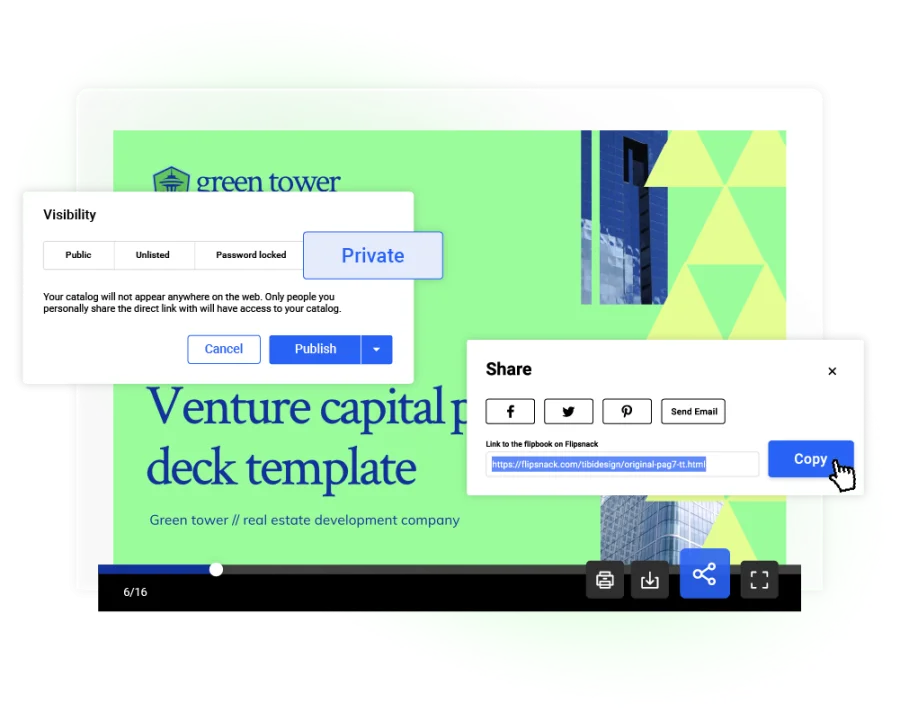
Investor decks can contain sensitive information, including financial projections, revenue data, product details, and market strategy. Instead of sending a file that can be downloaded and forwarded, consider using a private, password-protected link. Flipsnack, for example, lets you share your deck privately, control who has access, and keep everyone on the same up-to-date version.
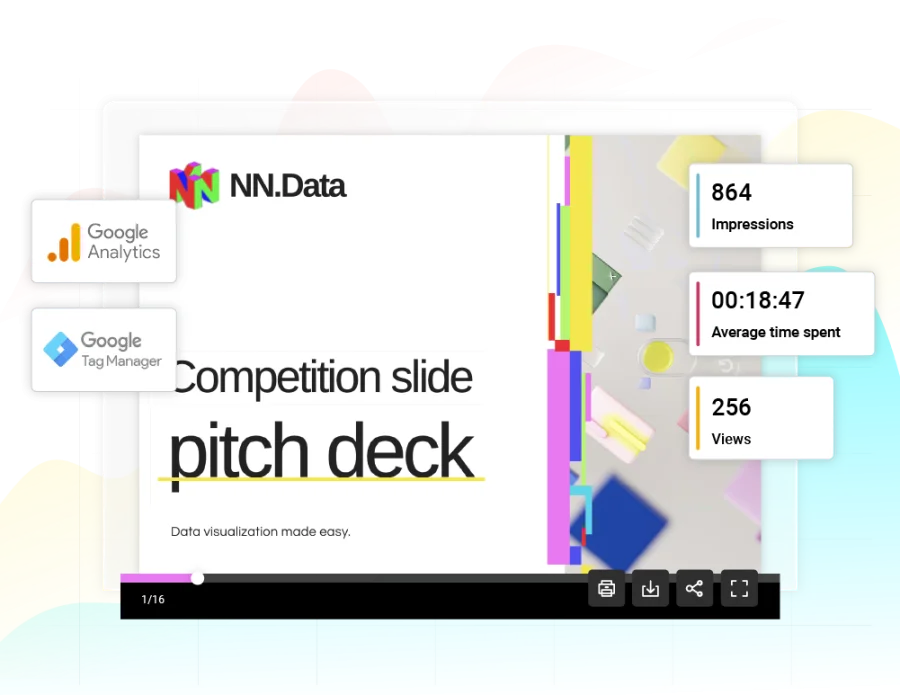
You also want to know what happens after you send your deck. With Flipsnack, you can create an individual trackable link for each investor, so you can see how that specific recipient interacts with the same presentation.
You can see when a link is opened, how often the deck is viewed, how much time the investor spends reading, and which pages get the most attention. Page-level statistics can show views, time spent, and clicks, helping you understand which parts of your deck caught an investor’s attention.
If you send your deck to five investors, for example, you’ll know how each investor engaged with the presentation and use those insights to prioritize follow-ups.
4 steps to make an investor pitch deck with Flipsnack
Once your content and story are ready, you need to decide how you’ll deliver your pitch deck to investors. A standard PDF may be enough to share the information, but it leaves you with little insight into what happens after you hit send.
Flipsnack turns your existing deck into a digital, interactive presentation that gives you more control over the entire sharing experience. You can add videos, links, and other interactive elements, share the deck privately, and have access to deck analytics.
It’s different than sending investors a file and hoping they read it. You can keep the deck up to date without resending a new file, protect sensitive fundraising information, and use engagement data for follow-ups.
To create an investor pitch deck in Flipsnack there are only four steps to follow:
1. Upload your PDF or start from scratch
Upload your existing pitch deck as a PDF, or build one from scratch in Flipsnack’s Design Studio. You can also start with a pitch deck template and customize it to match your brand.
2. Make your pitch deck interactive
Bring your deck to life with interactive elements such as videos, clickable links, charts, and slideshows. These extras add context without crowding your slides.
3. Collaborate and share your deck securely
Flipsnack gives co-founders, advisors, sales or finance teams, and other stakeholders a shared space to work on the deck together. Everyone can contribute and review changes before it goes out to investors. Once the deck is ready, you can customize the sharing link with your own domain and create a fully branded experience, so the deck feels entirely like an extension of your company.
Then share it through your website or a private link. Make it public or private, and add a password when you’re sharing sensitive fundraising details with investors.
4. Track investor engagement
Flipsnack’s statistics and named-reader analytics lets you turn your pitch deck from a file you send into a fundraising asset you can learn from. They give you insights such as, who opened your deck and which parts they explored, giving you more context for your next conversation.
Seal the deal with an impressive investor pitch deck
A great funding pitch deck tells a clear story, backs every claim with real evidence, and gives investors a reason to keep the conversation going.
Build yours with care, tailor it to the investor in front of you, and treat it as a living document that evolves with your company. That’s what turns a pitch deck into a fundraising tool investors actually act on.
Ready to put your pitch deck into practice? Build your investor pitch deck with Flipsnack, and share your vision with the investors who can help take your business to the next stage.
FAQs
Most investor pitch decks run about 10 slides, though there’s no fixed rule. The right length depends on your stage, how complex your business is, and how much proof you need to make your case. The goal is to give investors enough to evaluate the opportunity, without dumping everything you know about the company on them.
The financial details you include depend on your stage and business model. That might mean past and projected revenue, expenses, cash flow, margins, per-customer economics, burn rate, and runway. Your projections should connect to real assumptions. Investors will question forecasts that don’t match your current traction or growth plan.
A pitch deck is a short, visual presentation built to explain a business opportunity and spark investor interest. It’s much shorter than a business plan and focuses on what investors need to know fast. A business plan digs deeper. It covers operations, strategy, market research, and financial planning in more detail. It usually matters more later in the process, once investors are doing deeper research.
You don’t need a completely different deck for every investor, but some tailoring helps your pitch land better. Start by researching each investor’s industry focus, preferred stage, portfolio, and the kinds of deals they like. Then build your pitch deck template in Flipsnack, and adjust the story, examples, or proof points to fit what matters most to that investor. Keep the core facts about your company the same. Tailoring should make your deck more relevant, not change your actual investment case.