Shoppable Digital Catalogs: Engage Buyers and Drive Conversions
Last updated: March 25, 2026
You spent months perfecting your product line, competitive pricing, strong photography, and a sales team ready to close. Then you send buyers a PDF. Or a printed catalog that was already out of date the moment it left the press. Meanwhile, buyers encounter wrong prices, discontinued SKUs, and a purchasing process that asks them to close your catalog, open a browser, find your website, and then manually place an order. Every one of those steps is a conversion you’re losing. And because the catalog is static, you never even know which products they were interested in before they gave up.
The businesses pulling ahead aren’t doing more; they’re removing friction. With a digital catalog creator, their catalogs are interactive, always up to date, and let buyers go from browsing to buying in a single click. That’s exactly what a shoppable digital catalog does, and it’s what Flipsnack was built for.
Brands like Melissa & Doug used Flipsnack to cut catalog production time in half and drive a significant share of their sales directly through the catalog’s shopping feature within just the first month and a half of going live.
What is a shoppable digital catalog?
A shoppable digital catalog is an interactive online product catalog that lets buyers browse, click on products, view live pricing and availability, and complete a purchase, all without ever leaving the catalog. Unlike a static PDF or printed booklet, it functions as a fully transactional sales channel with clickable buy buttons, real-time inventory sync, and direct checkout integration. For retailers, wholesalers, and marketing teams, it means fewer lost sales, shorter buying cycles, and a catalog that actively drives revenue instead of sitting in someone’s inbox unopened.
Why static catalogs are holding back your business
Maybe by now, you feel like your business is still holding onto outdated methods that don’t match modern customer expectations. You invest in designing, printing, and distributing e-commerce catalogs, only for them to become outdated within weeks or months. Meanwhile, other companies have moved on to interactive, digital-first shopping experiences, leaving behind the cumbersome process of flipping through static pages and manually placing orders.
If your business is still relying on print catalogs, you’re likely facing these roadblocks:
- High printing and distribution costs – Producing and shipping physical catalogs is an expensive, resource-heavy process. The costs only increase when factoring in multiple versions for different product lines, regions, or languages.
- Limited reach and engagement – Traditional catalogs lack interactive features such as clickable product descriptions, embedded videos, or direct purchase links. Customers today expect shoppable experiences, and without these elements, print catalogs fail to meet modern expectations.
- Outdated product information – With print, any price updates, product changes, or availability adjustments require reprints, leading to wasted resources and lost sales when customers encounter outdated details.
- Inefficient ordering process – Traditional catalogs require buyers to manually search for products online or contact sales reps to place orders, making the process cumbersome and prone to errors.
In contrast, digital catalogs allow you to make instant updates, integrate with e-commerce platforms, and provide valuable insights into how customers interact with your catalog. Showing what products they view most to what pages they spend the most time on, helping you refine your sales strategies.
What businesses actually need from a shoppable catalog
The clearest way to understand what a shoppable catalog needs to do is to listen to the businesses already using them.
Some come in with large, complex product lines and a straightforward goal: give buyers everything they need to make a purchase decision without picking up the phone. A catalog with hundreds of products, live pricing, and a direct click-through to the product page on their website eliminates the need for a sales rep to be involved at every step. The buyer finds what they need, clicks through, and buys. That’s the whole journey.
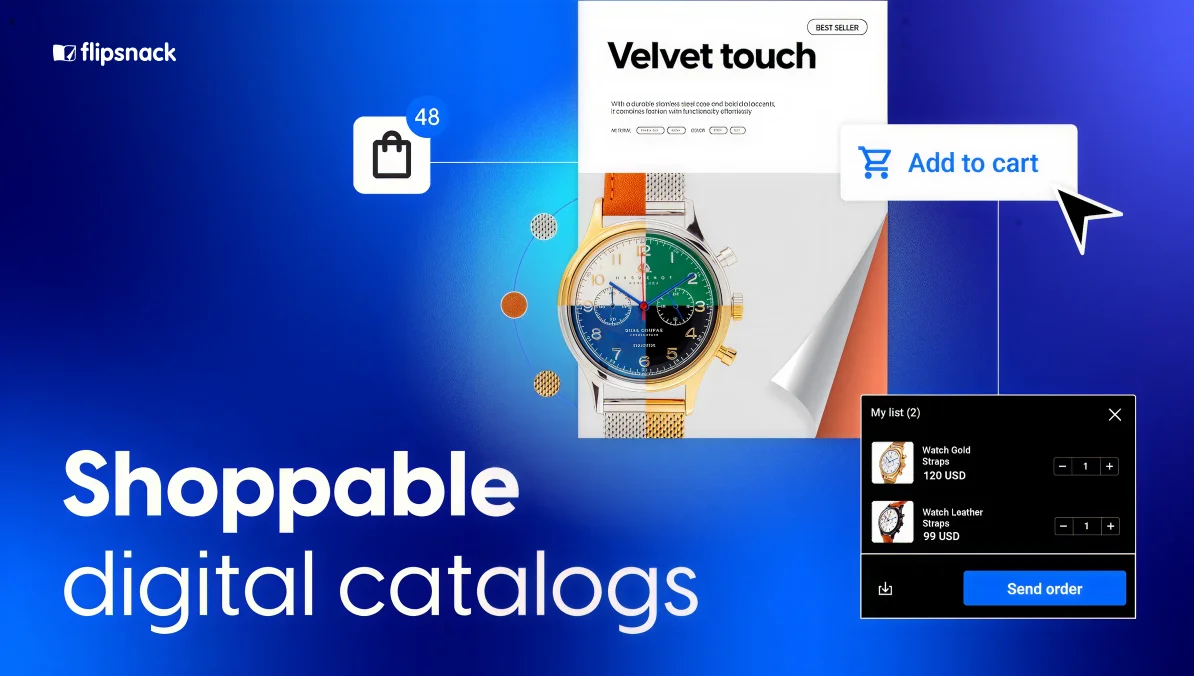
Others are running catalog-driven ordering workflows that look more like a full e-commerce experience. Melissa & Doug’s catalog, for example, is built specifically so retailers can browse items, add them to a cart, and send out an order, all from within the catalog itself. The catalog isn’t a brochure pointing somewhere else. It is the transaction.
Then some businesses have discovered that a catalog can replace the fragmented back-and-forth of traditional B2B sales entirely. A sales rep builds a curated selection of products tailored to a specific buyer, shares a single link, and the buyer browses, adds their chosen items, and sends the order back, no email chains, no spreadsheets, no miscommunication. That’s not a catalog in the traditional sense. That’s a personalized buying experience delivered at scale.
What connects all three use cases is the same underlying need: buyers want to see products, understand pricing, and act on their interest immediately. The catalog becomes the cart, the conversation, and the close, all in one place. Product catalogs have always been sales tools. The shift happening now is that the best ones are becoming transactional sales tools, where the distance between browsing and buying has been reduced to a single click.

How shoppable catalogs solved sales and workflow challenges for Melissa & Doug
Melissa & Doug, a leading children’s toy manufacturer, transformed their Specialty Sales Team’s ordering process with Flipsnack. Their goal was to make product catalogs more accessible, engaging, and efficient, eliminating the need for multiple platforms to manage product information and ordering.
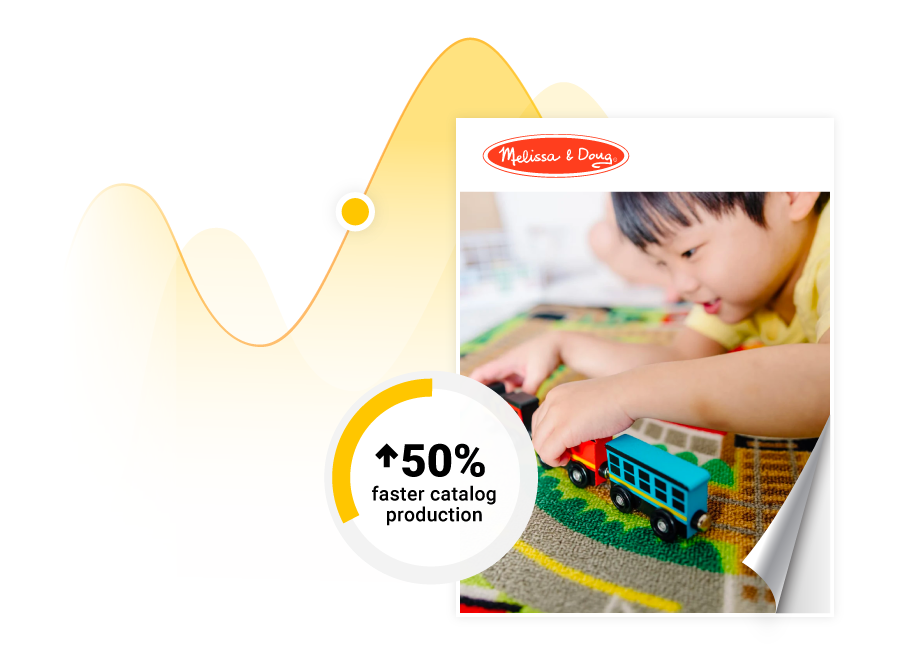
Flipsnack provided Melissa & Doug with a one-stop-shop digital catalog that housed all 700 products in an interactive format. The implementation of Flipsnack’s automation features allowed them to save 50% of catalog-creation time by automatically pulling product details into the digital catalog, reducing manual work.
Beyond efficiency, making their catalogs shoppable proved to be exactly what they needed. Within just a month and a half, a significant portion of their sales came directly from the interactive catalog, proving that a seamless digital experience can increase engagement and conversion rates.
You can see with the figures—only a month and a half since Flipsnack was live for us—a large portion of the sales in that time frame came from the shopping feature alone. The shopping feature made a huge difference and was the deciding factor for us.
Tracy Bubeck, Sales Administrator, Melissa & Doug
How to turn a PDF catalog into a shoppable link with Flipsnack
One of the most common questions marketing and sales teams ask is: “We already have a PDF catalog, how do we make it shoppable without rebuilding everything from scratch?”
With Flipsnack, the process is straightforward and requires no coding.
Step 1: Upload your existing PDF catalog
Flipsnack converts your PDF into a page-turning digital flipbook in minutes. Your existing layout, imagery, and product pages are preserved exactly as designed. If you don’t have a PDF, you can upload a product data feed (XML or CSV), and Flipsnack will automatically build the catalog structure from your existing product data.
Step 2: Add interactive product hotspots and buy buttons
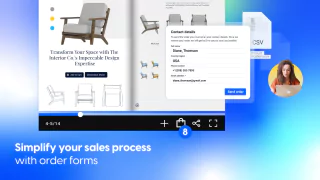
Using Flipsnack’s editor, you overlay clickable product tags directly onto product images. Each hotspot displays the product name, SKU, price, and a CTA button, whether that’s “Add to Cart,” “Request a Quote,” or “Buy Now.” This is where a static PDF becomes a shoppable catalog.
Step 3: Connect your e-commerce platform or checkout flow
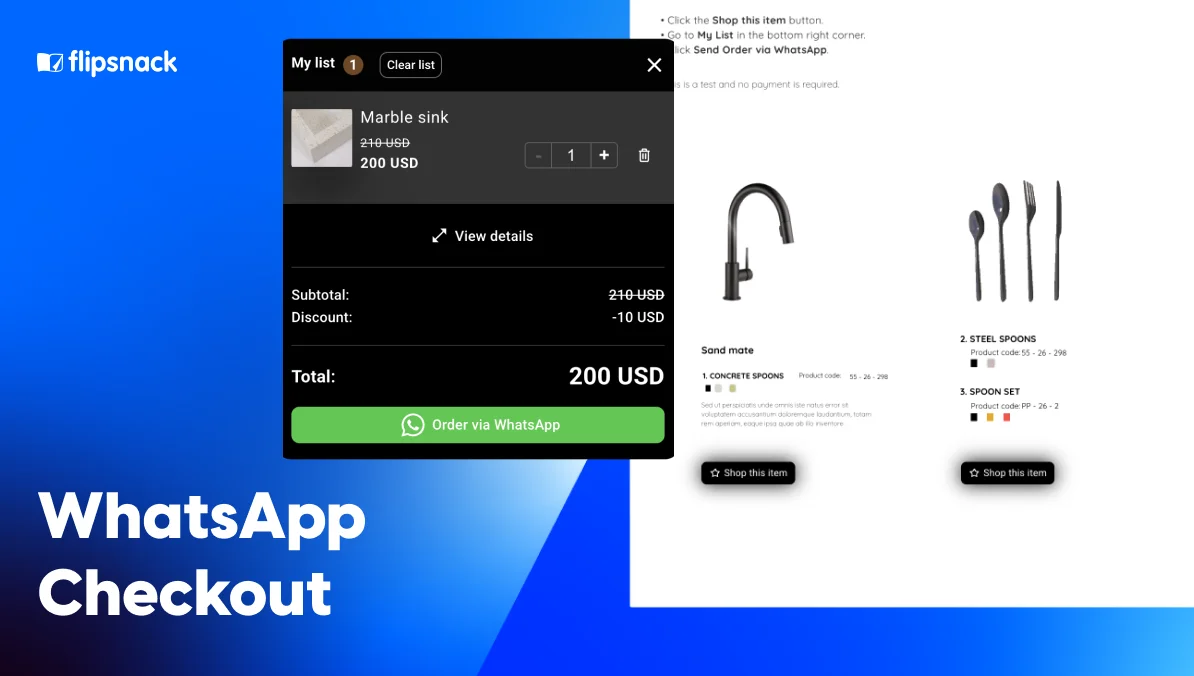
Flipsnack integrates directly with Shopify, syncing product data, inventory, and pricing automatically. For businesses not on Shopify, you can configure email checkout, WhatsApp pre-orders, or direct external links to product pages on your existing online store, no coding required.
Step 4: Publish and share your shoppable catalog link
Once live, your catalog gets a unique shareable URL. You can embed it on your website, include it in email campaigns, share it on social media, or send it directly to specific buyers. The catalog is accessible on any device, fully responsive, and optimized for mobile.
Step 5: Track performance with built-in analytics
From the moment your catalog goes live, Flipsnack’s analytics dashboard shows you which pages buyers visit most, which products get the most clicks, how long users spend on each section, and where they convert. This is the data loop that turns every catalog into a smarter version of the last one.
Here’s how to ensure your catalog delivers real business value
Drawing from the success stories of businesses that have transitioned to digital with Flipsnack. Preparing for the future involves embracing digital transformation, particularly in the form of a well-designed catalog that showcases the products in a better way, being a powerful sales tool.
Here’s how to ensure your catalog delivers real business value:
A compelling cover – Think of your catalog’s cover as the storefront window of a retail shop. It should be visually striking, informative, and aligned with your brand’s identity. Use high-quality product images, bold typography, and a strong call-to-action that entices users to explore further.
Clear product organization – A well-structured catalog mirrors an intuitive in-store shopping experience. Categories should be logically arranged, with easy-to-navigate sections. Use headers, a table of contents, and product tags so customers can quickly find the product details they need without frustration.
Interactive elements –Digital catalogs should include interactive elements like product videos, clickable product hotspots, and shoppable content. These elements keep users engaged longer and help them make informed purchasing decisions faster.

Mobile-first design – With more than half of online shopping happening via mobile devices, your catalog must be fully responsive. Optimize for fast loading speeds, easy scrolling, and touchscreen-friendly navigation. Ensure that product images, descriptions, and CTAs adapt seamlessly to various screen sizes.
Seamless checkout integration – Seamless checkout integration reduces friction by enabling users to complete purchases directly within the shoppable catalog. Businesses can choose from multiple checkout options, including email checkout, WhatsApp pre-orders, Shopify integration, and or external links to the online store.
Why now is the time to make a shoppable catalog with Flipsnack
More and more buyers are shopping online, looking for simpler, more efficient alternatives to traditional purchasing methods. Digital catalogs offer a seamless way to browse, compare, and purchase products without the hassle of managing static catalogs. As customer expectations evolve, businesses need to adapt to digital-first sales strategies to stay competitive.
Industries across the board, including manufacturing, wholesale, retail, and B2B services, are rapidly adopting interactive digital catalogs as a core component of their sales and marketing strategies.
Flipsnack offers the perfect solution by enabling businesses to create, manage, and distribute high-impact, interactive catalogs with ease. With Flipsnack, businesses benefit from:
- Lower costs – Cut printing expenses and update catalogs instantly.
- Greater reach – Share catalogs across email, social media, and websites.
- Data-driven insights – Track customer engagement and refine strategies in real-time.
With digital catalog shopping on the rise, businesses that don’t embrace digital catalogs now will struggle to compete in an increasingly digital marketplace. The solution? Choose a platform, like Flipsnack, to create, manage, and distribute high-impact, interactive catalogs.