Best Brochure Design Software in 2026: Tested, Compared, and Ranked
Last updated: October 6th, 2026
Brochure design has come a long way from its early days. What started as a simple folded piece of paper advertising goods in general stores and mail-order catalogs has evolved into a powerful marketing tool that lives both offline and online. Even today, brochures remain one of the most reliable and cost-effective ways to promote products and services.
You’ve probably come across a brochure recently, maybe in a hotel lobby, at a trade show, or even in your mailbox. But chances are, you’ve also seen one online without even realizing it. Digital brochures have become the modern standard for many businesses, offering the same impact as printed brochures but with more flexibility, interactivity, and reach, often presented in an interactive flip book format that readers can page through on any device.
That’s where brochure design software comes in. These tools make it easy to create and share brochures without the costs and limitations of printing. Whether you’re looking for a simple brochure maker with templates or a more advanced digital brochure software for professional use, there are plenty of options to choose from.
Before diving into how these tools work and which are the best brochure software solutions available, let’s start with a quick definition of what a brochure actually is.
At a glance: Which brochure software has what you need?
Not sure where to start? This table covers the features that matter most when actually making a brochure, from drag-and-drop editing and template libraries to print-ready output, interactive elements, and analytics. Scan your must-haves across the row, and you’ll have your answer in under a minute.
| Tool | Best for | Free plan | Starting paid price | Built-in analytics | G2 rating |
|---|---|---|---|---|---|
| Flipsnack | Design, publish, and track | Yes (5 flipbooks) | $38/month ($456/year) | Yes, plus Google Analytics integration | 4.7/5 (413) |
| Adobe InDesign | Advanced print layout | Not listed | $22.99/month (annual plan, billed monthly) | Not listed | 4.6/5 (3,439) |
| Canva | Beginners on a budget | Yes | $144/year per person (about $12/month) | Ad performance tracking only | 4.7/5 (7,717) |
| Venngage | Interactive brochures | Yes (5 designs) | $10/month (billed yearly) | No native dashboard | 4.7/5 (134) |
| Marq | Brand consistency | Yes (1 user, 3 projects) | $10/month (billed yearly) | Paid add-on | 4.5/5 (210) |
| Visme | Fast interactive design | Yes | $12.25/month ($147/year) | Pro and Enterprise only | 4.5/5 (510) |
| Piktochart | Infographic teams | Yes | $14/month (billed yearly) | Not advertised | 4.4/5 G2 (162), 4.7/5 Capterra (198) |
| FlippingBook | Quick PDF flipbooks | No (14-day trial) | $20/month ($234/year) | Yes | 4.7/5 (298) |
A brochure is a type of marketing collateral, either printed or digital, that informs readers about a product or service in a visually appealing, straightforward manner. Brochures differ from flyers in that they are multi-page documents, typically in trifold, bifold, or booklet format, designed for deeper information sharing rather than quick announcements.
Flyers are single-page materials designed to grab attention at the top of the funnel. Brochures are used at the middle or bottom of the funnel to inform and persuade prospects who already have awareness of your brand. Digital brochures go further, still adding interactivity, lead tracking, and instant online distribution.
Table of contents
- At a glance: Which brochure software has what you need?
- What is brochure design software, and why are the best options digital-first?
- Why businesses are switching from print to digital brochures
- Key features to look for in digital brochure software
- How we evaluated these tools
- The 6 best brochure design software tools
- 1. Flipsnack: End-to-end digital publishing platform for brochures
- 2. Adobe InDesign: Best for advanced design control
- 3. Canva: Best brochure maker on a budget
- 4. Venngage: Most versatile brochure maker
- 5. Marq (formerly Lucidpress) : Best brochure maker for small companies
- 6. Visme : Best brochure maker for fast design
- 7. Piktochart: Best for teams already using it for infographics
- 8. FlippingBook: Best for a fast, page-turn digital brochure
- A closing word about digital brochure makers
- FAQ about brochure software
What is brochure design software, and why are the best options digital-first?
Brochure design software is a creative tool that helps you plan, design, structure, and publish brochures — whether printed or digital — quickly and efficiently. Traditionally, marketers relied on complex desktop publishing programs like Adobe InDesign or QuarkXPress to create precise print-ready layouts. These tools were powerful but time-consuming, expensive, and limited to static designs.
Modern digital brochure software goes much further. It combines drag-and-drop editors, ready-made templates, cloud-based collaboration, and digital publishing capabilities — making brochure creation accessible to anyone, not just professional graphic designers.
With the right brochure creation software, you can:
- Track viewer engagement, page-by-page analytics, and lead tracking data through built-in analytics dashboards
- Design engaging, on-brand brochures directly in your browser
- Add interactive elements — clickable links, embedded videos, animations, image galleries, and buttons
- Publish via shareable link, embed on your website, or distribute through email, QR codes, and social media
- Update content at any time without reprinting
Why businesses are switching from print to digital brochures
For decades, printed brochures were the standard way to showcase products, promote services, and build trust with customers. But as marketing strategies and customer expectations have evolved, more and more companies are replacing stacks of printed brochures with sleek, interactive digital brochures created and distributed online.
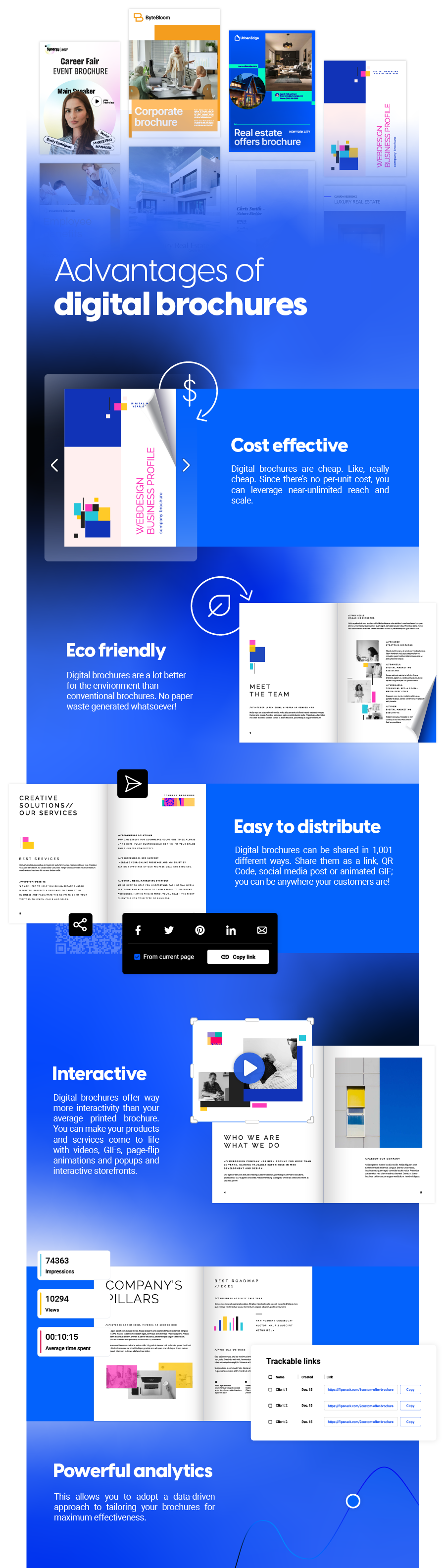
This shift focuses on making smarter, more efficient marketing decisions. Digital brochure software offers clear advantages that printed materials simply can’t match:
- Lower costs – No printing, shipping, or reprinting expenses. A single online brochure can be shared instantly and updated at any time.
- Faster distribution – Instead of waiting for a print run, businesses can publish a brochure online in minutes and share it worldwide.
- Engaging interactivity – Digital brochures allow you to embed links, videos, animations, and other elements that make the content more dynamic and persuasive.
- Real-time updates – If information changes, you don’t have to reprint. Simply edit the digital file and your audience sees the new version immediately.
- Performance tracking – With built-in analytics, brochure publishing software helps you see how readers engage with your content, from clicks to time spent on each page.
- Sustainability – Reducing paper use supports environmental goals, which many businesses now consider a priority.
By shifting their brochure strategy online, companies gain more control, reach, and flexibility — while cutting costs and staying environmentally responsible.
Digital brochures are expanding what brochures can do. Instead of a static handout, a brochure becomes a living, measurable marketing asset.
However, we don’t want to be ignorant of a few exceptions where a printed brochure is the right choice. As an example, if you own a travel agency in a small town, you might want to focus on conventional brochures.
Key features to look for in digital brochure software
Not all brochure design software is created equal. While traditional tools focus mainly on layout and print, modern digital brochure software is built to help businesses create, distribute, and track brochures entirely online. Whether you’re a marketer, designer, or business owner, choosing the right tool starts with knowing which features truly matter.
1. Templates and ease of use
A great brochure maker should make creation fast and intuitive. Look for pre-designed templates across trifold, bifold, and booklet formats, alongside drag-and-drop editors and flexible layout options that let anyone create professional results without advanced graphic design skills.
2. Interactivity and multimedia elements
The best tools let you add interactive elements, like clickable links, embedded videos, image slideshows, animations, iframe codes, buttons, and maps turning a static pamphlet into a measurable, immersive experience.
3. Online publishing and distribution
Unlike print, digital brochures can be shared instantly. A strong brochure publishing software solution lets you generate shareable links, let you embed brochures on websites, and distribute via email, social media, and QR codes, all without downloading or printing anything.
4. Real-time editing and version control
Version history, instant content updates, and real-time editing ensure your audience always sees accurate information, especially important for product catalogs, property listings, and pricing pages.
5. Analytics and lead tracking
Analytics dashboards show total views, page-by-page analytics, click tracking, and lead tracking data. This is the single biggest advantage digital brochure software has over print — and most businesses underuse it.
6. Collaboration and security
For larger teams, shared editing, role-based access control, and version history keep workflows clean and brand assets protected. For businesses with stricter IT requirements, 2FA and SSO ensure only the right people have access.
7. Brand kit and asset management
A brand kit stores your fonts, logos, color palettes, and reusable components so every brochure stays on-brand without rebuilding from scratch each time.
How we evaluated these tools
Before selecting the tools featured in this list, it was important to define clear and objective criteria. Since brochures have evolved far beyond traditional print, the focus here is on identifying digital brochure software that can truly meet the needs of modern businesses.
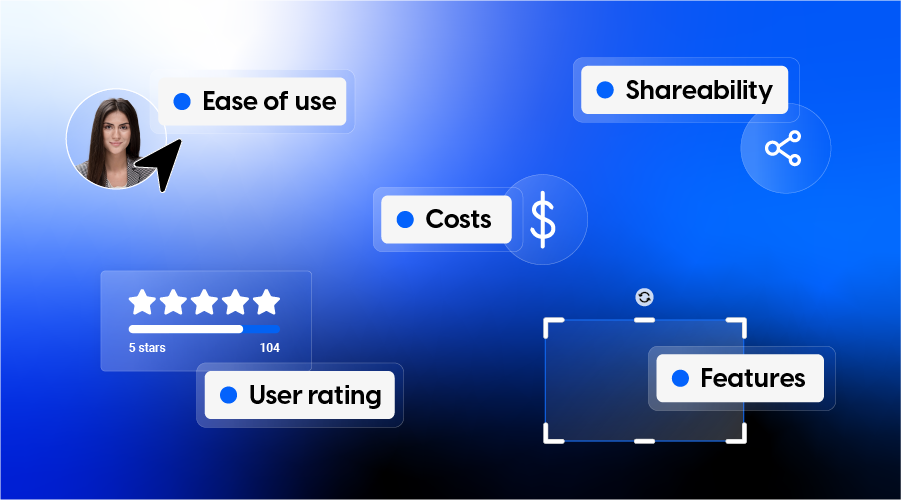
The tools included in this roundup were evaluated based on five key factors:
- Cost: How much a subscription or license to use the software costs
- Features: What features does the software offer, and how useful are they?
- User ratings: The average user rating on Capterra and G2
- Ease of use: How intuitive and efficient the interface of the software is.
- Shareability: How easy it is to distribute brochures made with the software
Other elements, such as customer support, scalability, and integration options, also played a role in the decision-making process. However, these five factors were the primary considerations in determining which brochure maker software stood out as the most effective and user-friendly options on the market.
The 6 best brochure design software tools
For this section, I’m going to be taking a look at what I believe are the best brochure makers on the market. Each of these software solutions has its own strengths and weaknesses, but all of them do at least one thing very well.
1. Flipsnack: End-to-end digital publishing platform for brochures
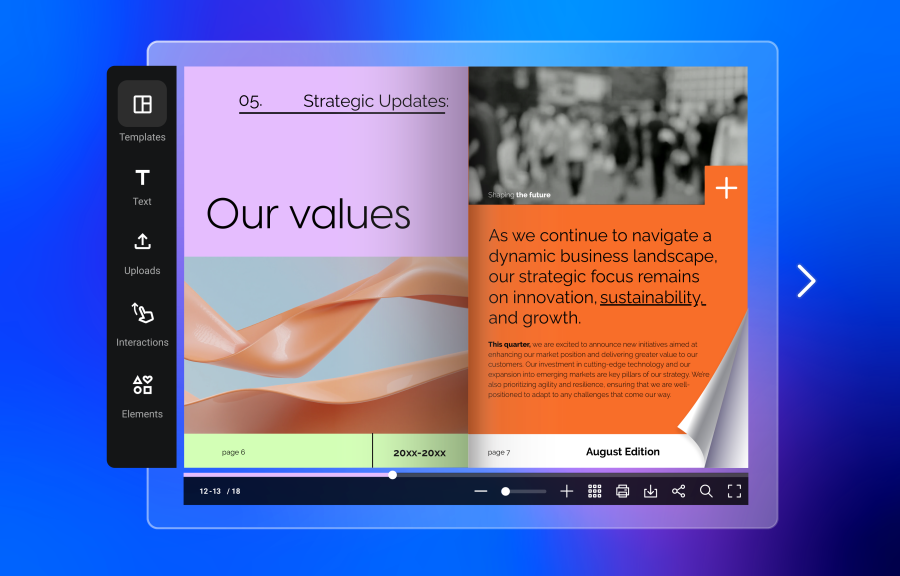
If your goal is to create interactive digital brochures that you can publish, share, and actually measure, Flipsnack is the strongest option on this list. It’s built specifically for the full digital publishing lifecycle, from design to distribution to analytics.
Used by:
Pandora, Delta, Electrolux, Converse, Marriott, Radioshuttle
Why professionals choose Flipsnack:
- Drag-and-drop Design Studio with a wide variety of professionally designed templates
- Convert existing PDFs into interactive brochures in minutes. You can edit the PDF directly inside Flipsnack; there’s no need for the original source file
- Add clickable links, embedded videos, image slideshows, and iframe codes
- Publish via direct shareable link, embed on your website, or distribute through email and social media
- Built-in analytics dashboard to track viewer engagement, page-by-page performance, and lead tracking
- Team collaboration features, role-based access control, and secure cloud hosting
- CSV automation for product catalogs and a high-variable content QR code generator for bridging print and digital
- AI-powered tools: one-click flipbook translation, AI Animate for images, MLS-to-brochure automation, and analytics turned into plain-text recommendations
- Export print-ready PDF with full CMYK formatting and 300 DPI resolution, and bleed and crop mark controls for precise professional printing
- Full brand kit control — store your logos, color palettes, custom fonts, and brand assets in one place
Plus integrations, to make the transition in your workflow better: HubSpot, Salesforce, Zapier, and MLS for real estate listing, Marq.
Why Flipsnack?
Flipsnack covers the whole brochure workflow in one place. Design from a template or a blank canvas, edit an existing PDF without going back to the original file, then publish with analytics, lead-capture forms, and print-ready PDF or HTML5 download. At the top tier, Catalog Generator automates product feeds, and SAML SSO with SOC 2/ISO 27001/HIPAA-aligned compliance covers regulated teams.
Who is it for?
Marketing teams, sales departments, real estate professionals, eCommerce businesses, and teams across retail, travel, education, and B2B marketing that want to create and distribute brochures entirely online.
Pricing (billed yearly): Free (5 flipbooks, 15 pages each); Pro $38/month ($456/year); Business $85/month ($1,020/year); Enterprise custom.
Reviews
Capterra: 4.6/5 stars
G2: 4.7/5 stars
2. Adobe InDesign: Best for advanced design control
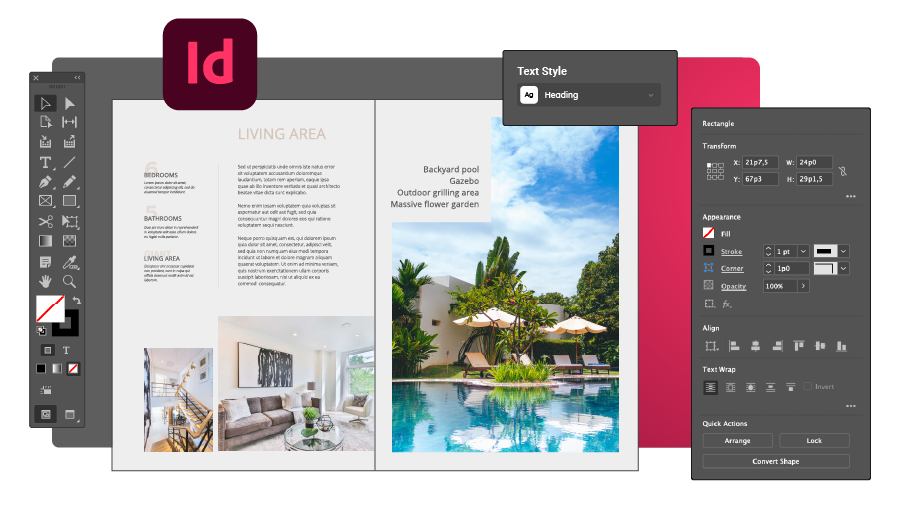
Adobe InDesign is a well-established brochure design software that offers unmatched precision and creative freedom. It’s a preferred tool for professional designers who want complete control over layout, typography, and branding.
Notable features:
- Professional-grade design and layout tools
- Industry standard for publication design
- Supports both print and digital exports (including interactive PDFs)
- Advanced typography and style management
- Seamless integration with the Adobe Creative Cloud ecosystem
Why InDesign?
InDesign remains the reference point for professional print layout: CMYK precision, master pages, long-document tools like running indexes, and pixel-level control nothing else on this list matches.
Where it gives ground:
Adobe’s plans page doesn’t detail any built-in web publishing, analytics, or sharing, so you export and distribute through something else. The learning curve is real for anyone without design training.
Who is it for?
Experienced designers, creative agencies, and marketing teams with in-house design expertise.
Pricing: Standalone $22.99/month (annual plan, billed monthly). Creative Cloud Pro bundle currently $34.99/month for 3 months, then $69.99/month. Team licensing from $37.99 to $99.99/month per seat.
Reviews
Capterra: 4.8/5
G2: 4.6/5
3. Canva: Best brochure maker on a budget
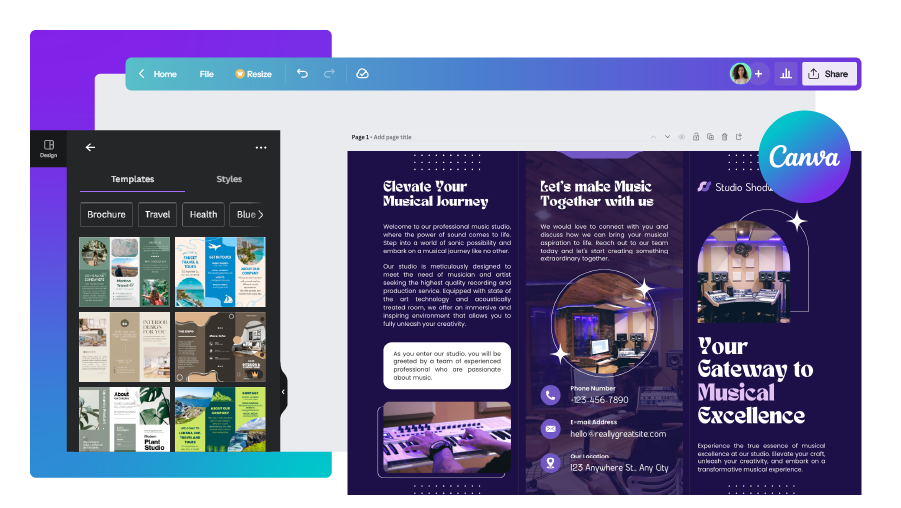
Canva is a widely used brochure maker known for its accessibility and large template library. It enables users to design attractive brochures quickly, even without a design background.
Used by:
Berkshire Hathaway, HubSpot, Skyscanner, UNHCR, USA Today, Moneytree
Notable features:
- Drag-and-drop interface with thousands of templates
- Extensive library of fonts, icons, and graphics
- Share as link, embed in email, embed on website, share on socials
- Lots of interactivity, including interactive buttons, videos
Why Canva?
Canva’s template library runs past 3.6 million designs on paid tiers, and it’s still the fastest on-ramp for someone with zero design background.
Where it gives ground:
Print-ready CMYK export is gated to Pro and above, so free users can design but not finish a file for a print shop. Its analytics cover ad performance tracking, not engagement on a shared brochure.
Who is it for?
Non-profits, schools and universities are a large target demographic, as many are eligible to claim free access to the tool.
Marketers are also among its target audience, although not the sole focus of the tool itself. It’s distinctly multi-purpose; whether you’re a college student or a CMO, there’s a good chance you can use this one on a daily basis.
Pricing: Free; Pro $144/year (about $12/month) per person; Business $250/year per person; Enterprise custom.
Reviews
Capterra: 4.7/5 stars
G2: 4.7/5 stars
4. Venngage: Most versatile brochure maker
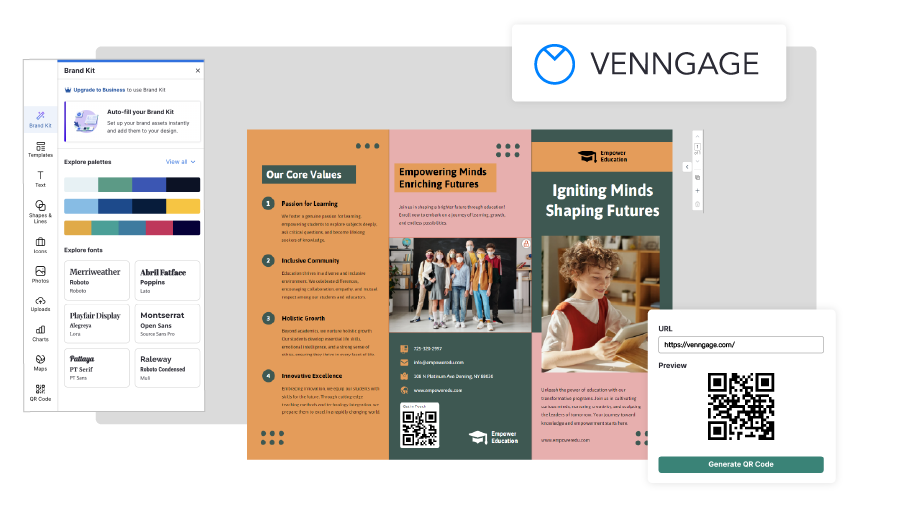
With over 2 million monthly visitors, Venngage is a major player in the digital brochure maker space. Known for its versatility, it offers a wide selection of templates and a flexible editor that makes it easy to design both digital and print materials.
Used by:
The New York Times, AirBnB, Google, HubSpot
Notable features:
- Intuitive drag-and-drop interface with extensive template options
- Wide variety of data-visualization elements such as charts, icons, and infographics
- Online publishing with shareable links and embed options
- Collaboration tools for team projects
- Brand kit features for consistent visual identity
- QR code creator
Why Venngage?
Venngage has moved past pure infographics into a multipurpose platform. It includes interactive elements (quizzes, checklists, expandable widgets, forms) at mid tiers that most competitors reserve for higher ones.
Where it gives ground:
No native analytics dashboard is listed on its pricing page. Tracking engagement means pairing it with an outside tool like Google Analytics, Mixpanel, or Hotjar.
Who is it for?
In my opinion, Venngage is best suited for marketing teams who intend to use print and digital media simultaneously. The collaboration tools are quite good, and its versatility makes it a very good option for companies looking to keep all of their marketing designs in one place.
Pricing: Free (5 designs); Premium $10/month billed yearly ($19 month-to-month); Business $24/month per user (yearly), Enterprise from $499/month, 10-seat minimum.
Reviews
Capterra: 4.6/5 stars
G2: 4.7/5 stars
5. Marq (formerly Lucidpress): Best brochure maker for small companies
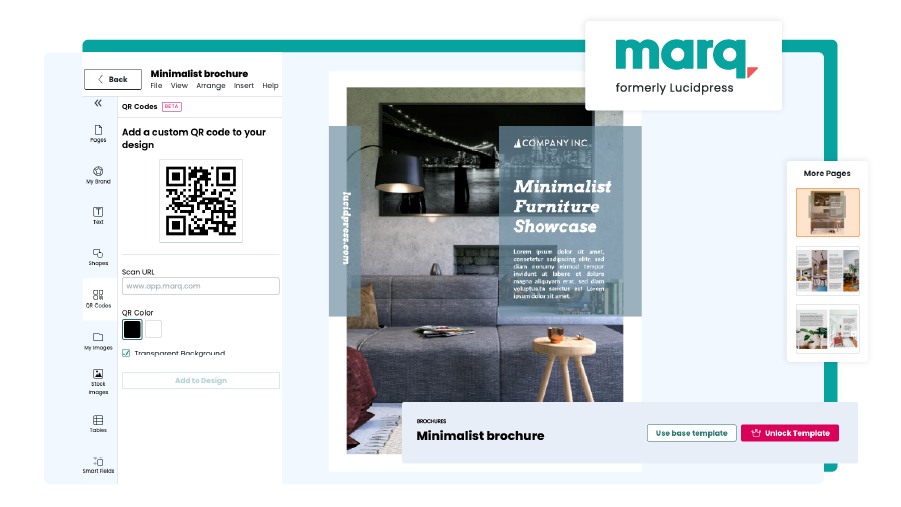
Marq takes a more focused approach than some of the bigger names in this space. Positioned as an all-in-one content marketing solution, it’s designed to give small businesses powerful branding and publishing tools without requiring a big marketing budget.
Used by:
Reinhart Realtors, D1 Training, Berkshire Hathaway, Yext
Notable features:
- Easy-to-use design studio with intuitive editing tools
- Interactive buttons, links, and video embedding
- Built-in stock photo library
- Multiple export formats (PDF, PNG, JPG)
- Online publishing and sharing (link, email, website, social media)
- QR code generator
- Smart fields and branding suite for consistent assets
- Secure platform with 2FA and SSO options
Why Marq?
Marq, formerly Lucidpress, is built to stop brand drift across a distributed team. Template locking keeps a regional office or a new rep from shipping an off-brand brochure, and “Print & Ship” comes with every tier.
Where it gives ground:
Analytics cost extra: “Basic Analytics” is a paid add-on on Team plans and “Advanced Analytics” is Enterprise only.
Who is it for?
Small businesses and growing companies that need a practical, affordable solution for designing and distributing brochures without heavy design or IT resources.
Pricing: Free (1 user, 3 projects); Pro $10/month billed yearly; Team $10/month per user billed yearly, 2 to 20 users; Enterprise custom.
Reviews
Capterra: 4.6/5
G2: 4.5/5
6. Visme: Best brochure maker for fast design
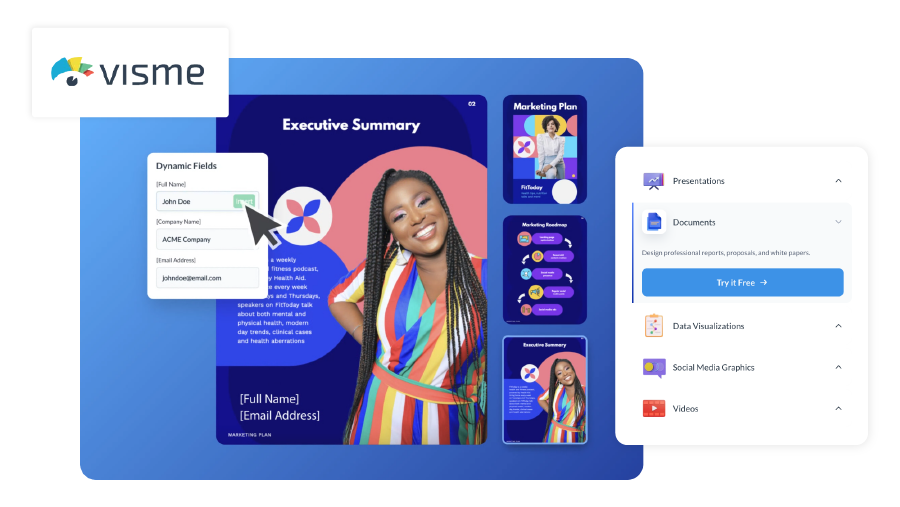
Visme is a digital brochure software built to help teams create visually engaging brochures quickly. It combines a large template library with customization tools, branding settings, and real-time collaboration features, making it ideal for fast turnarounds.
Notable features:
- Easy-to-use drag-and-drop editor
- Extensive library of templates, graphics, and icons
- Brand kit with fonts, logos, and color palettes
- Real-time collaboration and commenting
- Export as PDF or interactive digital formats
- Online sharing via links or embedding
Why Visme?
Visme’s interactivity goes further than most of this list at its entry paid tier: video and audio hotspots, animation timelines, and up to 10 third-party integrations on Starter.
Where it gives ground:
Analytics are gated to Pro and Enterprise, so the cheapest paid tier gets the interactive features without the tracking to see whether anyone engages with them.
Who is it for?
Ideal for marketers, small business owners, educators, and content creators who want to design brochures without advanced design skills. It’s also great for teams needing branding consistency and quick turnaround times.
Pricing: Free (Basic); Starter $12.25/month ($147/year); Pro $24.75/month ($297/year); Enterprise custom, with discounted student, educator, and nonprofit rates.
Reviews
Capterra: 4.5/5
G2: 4.5/5
7. Piktochart: Best for teams already using it for infographics
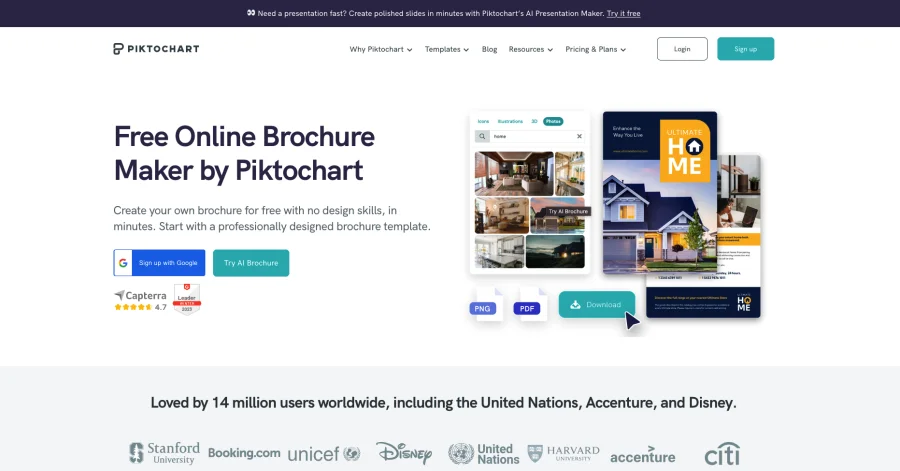
Piktochart is a Swiss army knife design tool that mainly focuses on creating infographics and other visuals that contain large amounts of copy.
Used by:
Standford University, Booking.com, CitiBank
Notable features:
- Dedicated AI brochure maker
- Brochures live in the same account as infographics, reports, and social graphics
- PNG export on the free plan; PDF export on Business, Education, and Nonprofit Pro tiers
- Font and color customization
Notable features:
- Dedicated AI brochure maker
- Brochures live in the same account as infographics, reports, and social graphics
- PNG export on the free plan; PDF export on Business, Education, and Nonprofit Pro tiers
- Font and color customization
Why Piktochart? Piktochart built its name on infographics and data visualization, and its brochure tools, including an AI brochure maker, live inside that same account. A team that already uses it for reports or social graphics has no new tool to learn.
Who is it for? Teams that already work in Piktochart and want brochures without adding another tool. [Confirm audience wording with the team]
Where it gives ground: PDF export for print is reserved for Business, Education, and Nonprofit Pro tiers, so free users get PNG only. Its product pages don’t advertise interactive elements, analytics, or team collaboration.
Pricing: Free; Pro $14/month billed yearly.
Reviews:
Capterra: 4.7/5
G2: 4.4/5
8. FlippingBook: Best for a fast, page-turn digital brochure
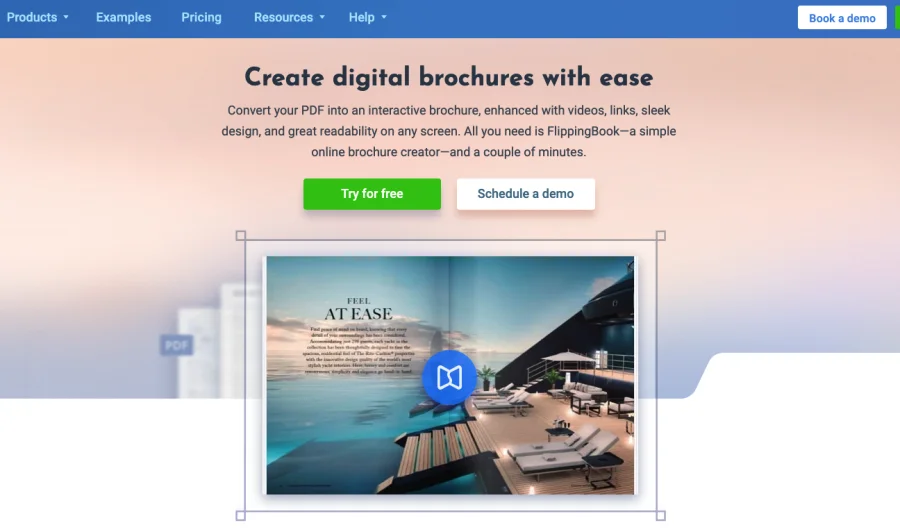
FlippingBook converts an existing PDF into a page-turning online brochure, with options to add video, forms, and basic engagement tracking. It starts from an uploaded file rather than a blank canvas, so the design itself needs to be done elsewhere.
Used by:
NHS, Intel, Nestle
Notable features:
- Page-flip effect on an uploaded PDF
- Embedded video, forms, and lead capture
- Analytics: opens, page views, clicks, visitor geolocation, device type
- Branding: logos, colors, backgrounds
- Sharing by link, QR code, social, or embed code; PDF download
Why FlippingBook?
FlippingBook turns a PDF into an interactive, page-flipping brochure. Real analytics come built in even at the entry tier: opens, page views, clicks, visitor geolocation, and device type.
Who is it for?
Sales and marketing teams that already have a finished PDF and want a fast digital version without designing anything new. [Confirm audience wording with the team]
Where it gives ground:
It starts from an uploaded PDF, and print-ready export isn’t listed as a feature. Collaboration (shared folders, multiple users) only unlocks at the $257/month Team plan and above.
Pricing:
Lite $20/month ($234/year annual), up through five more tiers to Team at $257/month; Enterprise custom. No free plan, but a 14-day trial needs no credit card.
Reviews:
G2: 4.7/5
A closing word about digital brochure makers
Brochures have evolved from simple printed handouts into powerful, interactive digital publishing assets. The right brochure design software makes it easier than ever to design, publish, and share marketing materials that reach audiences instantly — without the costs and delays of print.
The best choice isn’t always the most popular one. It’s the one that matches your workflow, your team’s skill level, your distribution strategy — whether that’s embedding a brochure on a landing page, sending a flipbook link in an email campaign, generating a QR code for a trade show, or producing print-ready sales collateral for a product catalog.
If you want the most complete digital publishing solution on this list, Flipsnack gives you everything: interactive brochures, viewer engagement analytics, lead tracking, and team collaboration — in one platform built for modern marketing teams.
FAQ about brochure software
Flyers are short, single-page marketing materials designed to grab attention and generate interest at the top of the funnel. They usually contain a brief message, a clear CTA, and minimal product details.
Brochures are longer and more detailed. They’re typically used at the middle or bottom of the funnel to inform and persuade potential customers who already know about your product or service. Digital brochures take this a step further by adding interactivity, analytics, and instant online distribution.
Yes. Brochures remain a proven marketing tool when used strategically. They help educate and convince potential customers who are already interested in a product or service.
Digital brochures are especially effective because they’re easy to distribute, cost less than print, can be updated in real time, and allow you to track engagement. They work well alongside email campaigns, landing pages, and other digital marketing assets.
Digital brochures are faster to produce, cheaper to distribute, and more sustainable than printed materials. They can include interactive elements like links, videos, and animations, which makes them more engaging. Plus, with built-in analytics, you can see exactly how readers interact with your content — something print can’t offer.
Digital brochures are widely used across industries:
• Real estate – for property listings and virtual tours
• Retail and eCommerce – for product catalogs and promotions
• Education – for program overviews and event materials
• Travel and hospitality – for destination guides and service packages
• B2B marketing – for presentations, sales collateral, and proposals
The best brochure design software depends on your goals:
• Flipsnack – best for creating, publishing, and sharing interactive brochures online.
• Adobe InDesign – best for professional designers who need advanced layout control.
• Canva – best for quick, template-based designs.
• Marq – best for maintaining brand consistency across teams.
For most businesses looking for a complete digital publishing solution, Flipsnack offers the best balance of ease of use, interactivity, and distribution features.
Yes. With digital brochure software like Flipsnack, you can see how many people viewed your brochure, how long they spent on each page, and where they clicked. These insights help you understand what content resonates and can directly inform your marketing strategy.
Yes. Simply sign up for a free account, choose from hundreds of professionally designed brochure templates, and start customizing right away using the drag-and-drop Design Studio. You don’t need to be a graphic designer. Flipsnack is built for anyone to create polished, on-brand brochures from scratch or by uploading and editing an existing PDF. From choosing your layout and color palette to adding your logo, images, and interactive elements, the entire process happens in your browser with no software to install.
If you want to skip the Adobe subscription and steep learning curve, Flipsnack is a strong alternative. You get professional brochure templates, drag-and-drop editing, full CMYK support, bleed and crop mark controls, and 300 DPI print-ready PDF export, plus digital publishing, analytics, and team collaboration that InDesign simply doesn’t offer. Start free and upgrade only when you need to.
With Flipsnack, this is handled for you. Choose a pre-designed trifold or bifold template; margins, gutters, and bleed areas are already set up correctly. When ready, export a print-ready PDF with CMYK, bleed, and crop marks already applied. No cut-off text, no white edges, no surprises.