Free Objection Handling Templates for Sales Reps, Managers & Enablement Teams
Updated on: April 22, 2026
What is an objection handling template?
An objection handling template is a structured document. It gives sales reps and managers a consistent framework for preparing and responding to prospect concerns at every stage of the sales cycle. Instead of relying on scattered notes or gut instinct, these templates standardize your best responses. They make that knowledge available to everyone on the team, every time.
In sales, objections aren’t obstacles. They’re signals. Research shows that 67% of lost deals trace back to unaddressed objections. And sellers who handle objections well can reach close rates as high as 64%. The difference between reps who convert concerns into closed deals is almost always prep. Prep needs structured docs, not just experience.
With dynamic objection handling templates, teams can go further than static scripts. You can embed video responses, competitive contrasts, ROI calculators, and live coaching tools. The result is objection handling that’s both consistent and genuinely persuasive.
Table of contents
- How to build objection-handling resources that actually change outcomes
- Choose your ideal objection handling template
- What customers say about Flipsnack templates
- 1. Objection handling presentation template
- 2. Competitive objection handling template
- 3. Customer feedback objection template
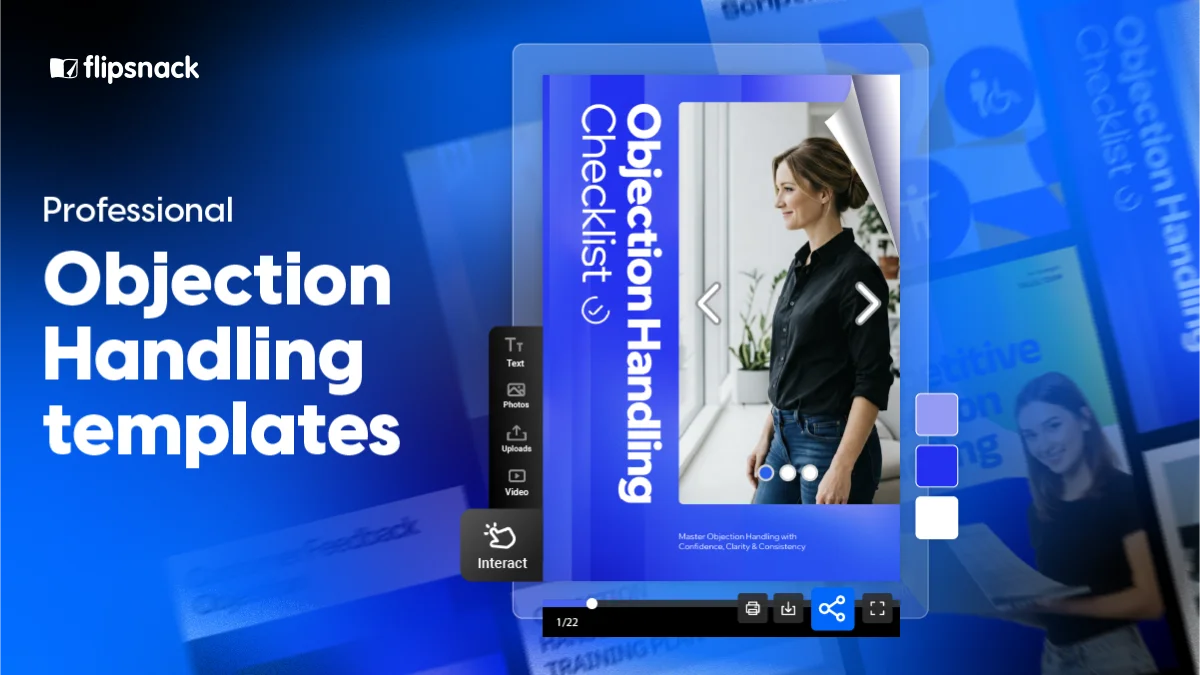
- 4. Objection handling checklist template
- 5. Objection handling script template
- 6. Objection handling training plan template
- 7. Objection resolution framework template
- 8. Objection response script template
- 9. Pricing objection handling template
- 10. Closing objection handling template
- How to edit objection templates in Flipsnack
- Why Flipsnack makes objection handling easier and better
- Frequently asked questions about objection handling templates
How to build objection-handling resources that actually change outcomes
Most sales teams have some version of objection handling docs. A shared Google Doc. A slide in the onboarding deck. A list of scripts nobody updates. The problem isn’t having these resources. It’s that they’re static, scattered, and disconnected from how reps actually work.
High-performing sales teams are 2.3x more likely to use structured playbooks to address objections, according to Salesforce. The reason is simple. Structured prep leads to consistent action. And consistent action at scale is what moves revenue.
In this guide, you’ll see what makes each type of objection handling template work. You’ll learn when to use each format. And you’ll see how to build dynamic objection resources in Flipsnack that reps will actually use, not just file away after training.
Types of objection handling templates: the complete landscape
Before picking a template, it helps to understand where each one fits. Effective sales teams don’t just have one script. They have structured resources for every objection type, every deal stage, and every use case.
Here’s a map of the full landscape, organized by function:
Objection type templates
Pricing objection templates, competitive objection templates, timing objection resources, and need and fit objection frameworks. These cover the four most common objection types: Budget, Authority, Need, and Timing (BANT). They give reps tailored responses instead of generic scripts that prospects see through right away.
Response frameworks & scripts
Objection handling script templates, objection response script templates, and objection resolution framework templates. These give reps structured language for live calls. Not lines to memorize, but flexible frameworks that stay on brand while allowing real personalization.
Training & development
Objection handling training plan templates and objection handling checklist templates. These prepare reps before they’re in front of prospects. They use role-play, clear criteria, and structured practice. The goal is to build confidence so objection handling feels natural, not rehearsed.
Customer-facing & pitch resources
Objection handling pitch templates, competitive objection templates, customer feedback objection templates, and closing objection templates. These support live and async customer talks. They turn objection responses into persuasive, evidence-backed exchanges.
The templates in this article cover the most important categories. From rep prep and training through live pitches and closing. All fully customizable in Flipsnack.
Common objection handling mistakes to avoid
Even experienced reps and training teams make the same mistakes. Here’s what to watch for before you start:
Treating objections as attacks
The most common mistake is responding defensively. Arguing back, over-explaining, or rushing to discount. Objections are a signal. They tell you what a prospect needs to move forward. The right response is curiosity, not defense. Ask open questions to understand the real concern before you respond.
Jumping in before you understand the objection
Many reps hear a familiar pattern and launch right into a rehearsed answer. But surface-level objections often hide deeper concerns. “It’s too expensive” might mean “I don’t see the ROI” or “I don’t have budget approval.” Confirm what the prospect actually means before you respond.
Discounting as the default response to price objections
Offering a discount right away signals that your price wasn’t justified. It also shifts the talk from value to cost. That’s the wrong frame for any pricing discussion. The right response is to return to value, not reduce price.
No docs of what actually works
Most teams have top performers whose objection responses are far more effective than average. But those responses live in individual heads, not in shared docs. When that person leaves, the knowledge leaves too. Templates exist to capture what works and share it across the team. Teams can also use call monitoring software to review real customer conversations, spot objection patterns, and turn winning responses into reusable playbook content.
Scripts that are too rigid to feel real
There’s a big difference between a script and a framework. A script tells a rep exactly what to say. Prospects recognize scripted responses and trust drops fast. A framework gives reps structure and key points, while leaving room for their own voice. Build templates as frameworks, not lines to recite.
Giving up after the first objection
Most customers say no several times before they say yes. Reps who disengage after the first pushback leave deals on the table. Structured objection handling docs give reps the confidence to persist with value-based responses, not pressure tactics.
No version control on scripts and playbooks
Products change. Pricing evolves. Competitors shift. Objection docs that aren’t updated become a risk. Reps using outdated competitive contrasts or old pricing info in live calls damage trust. Use a platform like Flipsnack, so updates happen in place without resending files.
What makes objection handling docs actually work, success metrics
An objection handling template is doing its job when:
- Reps respond to objections with structure and curiosity, not defensiveness
- Pricing talks stay focused on value and ROI, not discounts
- Competitive objections are handled with documented proof, not rep opinion
- Win rates improve in deals involving price, competitive, or timing objections
- New reps reach objection handling competency faster
- Managers can spot objection handling gaps from data before deals are lost
Choose your ideal objection handling template
| Template Name | Primary Use | Best For (Role / Deal Type) | Main Focus | Key Benefits |
|---|---|---|---|---|
| Objection Handling Pitch | Live and async customer-facing objection response | Sales reps; final pitches, proposal reviews, high-stakes negotiations | Last-minute doubts, contract concerns, timing and authority objections | Dynamic checklists and GIFs; embedded video responses; real-time layout; two-way talk structure |
| Competitive Objection Handling | Differentiating against competitor-based objections | Key strengths, competitor contrasts, and competitive placement | Sales managers and reps, all team sizes and deal types | Dynamic product contrasts; embedded video testimonials; dynamic CTAs; full brand editing |
| Customer Feedback Objection | Reframing negative feedback and past history objections | Sales reps and support teams, accounts with a prior negative history | Active listening stages, concern clarification, response crafting, and resolution confirmation | Embedded resolution stories; structured follow-up plans; feedback logs; private sharing for sensitive content |
| Objection Handling Checklist | Setting a standard for objection prep and response process | All reps: onboarding, coaching, and live call prep | Reframing criticism, rebuilding trust, and redirecting to a positive resolution | Repeatable structured framework; embedded training docs; reduces onboarding time; Flipsnack data on usage |
| Objection Handling Script | Consistent, brand-aligned responses across all common objections | Embedded charts and spreadsheets for data visualization; objection pattern review; scalable internal library building | Pricing, competitive, timing, and product objections | Modular adaptable content; multimedia learning elements; accessible design including screen-reader-friendly formats |
| Objection Handling Training Plan | Structured rep prep through role-play and scenario practice | Sales trainers, training leads, HR, new hire, and ongoing development | Training modules, role-play scenarios, review criteria | Organized repeatable program; co-development skill; trackable skill progression; evolves alongside sales strategy |
| Objection Resolution Framework | Structured multi-scenario objection resolution | All reps; complex deals with layered or recurring objections | Active listening, empathy, strategic response, confident close | Scenario-based dynamic practice; private sharing via password-protected links; protected competitive content |
| Objection Response Script | Tailored, data-backed responses for exact objection scenarios | All reps; nuanced talks requiring precision and tailoring | Pricing, competitor, timing, and product-exact responses | Contract concerns, budget approval, timing, and final terms |
| Pricing Objection Handling | Converting cost resistance into value demo | Sales reps and managers; all deals involving pricing discussions | ROI justification, cost-benefit review, value narrative | Pop-up cost calculators; dynamic charts; AI-translated for global teams; social proof integration |
| Closing Objection Handling | Navigating final-stage doubt and last-minute doubts | Sales reps; final decision stage, contract reviews, last-call negotiations | Contract concerns, budget approval, timing, final terms | Dynamic slides and audio prompts; confidence-building structure; real-time team-based refinement; momentum maintenance |
What customers say about Flipsnack templates
Both customers and sales people have just been honestly floored by this. They’re like, ‘I’ve never seen anything like this. This is so helpful to understand your product.’ I’ve even had marketing professionals from Raymond ask me about the sales tool we are using because it’s such an elegant way to tell our story, and it can also be applied to Raymond products.
Gabrielle McCarthy
Digital Marketing Manager at Radioshuttle
1. Objection handling presentation template
The final stages of a deal are where objections are most costly. Last-minute doubts about pricing, timing, or contract terms can derail hard-won opportunities. This objection handling template gives sales reps a structured, dynamic framework for moving through those critical moments. It turns doubt into trust in yourself and concerns into closed deals.
Best for: Sales reps at companies of all sizes. Use it for final pitches, proposal reviews, urgent talks, or high-stakes client meetings. It works best where composure and a structured response make the difference between a yes and a stall.
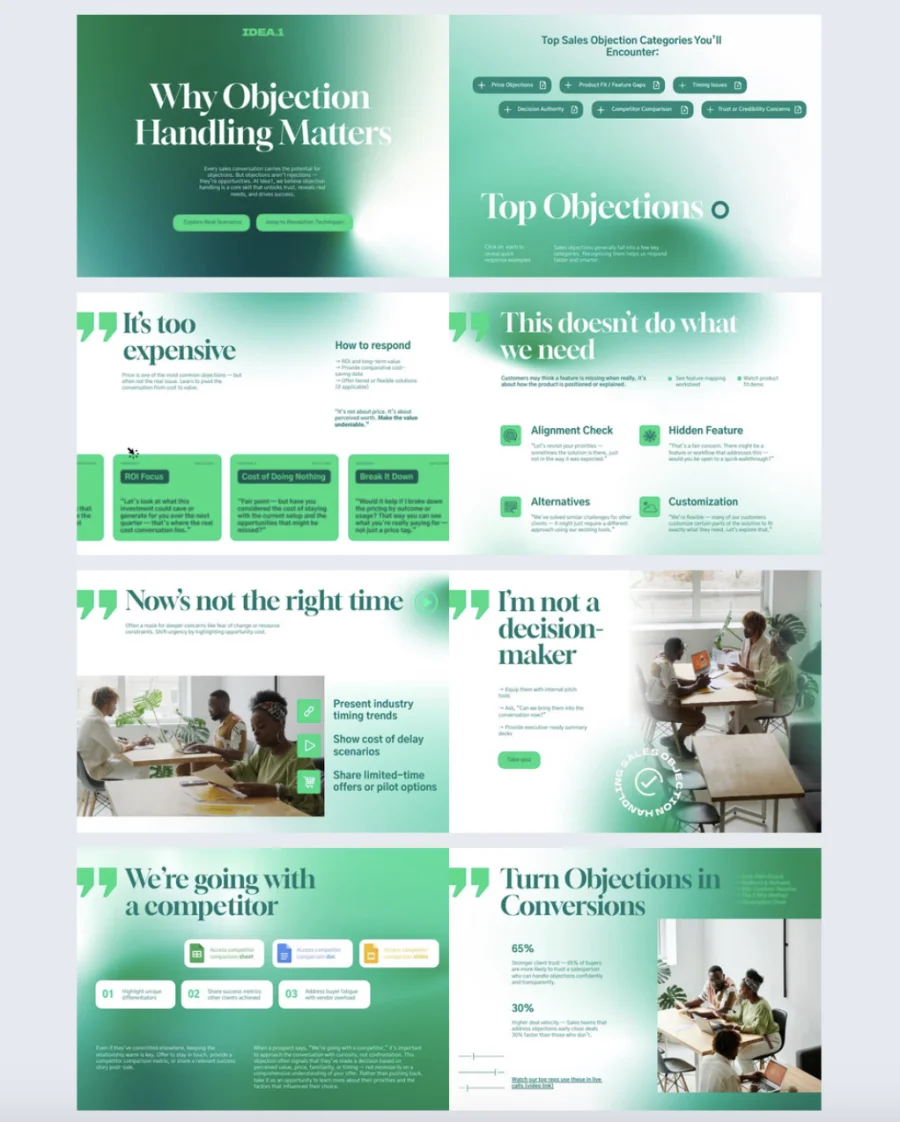

When to use this vs. Others: Choose this over the closing objection template when the context is a full pitch or proposal review. This template wraps the entire pitch around objection handling. The closing template focuses on the final decision moment only.
Real rollout example: A sales team at a 130-person software company used this template for a high-value enterprise renewal under rival threat. They built the final pitch around expected objections instead of product features. They addressed every major concern before the prospect raised it. The deal was renewed at a higher contract value than the year before.
Common pitfall to avoid: Don’t build a pitch that only handles the objections you expect. Use embedded question blocks and real-time flow to make space for new objections too. Prospects who feel heard close faster than those who feel processed.
Unique features: Dynamic checklists and polished slideshows; GIF motion effects and pop-up video responses; embedded quizzes and real-time flow buttons; data-driven elements that reinforce trust and urgency; secure private teamwork for team review.
2. Competitive objection handling template
Use our competitive objection handling template to sharpen your edge against rivals. This template helps you outline key differentiators and effectively address competitor-based objections. Designed to sharpen your edge against rivals, this template helps you outline key differentiators and address competitor-based objections. Include interactive product comparisons, video testimonials, and dynamic call-to-action buttons.
Best for: Sales reps and managers in rival markets where prospects often reference other solutions. Most of all useful in B2B SaaS, professional services, and technology sectors where feature and price side-by-side views are a standard part of the buyer’s process.
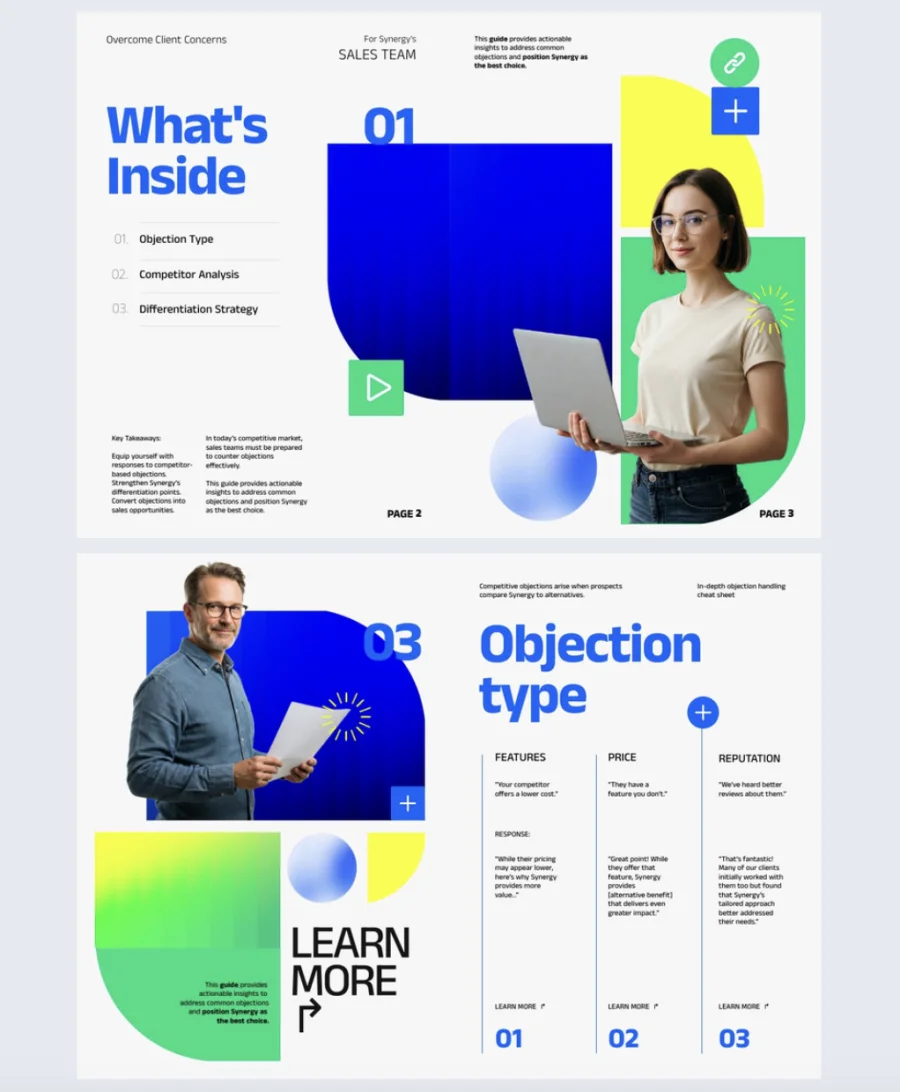
When to use this vs. Others: Choose this over the general script template when the exact challenge is rival placing yourself. This template goes deep on what sets you apart. A general script doesn’t have the depth to address rival cases properly.
Real rollout example: A sales training team at a 200-person B2B company built this template after a win/loss review showed that 34% of losses were due to reps being unable to stand out during rival reviews. Within one quarter of deploying the template, rivals’ win rate got better by 18%. Not because the product changed, but because reps had structured, evidence-backed responses.
Common pitfall to avoid: Don’t position your responses as attacks on the rival. “Here’s why they’re worse” is a losing frame. It sounds defensive and puts the prospect in an awkward spot. The right frame is “here’s what makes us right for your exact situation.”
Unique features: dynamic product side-by-side view tools; embedded video reviews from clients who switched from rivals; dynamic call-to-action buttons; full brand customization; engaging GIFs, videos, and quizzes.
3. Customer feedback objection template
Past negative experiences create some of the most deeply charged objections reps encounter. A previous bad rollout. A support issue that wasn’t resolved. Feedback from a peer in the industry. These can’t be handled with data alone. They need care, acknowledgment, and a structured process for rebuilding trust. This customer feedback template gives sales and support teams a step-by-step framework for turning criticism into trust.
Best for: Sales reps and customer success teams handling objections rooted in negative past history or doubt driven by peer feedback. Most of all useful in industries where customer reviews and referrals carry major weight in the buying decision.
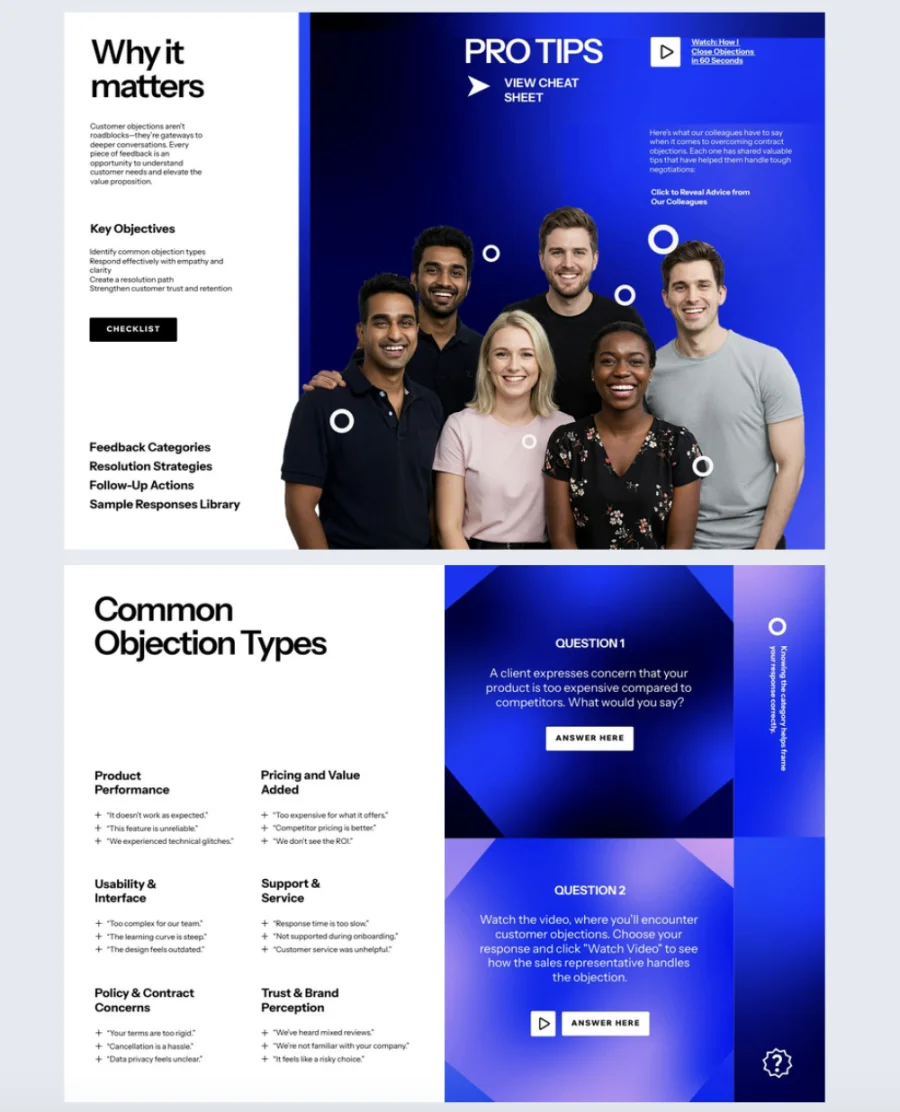
When to use this vs. Others: Choose this over the general script template when the concern is deep and history-based, not rational and information-based. A pricing objection responds to data. A trust objection responds to care and shown change. These need a different response structure.
Real rollout example: A customer success team at a 160-person company used this template after finding that enterprise renewal talks were stalling due to concerns about a past service issue. By structuring renewal calls around the feedback objection framework, they converted six of eight previously stalled renewals within one quarter.
Common pitfall to avoid: Don’t minimize the negative history before fully acknowledging it. Reps who rush to “yes but here’s what we did about it” before the prospect feels heard make things worse. Address fully first. Then redirect. Skipping step one makes step two fall flat.
Unique features: Embedded answer stories highlighting relevant success cases; structured follow-up plan templates; trackable feedback logs for openness; dynamic quizzes and spreadsheets for team training; private sharing via password-protected links.
4. Objection handling checklist template
Steady objection handling isn’t about memorizing perfect responses. It’s about following a reliable process every time. This checklist template gives sales managers and reps a clear, stage-by-stage framework. Active listening. Clarifying the real concern. Crafting a strategic response. Confirming answer. The structure turns a high-pressure moment into a repeatable, manageable process.
Best for: Sales managers and reps at companies of all sizes who want to move from ad hoc responses to a structured, responsible system. Most of all valuable for growing teams where rep-to-rep inconsistency in objection handling creates measurable variance in close rates.
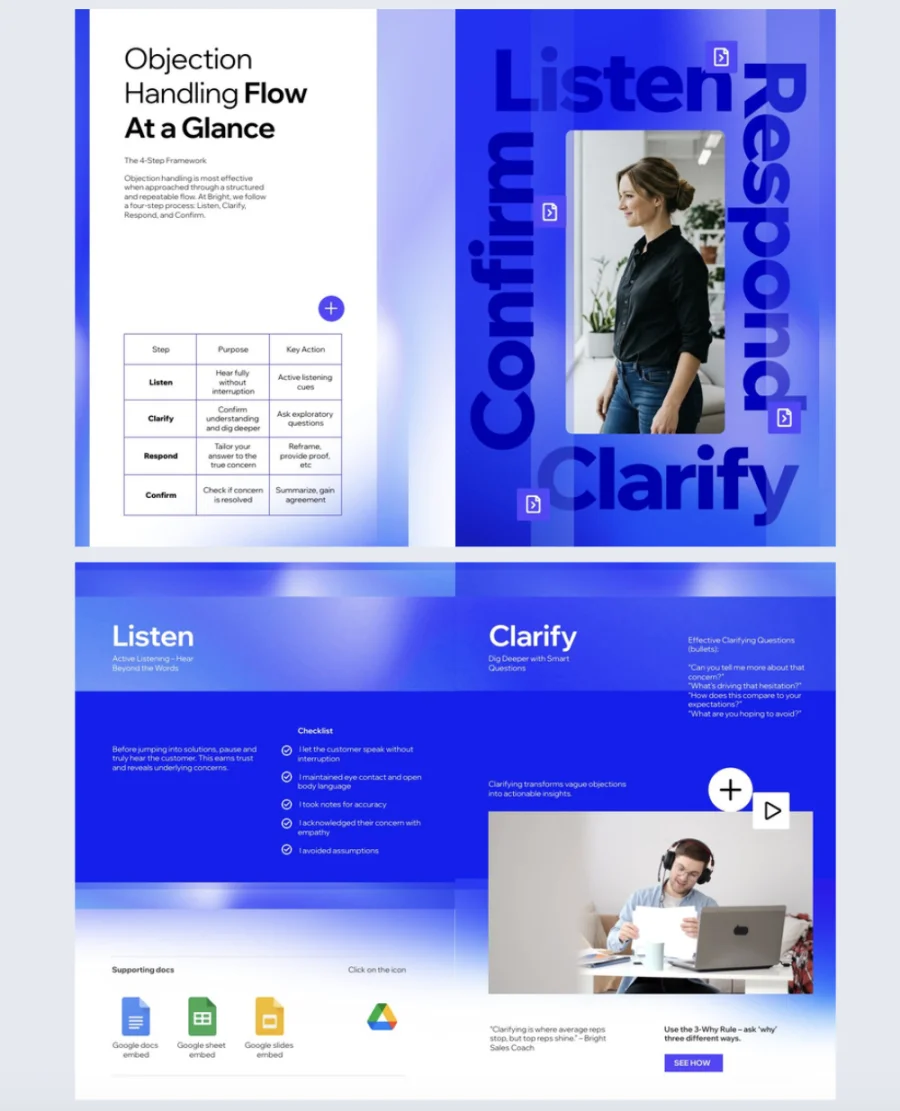
When to use this vs. Others: Choose this over the script templates when the goal is building process discipline, not providing exact language. The checklist ensures reps follow the right steps in the right order, regardless of the exact objection type. It makes every other template stronger when used alongside it.
Real rollout example: A sales manager at an 80-person company introduced this checklist as a mandatory pre-call prep tool. Most lost deals involved reps who had skipped the clarity step. They responded to what they assumed the objection meant, not what the prospect actually said. Within two months, manager-observed objection handling scores got better across the team.
Common pitfall to avoid: Don’t use the checklist only during training and then abandon it. The value of a checklist is in its steady use. Not just the learning phase. Build it into your pre-call prep routine and your post-call review process.
Unique features: Clear stage-by-stage structure from active listening through answer confirmation; embedded training records and dynamic sheets; contact forms for central knowledge sharing; Flipsnack data tracking, which sections get the most use.
5. Objection handling script template
In high-pressure sales calls, doubt costs deals. This script template gives reps a structured, modular framework for responding to the most common objection types. Pricing. Rival side-by-side views. Timing. Product fit. The responses are steady with brand messaging, flexible to each style, and truly convincing. Not obviously rehearsed.
Best for: All reps across team sizes and history levels. Use it for onboarding new hires, coaching mid-level reps, or refreshing veteran closers whose responses have become stale. This template works at every career stage because it’s built as a framework, not a verbatim script.
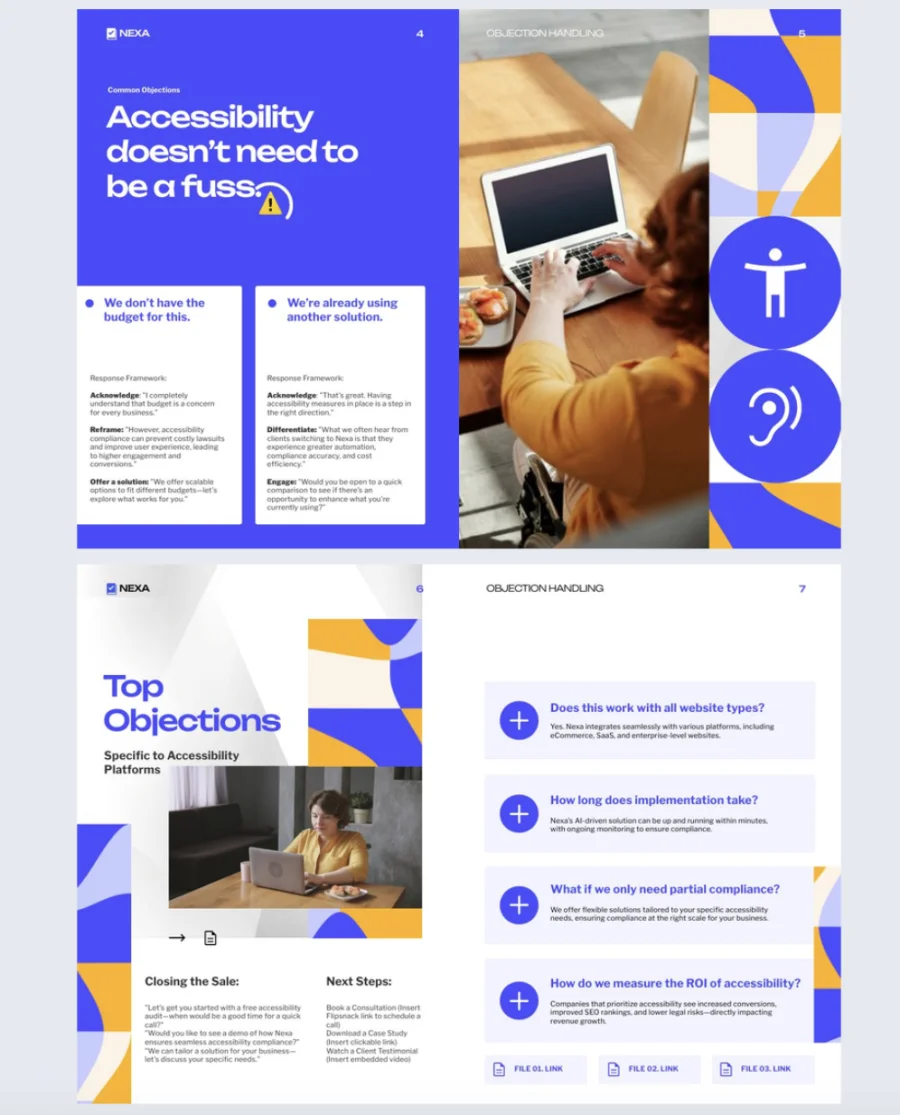
When to use this vs. Others: Choose this over the objection response script template when you need broad coverage across multiple objection types in one record. Use the script template for general prep and the response script for complex deal situations.
Real rollout example: A training team at a 175-person company deployed this template as the foundation of their new hire objection handling training. Instead of having new reps shadow senior sellers for weeks, they entered their first prospect calls with a clear framework for the four most common objection types. First-quarter close rates for new hires got better by 22% compared to the previous cohort.
Common pitfall to avoid: Don’t treat the script as something to memorize and recite. Prospects recognize scripted responses right away, and trust erodes. Train reps to take in the structure and key value points, then deliver them in their own voice. The template provides the setup. Authenticity provides the convincing.
Unique features: Modular content flexible across cases; GIFs, videos, spotlight motion effects, and flow buttons; accessibility-friendly design including screen-reader-compatible formats and captioned videos.
6. Objection handling training plan template
Train your sales team with structured modules and role-play exercises using the objection handling training plan template with structured modules and role-play exercises. Use Flipsnack’s tools to improve objection handling with engaging content. A training-focused template designed to prepare sales teams for real-world objection handling.
Best for: Sales trainers, training leads, and HR professionals at companies of all sizes building or refining structured objection handling training. Most of all useful for teams whose current approach is mainly shadow-based or ad hoc. Not systematically designed and measured.
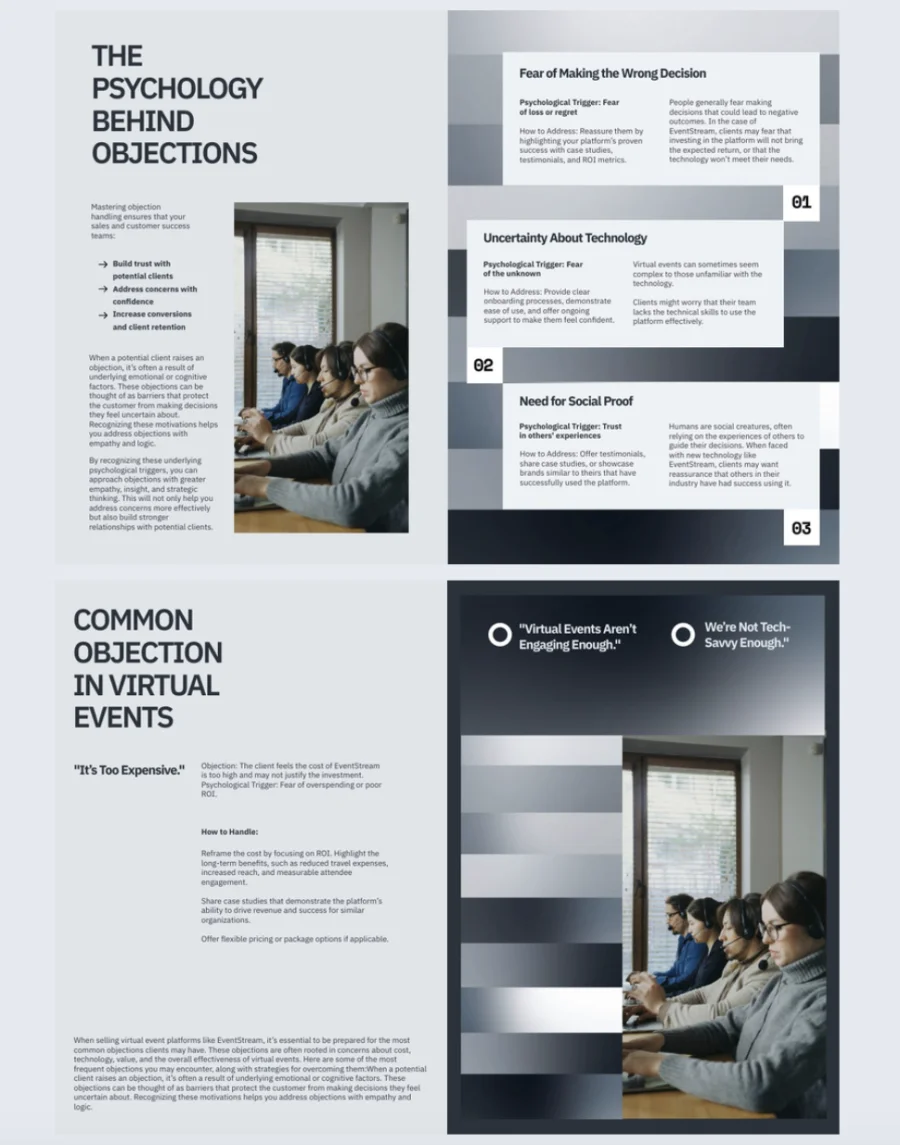
When to use this vs. Others: Choose this over the checklist or script templates when the work is designing a training program, not preparing for an exact call. The training plan is the program set up. The script and checklist templates are the resources used within it. Use them together for a complete objection handling system.
Real rollout example: An training lead at a 220-person company built a structured 4-week objection handling training program using this template. Their SDR team was failing to book second meetings, and objection handling was the main reason. By structuring training around modules, role-play cases, and review rubrics, they reduced the time to objection handling competency from 11 weeks to 6.
Common pitfall to avoid: Don’t build training modules and only evaluate reps at the end. Embed assessment checkpoints throughout the program. Quizzes after each module. Manager-evaluated role-plays at key milestones. Reps who are struggling should be found and supported during training, not after weeks of struggling in front of real prospects.
Unique features: Structured training modules with dynamic role-play cases; clear review criteria for measurable skill assessment; visual GIFs, videos, slideshows, and flow tools; co-growth capability for trainer teams.

7. Objection resolution framework template
The objection resolution framework template provides a structured, repeatable approach to handling even the most complex objections with precision and empathy. This format is specifically designed to promote active learning and scenario-based practice, enabling sales teams to internalize effective strategies and confidently apply them in real-world conversations.
Through dynamic slideshows, interactive questions, and pop-up videos, reps are guided through each critical phase of objection resolution: active listening, empathizing authentically, addressing concerns strategically, and closing with assurance. Rather than memorizing disconnected tactics, teams practice resolving objections within realistic frameworks that mirror client interactions.
Best for: All reps, with particular value for those handling complex B2B deals where objections are multi-layered or stakeholder-specific. Also ideal for managers who want to develop true objection handling capability in their team, not just surface-level script compliance.
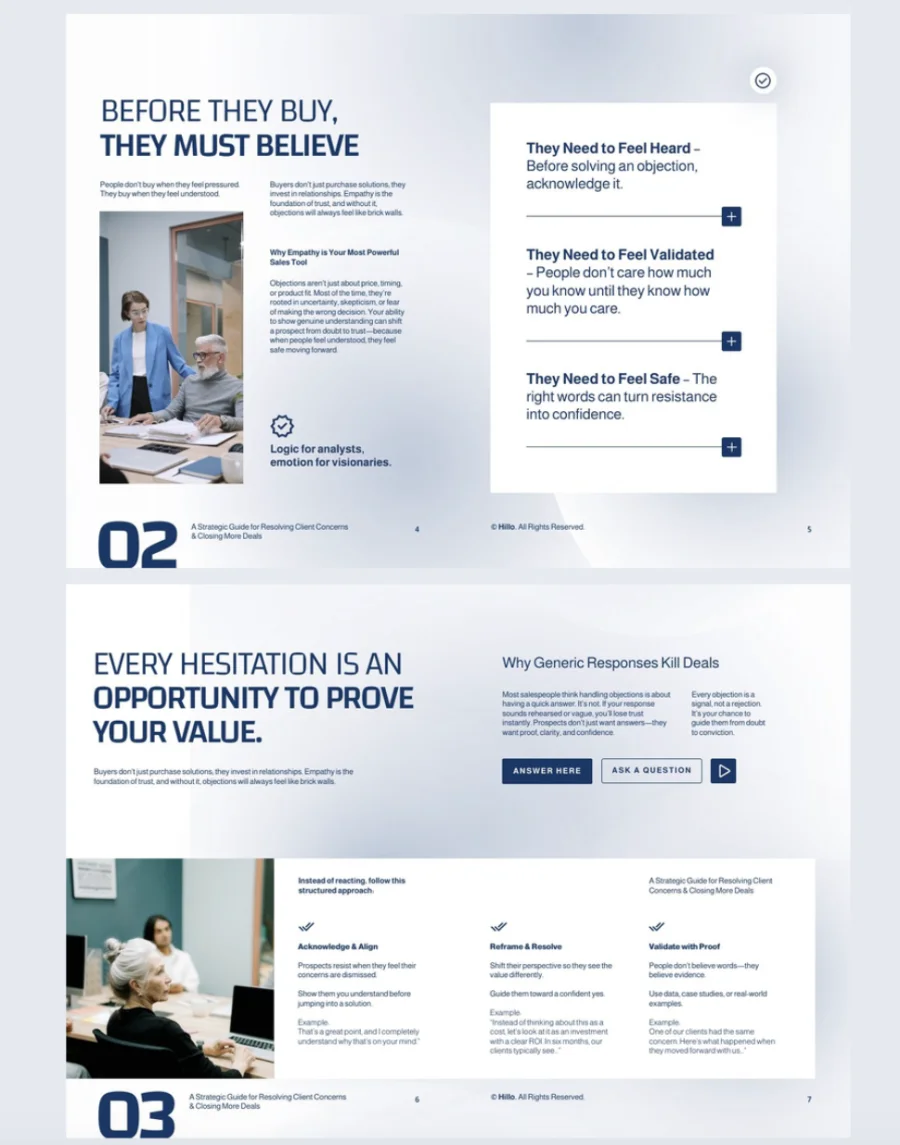
When to use this vs. others: Choose this over the script templates when the goal is developing adaptable judgment, not preparing for specific known objections. The framework is most valuable for experienced reps who have mastered the scripts and need to develop flexibility to handle new objections.
Real implementation example: A sales director at a 300-person enterprise software company used this framework as the capstone of their objection handling training program. Reps practiced resolution scenarios with dynamic slideshows and interactive question sets that didn’t telegraph the right answer in advance. They developed significantly stronger performance on objection types not covered in their prepared scripts.
Common pitfall to avoid: Don’t present this as a rigid process to follow step by step in live conversations. The framework is a preparation tool, not a live script. Reps should internalize the phases: listen, empathize, clarify, respond, confirm. Then apply them fluidly, not mechanically.
Unique features: Dynamic slideshows and interactive questions guiding each critical phase; pop-up video coaching for specific scenario types; secure distribution via password-protected links for proprietary frameworks; protects competitive intelligence while maintaining team-wide access.
8. Objection response script template
The objection response script template is built for the realities of nuanced sales conversations, where one-size-fits-all responses often fall short. This flexible resource supports full customization, empowering teams to craft tailored replies that address specific concerns around pricing, competition, timing, or product details with precision. By integrating dynamic elements like pie charts, embedded spreadsheets, quizzes, and scenario-based questions, teams can go beyond static responses. These features help sales reps visualize trends, analyze objection patterns, and practice personalized messaging within the same interactive document.
Best for: All reps handling complex or recurring objection scenarios where a generic category script isn’t specific enough. Especially useful for those building internal objection libraries or resolution playbooks that can be referenced across multiple deals and team members.
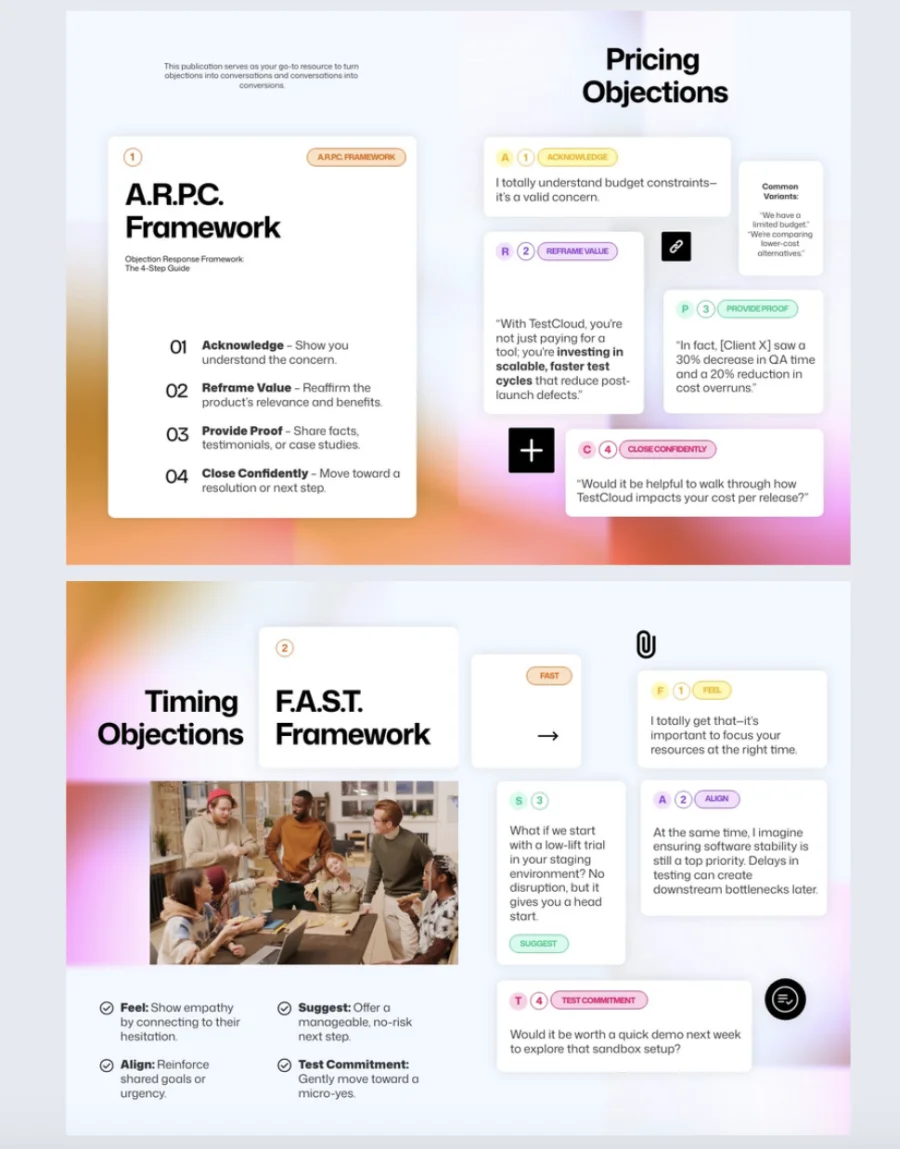
When to use this vs. others: Choose this over the general script template when a specific, recurring objection in your market needs a more detailed, evidence-backed response. Use both. The script template for general preparation. The response script for targeted scenarios where precision matters.
Real implementation example: A revenue operations team at a 150-person company used this template to build a library of 24 tailored objection responses. They covered their most frequently encountered scenarios, segmented by deal size, industry, and buyer persona. Reps who used the library in preparation for calls showed measurably higher conversion rates than those who relied on general preparation alone.
Common pitfall to avoid: Don’t build the response library and then leave it static. Objection patterns change as your market evolves and your product changes. Schedule a quarterly review of the library. Use Flipsnack analytics to track which responses reps access most.
Unique features: Embedded pie charts and spreadsheets for visualizing objection patterns; scenario-based interactive questions for active learning; scalable internal objection library structure; customizable by deal type, industry, and buyer persona.
9. Pricing objection handling template
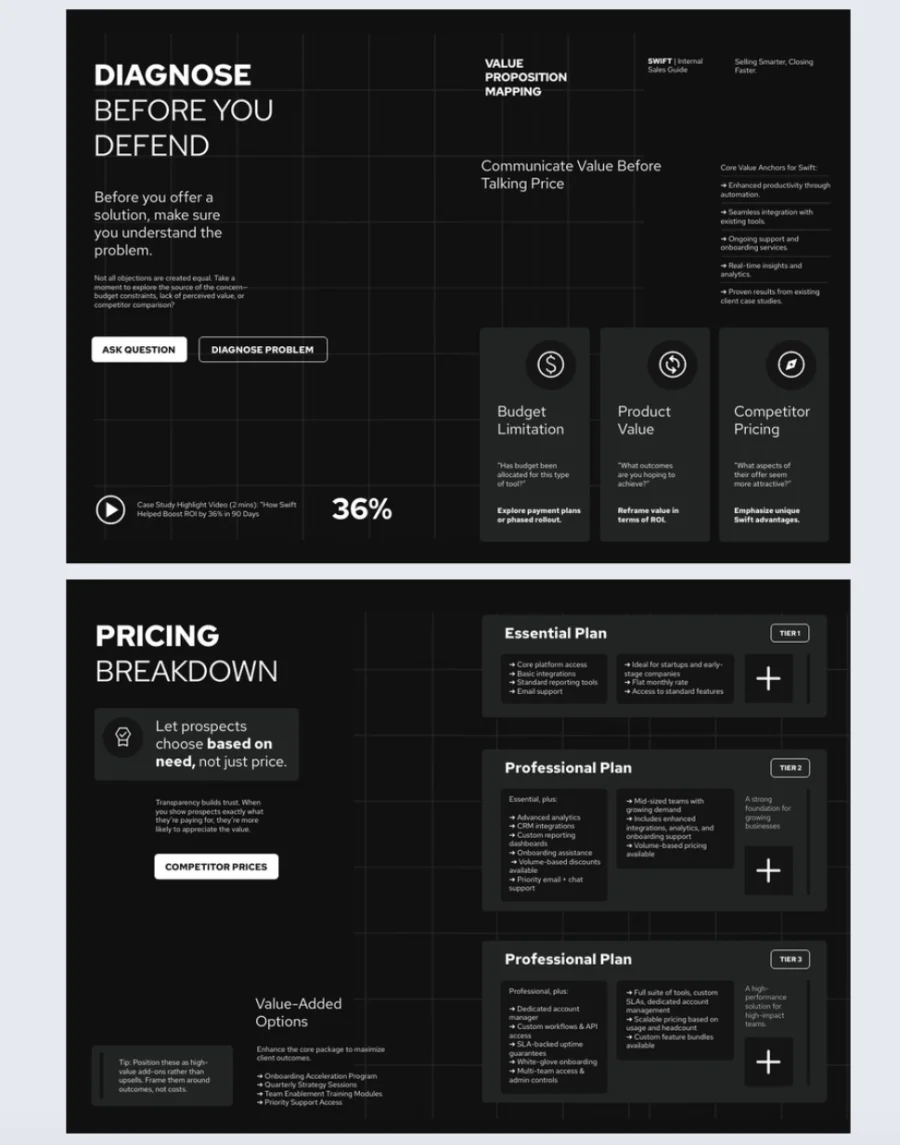
The pricing objection handling template is built to help sales teams reframe cost discussions into clear demonstrations of value. Given that pricing can often lead to hesitation, this interactive, persuasive resource equips your team to confidently justify ROI and highlight value propositions.
This template features a structured pricing breakdown, detailed cost-benefit analysis visuals, and compelling value narratives tailored for sales representatives and managers facing tough pricing objections. Dynamic elements like spotlight GIFs, pop-up cost calculators, quizzes, interactive charts, and forms keep prospects engaged, helping them see the true impact of their investment.
Best for: Sales reps and managers at companies of all sizes whose prospects regularly raise price as an objection. Especially useful in B2B environments where the cost-benefit case needs to be articulated clearly before budget approval decisions are made.
When to use this vs. others: Choose this over the general script template when pricing conversations are a consistent pattern in your deal cycle. Pricing objections are high-stakes enough to warrant their own specialized resource rather than a section in a general objection script.
Real implementation example: A sales team at a 110-person professional services company used this template after win/loss analysis showed that 48% of their losses involved price as the stated objection. By restructuring their pricing conversation around embedded cost-benefit visuals, pop-up ROI calculators, and specific case studies, their pricing-related loss rate dropped by 30% over two quarters. Without changing their pricing at all.
Common pitfall to avoid: Don’t bring up pricing before the prospect has fully understood the value of what you’re offering. Discussing price too early is one of the most common and costly sales mistakes. Use this template to prepare for conversations where price comes up, not to introduce price before value has been established.
Unique features: Structured pricing breakdown and cost-benefit analysis visuals; pop-up cost calculators and interactive ROI charts; AI-translated versions for global sales teams; integrated social proof links; perfect for use during sales calls, live demos, or post-presentation follow-ups.
10. Closing objection handling template
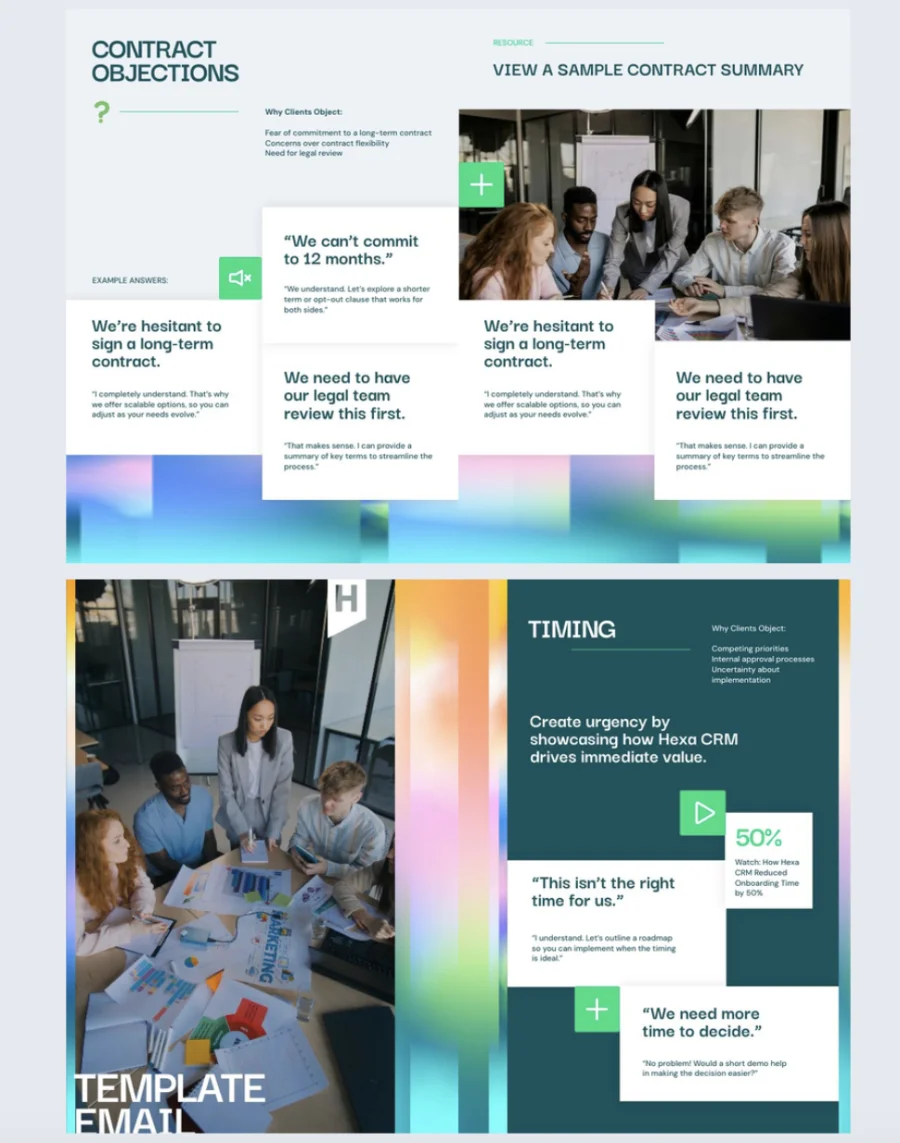
The closing objection handling template equips sales teams to confidently navigate the most critical, high-stakes moments of the deal the final decision stage. Because when last-minute doubts about contracts, timing, budgets, or final terms arise, having a persuasive, structured response can be the difference between a closed deal and a missed opportunity.
This interactive template leverages dynamic slides, engaging videos, quizzes, pop-up frames, audio prompts, GIFs, and checklists to help sales representatives systematically address every lingering concern. As a result, each element is crafted to reinforce key messages, build trust, and maintain momentum when hesitation threatens to stall progress.
Best for: Sales reps at companies of all sizes in the final stages of deals. Especially useful where late-stage objections have historically caused stalls or losses that weren’t anticipated based on earlier conversation momentum.
When to use this vs. others: Choose this over the general objection handling presentation template when the context is specifically the final decision moment. The closing template is purpose-built for the last mile. The presentation template covers the full pitch journey.
Real implementation example: A closing specialist at a 90-person SaaS company used this template for a high-value enterprise deal that had stalled at contract review for three weeks. By structuring the re-engagement around the closing objection framework, they identified the specific remaining concern and addressed it with relevant evidence. The deal moved to signature within five days of the follow-up conversation.
Common pitfall to avoid: Don’t mistake a stalled deal for a lost deal. Most prospects who raise last-minute closing objections haven’t decided against you. They’re experiencing doubt or internal friction that needs to be addressed, not surrendered to. This template gives reps specific, confidence-building responses for each type of final-stage hesitation.
Unique features: Dynamic slides, engaging videos, quizzes, pop-up frames, audio prompts, GIFs, and checklists; confidence-building structure for each common closing objection type; real-time collaborative refinement with managers and trainers; momentum-maintaining response architecture.
How to edit objection templates in Flipsnack
Creating a unified objection-handling process shouldn’t feel like juggling half-finished scripts, scattered responses, or outdated PDFs. With Flipsnack, you move from reactive improvisation to a centralized, interactive system designed for speed, alignment, and professionalism—without bottlenecks or design dependencies.
1. Choose a template or start from scratch
Browse Flipsnack’s library of objection handling templates or build your own from scratch using the drag-and-drop editor. Each template is pre-structured for a exact objection handling use case. You start with a format that reflects how objection calls actually work.
2. Customize with interactive elements
Insert GIFs, embedded video responses, clickable flow buttons, real-time forms, ROI tools, and case-based quizzes. These elements transform static scripts into engaging preparation tools. Every dynamic element makes the content more memorable and more likely to be used in live calls.
3. Collaborate with stakeholders
Assign roles, leave comments, and refine scripts with input from managers, trainers, and peers directly inside Flipsnack. Team-based growth produces better objection responses. Sales leaders know the deal dynamics. Product teams know the technical strengths. Marketing knows the messaging. Build that knowledge into the record together.
4. Share securely
Share objection handling materials via password-protected links for sensitive competitive content. Embed them directly in sales portals or LMS platforms for central access. Organize them into digital bookshelves for team-wide reference. Use SSO authentication for enterprise teams with compliance requirements. Role-based permissions ensure managers can refine content while reps access the published version, without version confusion.
5. Track usage and iterate
Use Flipsnack’s data dashboard to monitor which templates are accessed most, which sections get the most use, and which dynamic elements are being used. The sections reps revisit most often are the objection types where confidence is lowest. That data tells you exactly where to invest your next coaching and content growth effort.
Why Flipsnack makes objection handling easier and better
Objection handling is one of the highest-leverage skills in sales. And one of the hardest to develop at scale without structured records. Flipsnack gives sales teams purpose-built, fully editable templates. You can brand them to your voice, enrich them with media evidence, share them securely, and track what’s actually working.
The result is a sales team that approaches objections with prep and confidence, not improvisation and anxiety. And a manager who has the data to know which objection patterns need more focus before they show up as lost deals.
Frequently asked questions about objection handling templates
What is objection handling in sales?
Objection handling is the process of responding to a prospect’s concerns in a way that builds trust and moves the call forward. Objections are a normal part of every sales process. They represent what a buyer needs to resolve before they’re ready to move forward. They are not a sign that the deal is lost.
What are the most common types of sales objections?
The four most common types follow the BANT framework. Budget objections: “It’s too expensive,” or “We don’t have a budget right now.” Approval objections: “I need to check with my manager,” or “This isn’t my decision.” Need objections: “We’re happy with our current solution.” And Timing objections: “we’re not ready yet” or “let’s revisit next quarter.” Each type needs a different response approach. That’s why type-exact templates outperform generic scripts.
What is the best way to handle a pricing objection?
The strongest response is to return to value, not reduce price. Discounting right away signals that your original price wasn’t justified. It also invites more talk. Instead, reframe the call around ROI and exact business outcomes. What does the cost of not solving this problem look like? Use the pricing objection handling template to prepare cost-benefit visuals and client outcome evidence.
How do you handle competitive objections?
The key is to stand out without attacking. Instead of saying “here’s why the competitor is worse,” say “here’s what makes us the right fit for your situation.” Lead with your unique strengths. Use customer evidence from accounts that chose you. Ask discovery questions that surface the gaps in the competitor’s offering. No need for you to state them directly.
What is the difference between an objection handling script and a framework?
A script provides exact language for specific objection scenarios. What to say when a prospect says “your price is too high.” A framework provides the underlying structure for handling any objection. The sequence of steps: listen, clarify, show care, respond, confirm. Scripts are faster to apply. Frameworks are more durable and flexible. Use scripts for known high-frequency objections. Use frameworks for cases you haven’t fully anticipated.
How do you train a sales team on objection handling?
Start with an assessment. Find which objection types are causing the most deal losses through win/loss review before designing any training. Then build a structured program using the training plan template. Include explicit instruction, case-based role-play, and manager-evaluated skill demonstrations at key milestones. Reinforce with checklists for pre-call prep and scripts for the highest-frequency objection types.
How often should objection handling templates be updated?
Review your templates whenever the competitor landscape changes, pricing is updated, new product features are released, or a win/loss review reveals new objection patterns. At a minimum, do a quarterly review of your most-used templates. This ensures reps aren’t using outdated competitive comparisons or referencing discontinued offers. With Flipsnack, updates happen in place. The shared link always reflects the current version. No version confusion from email attachments.
What makes an objection handling template strong?
The strongest templates are built as frameworks, not verbatim scripts. They include evidence-based content: data, case studies, ROI calculations. They’re updated often as objection patterns evolve. And they’re structured for quick reference before a call, not for extended study. Templates that take more than 60 seconds to scan before a call will be ignored. Structure for practical use, not comprehensiveness.