Internal Corporate Communication in 2026: Build a Corporate Magazine With Flipsnack
Published on: December 14, 2021
Last update: January 19, 2026
Most internal corporate communication fails for the same reason. You publish important updates in places people already ignore. Email threads pile up, chat gets noisy, and the intranet becomes a dumping ground that nobody trusts.
A corporate magazine fixes a lot of that.
It turns scattered internal communication documents into a consistent, readable format people can actually follow. It also gives you one repeatable way to share company news without sending five follow-ups.
In this guide, corporate magazine is simply another way to say internal corporate communications.
It is a structured publication that keeps employees informed, supports culture, and gives leaders a reliable channel for updates. Think of it as a practical internal comms strategy that helps you publish consistently without adding more noise.
Flipsnack is a practical way to create those corporate magazines as branded flipbooks, share them securely, and track what people read.
Table of contents
- What is internal corporate communication?
- What does a corporate magazine include?
- Benefits of corporate magazin es
- Interactive internal documents changed the game for Keywords Studios US Human Resources
- A simple corporate magazine structure that covers what employees need
- How to build your corporate magazine with Flipsnack
- Step 1: Do a quick internal communication audit before you publish anything
- Step 2: Create your corporate magazine in Flipsnack
- Step 3: Make it interactive so employees do more than skim
- Step 4: Share it securely without making access a headache
- Step 5: Track what people actually read, then improve the next issue
- How to keep corporate magazines from turning into another channel nobody trusts
- Turn internal corporate communications into a magazine people will read
What is internal corporate communication?
Essentially, internal communication is the action or function responsible for effective communication within an organization. This could be anything from a simple message on a message board, all the way up to an entire corporate presentation.
Typically, the people in charge of internal communication are HR representatives or a designated expert in the field. To keep things aligned across teams, most companies rely on a few repeatable internal communication strategies that define what gets published, how often, and where employees should look first.
Some documents that can be considered internal communication:
- HR documents
- Onboarding documents
- Internal guides
- Employee benefits guides
- Employee handbooks
- Health & wellbeing documents
- Company newsletters
- Reports
- Even messages posted to work group chats
What does a corporate magazine include?
Internal corporate communication is not one thing.
It includes
- policy updates
- onboarding
- leadership messages
- benefits changes
- training materials
- weekly or monthly updates
The problem is not that teams do not communicate. The problem is that communication arrives in the wrong shape.
People get a PDF attachment they never open, a long email they skim, and a link they lose. A corporate internal communications magazine gives you a single format that is easier to consume, easier to maintain, and easier to measure.
Benefits of corporate magazines
1. Reduces overload
First, it reduces overload by bundling what matters into one publish moment, with a clear table of contents and sections. You can still send urgent alerts, but most updates do not need to compete in the inbox every day.
2. Improves clarity
Second, it improves clarity. A magazine forces you to explain the why, what changed, and what employees need to do next, instead of dropping raw information and hoping people figure it out. For instance, if some of your employees find your internal communications difficult to understand, you could provide them with access to language learning apps or courses to help them learn the local language, such as French or Italian.
3. Supports communication and employer branding
Third, it supports internal communication and employer branding. When internal communications look and feel like your brand, employees get a consistent signal about what the company stands for, and they feel recognized and valued.
Flipsnack supports this with branded templates and brand controls, so teams can publish with consistent logos, colors, fonts, and layouts.
Interactive internal documents changed the game for Keywords Studios US Human Resources
Keywords Studios US Human Resources in Bothell, Washington, manages internal communication for a 750-person team. They wanted employees to actually read HR updates, and they needed a safer way to share private documents.
Their struggles
They were relying on PDFs and PowerPoint files for internal comms, which were not very engaging and often became bulky email attachments. They also needed a web-based way to share documents that could be restricted to the right people.
How Flipsnack helped
Flipsnack gave them interactive, cloud-based flipbooks and a sharing setup that fit internal HR needs.
They used Flipsnack to:
- Add links, video, audio, and pop-ups to make HR content more engaging.
- Share documents through a web-based platform instead of sending heavy attachments.
- Protect private publications with password protection and other security options.
- Edit and update publications quickly, then share a link directly in the email body.
Key results
- Around 4,500 visits to internal documents within a year.
- Over 10,000 impressions.
- Employees spent more than 10 minutes reading a publication.
- A stronger internal communication approach that was rolled out from the US HR team to global partners.
- Secure corporate publications that were easier to manage and distribute.
A simple corporate magazine structure that covers what employees need
You do not need a huge publication. You need a reliable structure that repeats so employees know where to look.
A strong baseline structure looks like this:
- Lead section: A short leadership note, one page is enough. Make it specific and make it useful.
- What is changing: Policies, process changes, important deadlines, and decisions.
- What is working: Wins, customer stories, milestones, shout-outs. This is where culture becomes real.
- What employees should do next: Clear actions, owners, and dates.
- Questions and feedback: A place to ask, vote, or respond.
That last section matters more than most teams admit. Top-down communication breaks trust fast. Your current article calls this out directly, and it is still true. People tune out when they feel talked at.
Besides this structure, there are also a few extra things you can do:
Make it fun
If your culture allows it, make internal communication enjoyable. Most internal communication documents fail because they are long blocks of text that people skim or ignore. Instead, make your updates interactive. Use videos and images, break up text with clear sections, and add simple polls or short surveys when it helps. Interactivity, like videos and GIFs, keeps attention and makes people more likely to engage.
Take a look at this flipbook example below to see how interactive elements can change the experience.

Throw out top-down communication
Top-down communication is a one-way broadcast, and it often disconnects leaders from what employees actually need. It is not productive, and it can create blind spots because feedback stops flowing upward.
Replace it with cross communication. Make it normal for employees to ask questions, share context, and give feedback. Leaders still need to lead the message, but they should not be the only voice.
Email is your primary channel; use it properly
Email is still the backbone of corporate internal communications, but it does not have to be a wall of text that people skim, ignore, and forget. The best approach is to keep the email short and clear, then send employees to a more engaging update that is easy to read and revisit.
With Flipsnack, you can turn internal communication documents into interactive flipbooks and share them straight from an email as a simple link. Instead of sending heavy attachments, you send a corporate magazine-style issue that includes visuals, videos, and click-through sections, so the email becomes an invitation to something people actually want to open.
Another helpful email tool is Clean Email, which can help you manage your inbox, allowing you to focus on the most important messages.
Make communication easy and convenient
Internal corporate communication should be easy to find and easy to understand. That means meeting employees where they already work, especially remote and frontline teams who rely on laptops and mobile devices. For many teams, that includes email and team chat apps used for day-to-day coordination, alongside other internal tools. Network Right says proper infrastructure management is essential for maintaining seamless communication across distributed teams.
If employees have to hunt for messages or decode complicated wording, engagement drops. Keep language clear, publish updates in predictable places, and use formats that work on any device. At the same time, use internal communication and employer branding to reinforce values through consistent design and tone, without making every message feel like marketing.
How to build your corporate magazine with Flipsnack
Step 1: Do a quick internal communication audit before you publish anything
This does not need to be a formal project. You just need to stop guessing.
Ask these questions:
- What internal communication documents are you publishing today, and where do they live?
- Which messages are recurring, and which are one-offs?
- Which teams are not desk-based and do not live in email all day?
- What do you currently measure, beyond “sent”?
Once you see the mess on paper, the magazine becomes the solution. You move recurring content into the magazine, you keep urgent alerts separate, and you retire random updates that do not deserve attention.
If you want this to work for frontline teams, treat mobile access as a requirement, not a nice-to-have.
Flipsnack positions internal communications as content that should not get lost in email overload, and it is built to deliver updates in a trackable format.
Step 2: Create your corporate magazine in Flipsnack
The best way to fail is to make each issue from scratch. Consistency is the point, so start with a repeatable template.
In Flipsnack, you can create interactive documents from scratch or upload an existing file, then turn it into a publication and save it as a template.
Flipsnack supports branded document templates that others can use while preserving branding, which helps keep corporate internal communications consistent even when multiple teams contribute.
Practical approach:
Create one magazine template for company-wide news, then spin off lighter versions for departments if needed. Do not start with five magazines unless you want five editorial calendars to maintain.
Step 3: Make it interactive so employees do more than skim
If your magazine is just a prettier PDF, you are leaving results on the table. Interactivity is how you turn reading into action.
Flipsnack supports adding elements like videos, links, forms, and quizzes to make communication engaging.
Use interactivity for three things:
1. Clarify
Embed a short video update when text may be misunderstood.
2. Collect feedback
Add a form, poll, or embedded content so employees can respond inside the publication. Flipsnack supports embedding content using embed codes, which lets you place multimedia or interactive content directly in the flipbook.
3. Check understanding
If you publish training or policy changes, add a short quiz. Flipsnack quizzes are designed to test knowledge, gather feedback, and track results inside the flipbook.
This is the part most internal communication advice skips. They tell you to “listen to employees,” but they do not show you how to make listening part of the document itself. A corporate magazine makes that easy, because feedback becomes a regular section, not a separate campaign that gets forgotten.
Step 4: Share it securely without making access a headache
A corporate magazine often includes sensitive information. Strategy shifts, policy changes, internal numbers, and people updates should not leak.
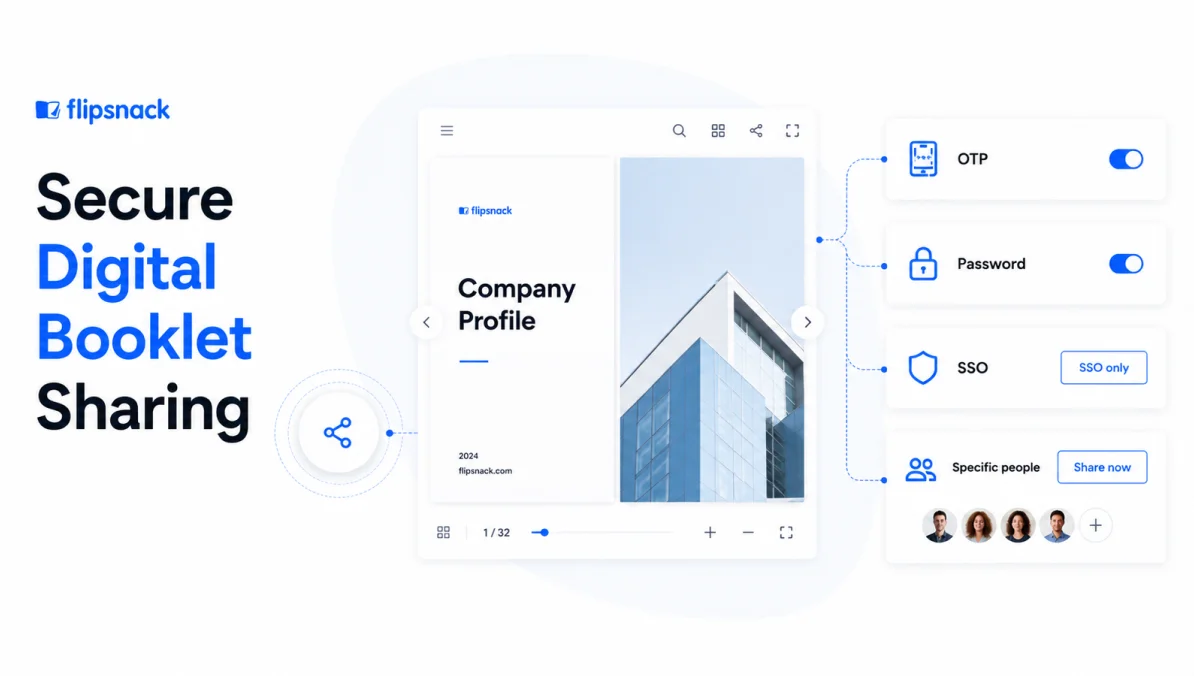
Flipsnack is explicit about secure sharing for internal corporate communications, including role-based permissions and SSO authentication for access control.
In Enterprise settings typical of a managed service provider, SSO sharing ensures employees authenticate through company credentials and are granted access only to authorized flipbooks.
For smaller teams or simpler rollouts, password protection is another option. Flipsnack’s help documentation describes password-locked flipbooks as a way to restrict access so only people with the password can view the content.
The point is not security theater. The point is trust. Employees should feel confident they are reading the current version from the official source, and leaders should feel confident that sensitive news stays internal.
Step 5: Track what people actually read, then improve the next issue
If you cannot measure internal corporate communication, you will end up arguing opinions instead of fixing the problem.
At minimum, track:
- Views and unique readers.
- Time spent reading.
- Drop off points.
- Clicks on key links and calls to action.
- Feedback submissions.
- Quiz completion and results when relevant.
Flipsnack positions built-in analytics as a way to monitor who views documents and measure reading activity, and it also calls out insights on every reader and shared document for internal communication use cases.
Then use the results to make decisions:
- If people open but do not finish, your magazine is too long, or the first pages are weak.
- If people finish but do not act, your calls to action are unclear.
- If people never open, your distribution is failing, or the magazine has no credibility.
This is what most solutions for corporate communication miss. They focus on publishing, not on behavior change. Measurement is what lets you stop guessing.
How to keep corporate magazines from turning into another channel nobody trusts
A corporate magazine becomes noise if it is inconsistent, bloated, or disconnected from real work. Here is how you prevent that.
1. Keep a predictable cadence
Weekly is fine for fast-moving orgs. Monthly is fine for slower rhythms. The bigger mistake is random publishing. People will not build a habit around surprise.
2. Be ruthless about length
If an update can be one paragraph, keep it one paragraph. Save depth for what is truly important.
3. Make ownership visible
Every major update should have an owner and a next step. If you publish “FYI only” content, employees learn to ignore you.
4. Close the feedback loop
If you ask for input, publish what you changed. “We heard you” only matters when it leads to action.
Turn internal corporate communications into a magazine people will read
A corporate magazine is one of the most effective ways to improve internal corporate communication because it gives employees a familiar format they can trust. Instead of scattering updates across emails, attachments, and chat threads, you publish a single issue that is easy to scan, easy to revisit, and hard to miss. Over time, that consistency strengthens corporate internal communications and supports internal communication and employer branding, because employees experience the same tone, design, and values in every update.
Flipsnack makes this approach realistic. You can turn internal communication documents into interactive flipbooks, keep them secure, and track what people actually read, then use that data to improve the next issue. When email stays the main channel and the magazine becomes the destination, internal corporate communications become clearer, more engaging, and easier to manage without adding more noise.