What is a Benefits Booklet in Group Benefits? Group Benefits Explained
Published on: September 25, 2026
What is a benefits booklet in group benefits?
Open enrollment starts Monday. Your team sends a 48-page PDF, and by Wednesday HR inboxes fill with identical questions about deductibles.
Most answers sit on page 31. Few employees scroll that far.
Your benefits aren’t the issue. Confusion is: about which document employees hold, what it legally has to say and how anyone finds anything inside it.
This guide covers what a benefits booklet is, how it compares with an SPD, SBC and certificate of coverage, what belongs inside and how to deliver one people read.
What is a benefits booklet?
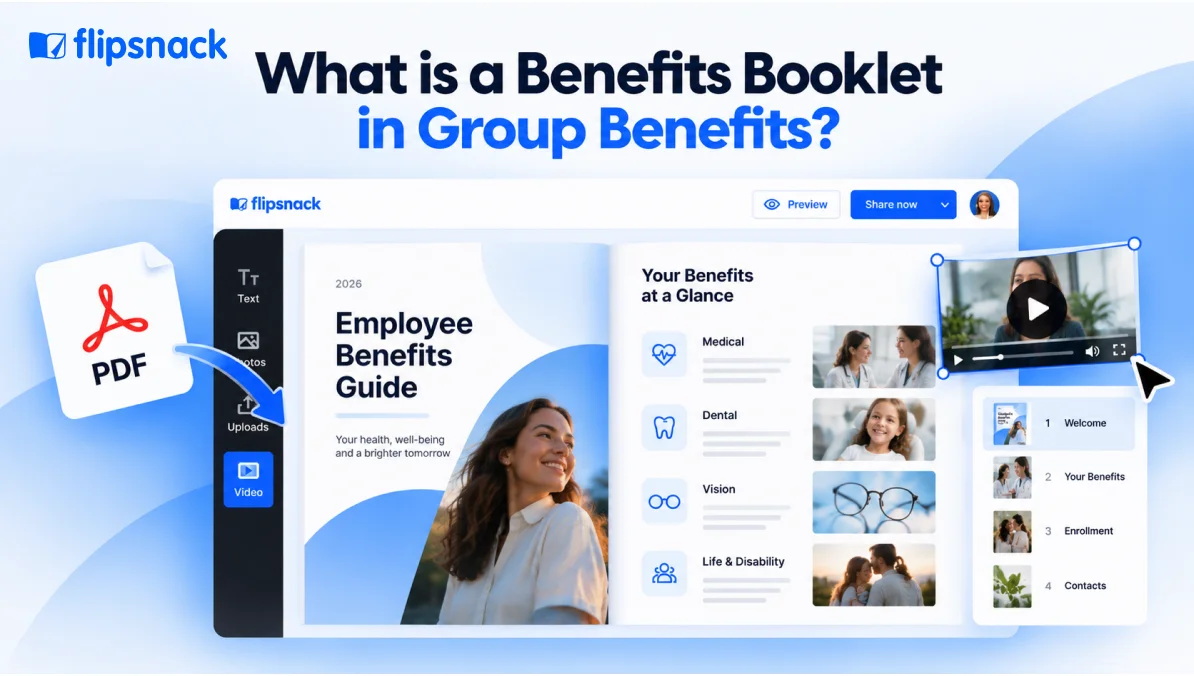
A benefits booklet is a plain-language document that explains every benefit in an employer’s group plan, including eligibility, coverage, costs, enrollment steps, and claims procedures. Insurance carriers, employers or benefits brokers issue one, usually at hire and before open enrollment.
In group insurance, “benefit booklet” often refers to the carrier’s certificate of coverage. HR teams also use the term for a branded guide that bundles medical, dental, vision, life and disability plans in one place.
Key takeaways
- Three possible authors. Carriers, employers and brokers each produce their own version.
- Not a legal label. No federal law requires a document called a “benefits booklet.” ERISA requires an SPD.
- Carrier booklets rarely suffice alone. Most employers add a wrap SPD to fill ERISA gaps.
- Format decides readership. Searchable, mobile-friendly booklets answer questions before they reach HR.
Who creates a benefits booklet: the carrier, the employer or the broker?
Three parties produce benefit booklets, and each version serves a separate purpose. Carriers issue the coverage certificate, employers own ERISA disclosures, and brokers often design the employee-facing guide that ties everything together.
| Who | What they produce | Main purpose |
| Insurance carrier | Certificate of coverage (some carriers say “evidence of coverage”) | Describes what an insured policy pays for, often under state insurance rules |
| Employer (plan sponsor) | SPD, wrap document, internal benefits booklet | Meets ERISA disclosure duties and explains company-specific rules |
| Benefits broker or consultant | Branded benefits guide or enrollment booklet | Translates several carrier documents into one readable overview |
Employees rarely know which version they’re holding. That’s why identical questions reach HR from three directions.
What’s inside an employee benefits booklet?
A complete employee benefits booklet covers who qualifies, what each plan includes, what coverage costs, how to enroll and how to file a claim. Keep a predictable order so employees locate answers without calling HR.
- Eligibility and waiting periods. Who qualifies, which dependents count and when coverage begins.
- Medical plan options. PPO, HMO and HDHP plans side by side, with deductibles, copays and out-of-pocket maximums.
- Employee contributions. Per-paycheck premiums for each coverage tier.
- HSA and FSA accounts. Contribution limits and which medical plan each account pairs with.
- Dental, vision, life and disability coverage. Flag whether premiums come out pre-tax or after-tax, since that changes how disability payouts get taxed.
- Wellness programs and extras. EAP access, fertility support, pet insurance, commuter perks.
- Enrollment steps and deadlines. Dates, portal links and rules for qualifying life events.
- Claims and appeals. How to file, who decides and how to contest a denial.
- Contacts and legal notices. Carrier phone numbers, plan administrator details and required notices.
Tip: Add a “What’s new this year” page right after your table of contents. Plan changes otherwise vanish inside 40 pages of unchanged detail.
Benefits booklet vs. SPD vs. SBC vs. certificate of coverage: what’s the difference?
A benefits booklet explains, the other documents satisfy legal duties. An SPD is the employer’s ERISA disclosure, an SBC is a standardized ACA summary of one medical plan and a certificate of coverage is the carrier’s description of an insured policy.
| Document | Who issues it | Required by | What it does | Format notes |
| Benefits booklet | Employer, carrier or broker | No law requires this label | Explains all benefits in plain language | Any length, print or digital |
| Certificate of coverage (COC) / evidence of coverage (EOC) | Insurance carrier | Often state insurance law, for insured plans | Details what an insured policy covers | Carrier template |
| Summary plan description (SPD) | Plan administrator, usually the employer | ERISA | Summarizes plan rights, rules and claims procedures | Due within 90 days of coverage |
| Summary of benefits and coverage (SBC) | Group health plan or insurer | Affordable Care Act | Lets employees compare medical plans on a standard form | Max four double-sided pages, 12-point font minimum |
| Plan document | Employer (plan sponsor) | ERISA | Governs the plan legally | Formal, rarely read by employees |
| Master group policy | Carrier, signed with the employer | Insurance contract | Binds carrier and employer | Employees seldom see it |
| Benefits guide | HR team or broker | None | Markets benefits during enrollment | Visual, branded |
One booklet can bundle several of these documents. Bundling doesn’t erase the separate legal requirements behind each one.
Can a carrier’s benefit booklet serve as your SPD?
Usually not on its own. Carrier certificates tend to omit employer-specific ERISA details, such as plan identification information, eligibility descriptions and circumstances that cause loss of benefits (Thomson Reuters).
Many employers close that gap with a wrap SPD. This separate document wraps around carrier booklets and adds the missing information. Practitioners on BenefitsLink state the rule plainly: “The burden of ERISA disclosure is on the employer, not the insurance carrier.”
Timing matters too. Plan administrators must furnish SPDs within 90 days after someone becomes covered, respond to written requests within 30 days and face penalties of up to $110 per day for late responses (Maynard Nexsen, October 2025).
This section explains terminology, not your plan’s obligations. Confirm requirements with your broker or ERISA counsel.
When do employees receive a benefits booklet?
Employees typically receive benefit booklets at hire, before each open enrollment period and whenever a plan changes materially. They can also request an SPD in writing at any time.
- New hires. SPDs are due within 90 days after coverage begins.
- Open enrollment. Most employers refresh and redistribute their booklet before the annual election window.
- Mid-year plan changes. A summary of material modifications (SMM) goes out within 210 days after the plan year ends, or within 60 days for material reductions in group health coverage.
- Periodic refresh. Updated SPDs are due at least every five years when material changes occurred.
- On request. Written requests get a response within 30 days.
Each of these moments is a distribution event. Every PDF re-send is another chance for employees to open last year’s file.
Should your benefits booklet be printed or digital?
Digital booklets win on speed, updates and tracking. Printed booklets still win for employees without reliable screen access. Most HR teams publish digitally and keep paper copies available on request.
| Capability | Printed booklet | Interactive flipbook | |
| Fix a typo after release | Reprint | Re-send a new file | Update behind the same link |
| See who read it | ✗ | ✗ | ✓ Views, clicks, time spent |
| Read on a phone | ✗ | Pinch and zoom | ✓ Screen-friendly |
| Embed video and portal links | ✗ | Links only | ✓ Video, links, clickable TOC |
| Works without a device | ✓ | ✓ Once downloaded | ✗ Needs a connection |
| Per-copy cost | Printing and postage | None | None |
Frontline, field and retiree populations often lack company email. For them, a mailed booklet remains the fairest option. For everyone else, a static file is the weakest link in benefits communication.
Can you send a benefits booklet electronically?
Yes, under conditions set by the U.S. Department of Labor. Group health plans currently rely on the DOL’s 2002 electronic disclosure safe harbor.
On July 23, 2026, the DOL proposed a new safe harbor for group health plans. It would let administrators post disclosures on secure websites and notify participants electronically. Email delivery of the documents themselves is excluded over HIPAA privacy concerns, and participants keep the right to free paper copies (Thomson Reuters; Federal Register). Comments closed September 21, 2026. The rule isn’t final yet.
Keep benefits booklets accessible and private
Benefits documents reach every employee, including screen reader users. Choose a format with keyboard navigation, page descriptions and a documented accessibility standard. Flipsnack’s player aligns with WCAG 2.1 Level AA and supports ADA and Section 508 requirements (Flipsnack accessibility).
Privacy matters equally. Unlisted links, password protection and SSO keep plan details inside your workforce, so a forwarded link doesn’t expose rates to the public.
Why do employees skip their benefits booklet?
The short answer: Length and structure. Health plan sections run longest, perks get buried and yearly changes look identical to last year’s pages. Employees skim, then email HR.
One financial planner calls the health section of a typical booklet “the longest and most overwhelming section” (Flow Financial Planning). Some employees now paste their enrollment documents into ChatGPT and ask for plain-language explanations of HDHP and PPO trade-offs (Tom’s Guide).
A static PDF waits to be read. An interactive booklet walks readers to the answer.
- Clickable table of contents. Employees jump straight to dental instead of scrolling past medical.
- “What’s new” page. Changes surface in seconds, not on page 27.
- Short video walkthroughs. A two-minute explainer beats three pages on deductibles.
- One-page plan comparison. Premiums, deductibles and out-of-pocket maximums in a single view.
- Phone-sized sections. Shift workers read on breaks, not at desks.
For more ideas, see our guide to engaging employee benefit guides.
Example: NC State Health Plan’s 2026 benefits booklet
The North Carolina State Health Plan publishes its 2026 Standard PPO Plan benefits booklet as a Flipsnack flipbook, with a dedicated accessible (ADA) version for members who use assistive technology.
What to borrow from it:
- One booklet per plan. Separate booklets for each plan option keep every document focused.
- Accessibility built in. An ADA-labeled version ships alongside the standard file.
- One link to share. Members open the booklet in a browser, with nothing to download.
How do you create a digital benefits booklet in Flipsnack?
Start from a template or your existing PDF, add interactive elements, share privately and track engagement. Most teams publish their first version in a day.
Step 1: Start from a template or upload your PDF
Pick one of the employee benefits templates or upload last year’s booklet. Uploading keeps your existing layout intact.
Step 2: Add links, video and a clickable table of contents
Link each plan to your enrollment portal and embed short explainer videos, so employees act without leaving the page.
Step 3: Apply your brand
Match colors, fonts and logos in Design Studio, so the booklet looks like it came from your company, not a carrier.
Step 4: Share privately
Publish as unlisted, add a password or require SSO, so only employees see plan rates.
Step 5: Track engagement and fix mistakes live
Check views, clicks and average time spent to see which sections employees open. Found a typo? Edit and refresh the same link.
My favorite part is that when you inevitably find a typo, you can just fix it and reload the corrected guide behind the scenes without calling attention to the error.
Jeffrey Lenderman, Lead Consultant
Flipsnack handles delivery, not legal drafting. You’ll still need your broker or counsel to confirm SPD content.
Final thoughts on benefits booklets
A benefits booklet isn’t one fixed document. It’s whichever version employees open when they need an answer, whether carrier certificate, SPD or branded guide.
Get the legal documents right first. Then make the version employees read searchable, current and measurable.
Your booklet already exists. The question is whether anyone reaches page 31.
Frequently asked questions about benefits booklets
No federal law requires a document called a “benefits booklet.” ERISA does require employers to give participants a summary plan description (SPD) within 90 days after coverage begins. Many employers deliver the SPD inside, or alongside, a broader benefits booklet.
Often, yes. Insurance carriers frequently call their certificate of coverage a “benefit booklet.” That carrier document describes an insured policy, but it usually lacks employer-specific ERISA details, so employers pair it with a wrap SPD.
A benefits booklet explains plan details comprehensively, sometimes for compliance. A benefits guide is a shorter, visual overview used to promote benefits during open enrollment. Many HR teams merge both into one branded document.
Yes. Group health plans can deliver ERISA disclosures electronically under the DOL’s 2002 safe harbor. A proposed 2026 rule would add secure-website delivery with electronic notice, but it isn’t final as of September 2026.
An employee benefit guide is a document that summarizes an employer’s benefits, including medical, dental, vision, retirement and wellness programs, so employees can compare options and enroll. Digital guides add links, video and search to cut HR questions.