Canva Flipbook with Flipsnack: Page-Turning Effects, Interactivity, and Analytics in Minutes
Published on: August 6, 2024
Last updated: June 8, 2026
Canva has changed the way people design. With its drag-and-drop editor, thousands of templates, and easy collaboration features, it’s no wonder that marketers, educators, and small businesses rely on it to create everything from brochures and presentations to catalogs and flyers.
But here’s the problem: when the design is done, you’re left with a static PDF or a Canva presentation link that doesn’t do much. That’s where Canva stops, and where your audience’s expectations begin.
A flat PDF can’t tell you if someone read it, which page they spent the most time on, or whether they clicked your call-to-action. It can’t embed videos, product galleries, or lead forms. And sharing a Canva presentation as a book-like experience? That’s not something Canva handles on its own. It certainly doesn’t deliver the premium, interactive experience that today’s customers and teams expect.
Instead of stopping at a static file, many professionals look for ways to turn a Canva design into a flipbook. Why? Because flipbooks add what Canva alone cannot: interactivity, measurable engagement, and a premium reading experience that works seamlessly across devices.
Not natively. Canva offers a “Page Turn” transition between slides in presentation mode, but that’s not the same as a true flipbook experience. The transition plays when you advance slides during a live presentation. It doesn’t create a browsable, book-like format that others can open and flip through on their own.
What most people are actually looking for when they search for a Canva animated page turn effect is an interactive digital publication that behaves like a real book: pages that curl and turn, a spread view, smooth navigation, and the ability to share it as a standalone link. Canva doesn’t offer that. A dedicated flipbook tool like Flipsnack does.
How to create a digital flipbook from your Canva PDF design
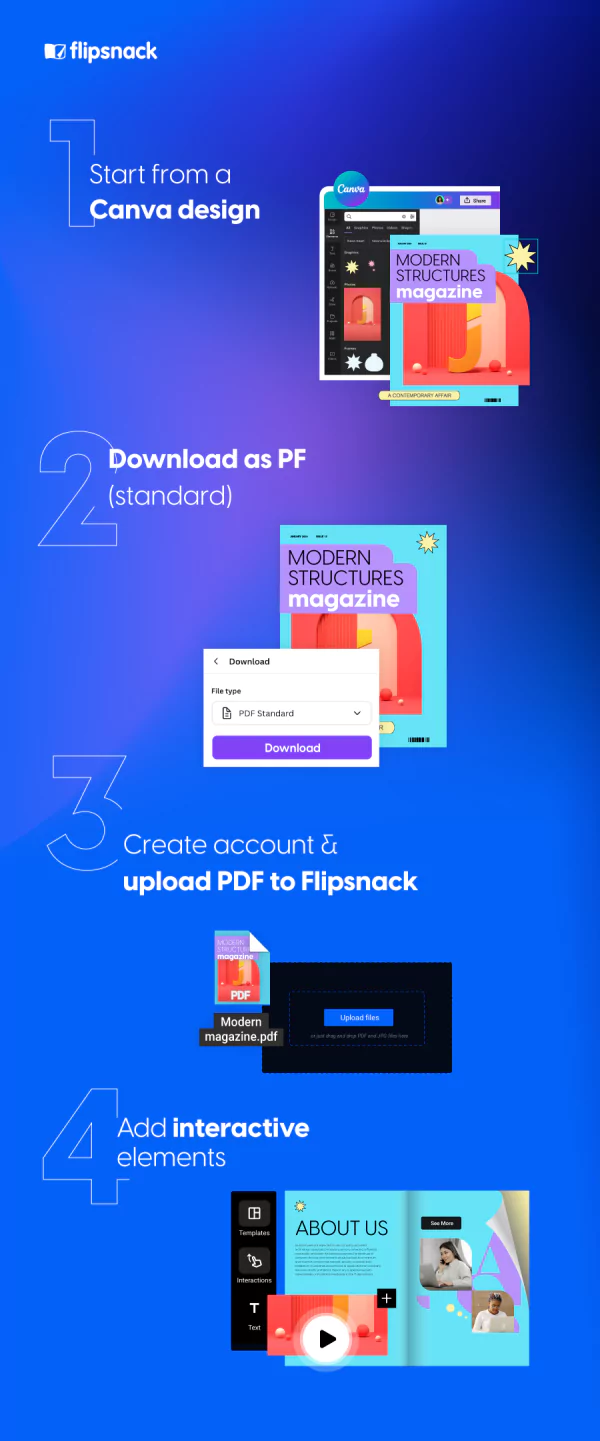
Creating a Canva flipbook with Flipsnack is a matter of a few clicks from the starting point, which is a Canva design.
1. Start from a Canva design or presentation
Pick a Canva template or build your design from scratch. This works whether you’re starting from a multi-page brochure, a product catalog, or a Canva presentation you want to share as a book-like format. For fresh layout and color ideas, see graphic inspiration before you export.
2. Download your Canva design as a PDF
Once your design is ready, download it as a PDF (standard quality). This is the file you’ll upload to Flipsnack in the next step. If you’re working from a Canva presentation, simply export it the same way — File > Download > PDF standard.
3. Upload your PDF to Flipsnack and convert it to a flipbook
Create a free Flipsnack account and upload your Canva PDF. The conversion from PDF to flipbook is fast and seamless. Flipsnack automatically applies the page-turning effect and formats your design as a browsable, book-like publication. Canva limits exports to 50MB, but Flipsnack accepts PDFs of any size, so you can publish without compromise.
Looking for a free Canva flipbook maker to get started? Flipsnack has a free plan with no credit card required. If your needs grow, paid plans unlock advanced analytics, private sharing, and full branding control.
4. Add interactive elements to your Canva flipbook
Once uploaded, Flipsnack’s Design Studio lets you layer interactivity directly onto your pages:
- Videos (YouTube or Vimeo)
- Clickable links and buttons
- Slideshows or image galleries
- Maps, charts, and forms
- Product tags or shopping lists
These elements transform your static Canva design into a dynamic, engaging experience — ideal for marketing catalogs, internal newsletters, or digital magazines that actually get read.
What Flipsnack adds to your Canva flipbook
Now that you know how to convert a Canva design into a flipbook, let’s look at what Flipsnack brings to the table beyond the page-turning effect. Instead of juggling multiple tools for design, distribution, security, and analytics, you can manage everything in one place.
1. Increase engagement through interactive elements
The biggest limitation of a static Canva PDF is that it can’t respond to your audience. Flipsnack changes that by letting you layer interactive elements directly onto your pages: videos, hyperlinks, navigation buttons, photo slideshows, interactive maps, and lead forms. Each of these keeps readers engaged longer and gives them more ways to act on what they’re reading, whether that’s browsing a digital magazine, exploring a product catalog, or receiving an internal company newsletter.
- Videos: Embed YouTube or Vimeo videos directly onto your flipbook pages for a richer reading experience.
- Hyperlinks and navigation buttons: Add clickable links for additional information, or go-to buttons that make navigation smoother and more intuitive.
- Photo slideshows: Insert up to 10 images in a single space-saving gallery — perfect for showcasing product variations or team event photos.
- Interactive maps: Add a Google map as an iframe by searching for a location and copying the embed link under the Share button. Especially useful for real estate brochures and listings.
- Lead forms: Use form fields to gate content, collect survey responses, or capture consultation requests directly from within your flipbook.
2. Share your Canva flipbook publicly or privately
One of the most practical advantages of publishing your Canva design as a flipbook is the control you get over how it’s shared. Whether your content is meant for a wide public audience or a specific internal team, Flipsnack covers both.
Public sharing
- Full-view link: Distribute your flipbook via a clean, distraction-free link that works responsively on any device.
- Email: Send catalog offers or monthly updates to your audience. Flipsnack lets you upload up to 1,000 addresses at once.
- Social media: Share a short GIF or 20-second MP4 teaser to drive traffic to your full flipbook.
Private sharing
- Unlisted: Keep your publication hidden from search engines. Only people with your shared link can access it.
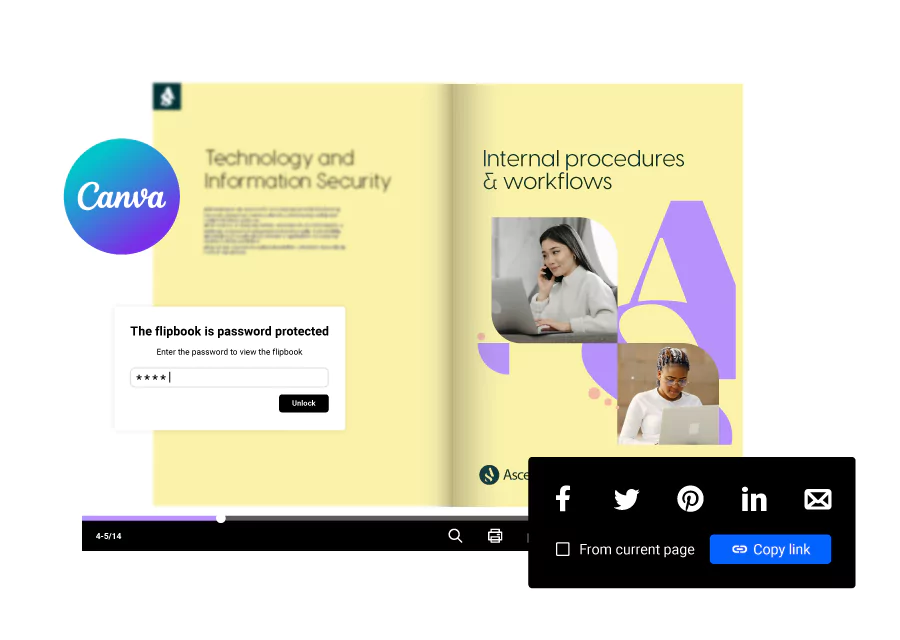
- Password protection: Require a password before readers can view the content, so only authorized people get in.
- SSO (Single Sign-On): Connect your company’s SSO system to Flipsnack for seamless, secure internal access.
3. Track how readers interact with your Canva flipbook
Publishing a static Canva PDF means you have no idea what happens after someone opens it. With Flipsnack, you get detailed analytics on every flipbook you publish — useful whether you’re sending a monthly newsletter, a sales presentation, or a product catalog.
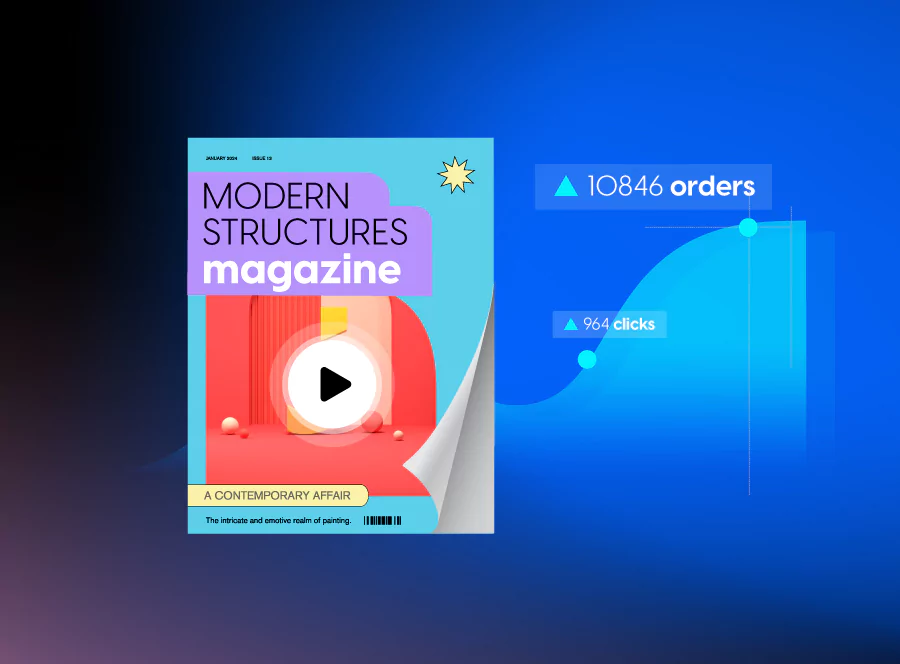
- Views & impressions – measure how many people saw and interacted with your flipbook.
- Clicks on interactive elements – understand which videos, links, or CTAs drive engagement.
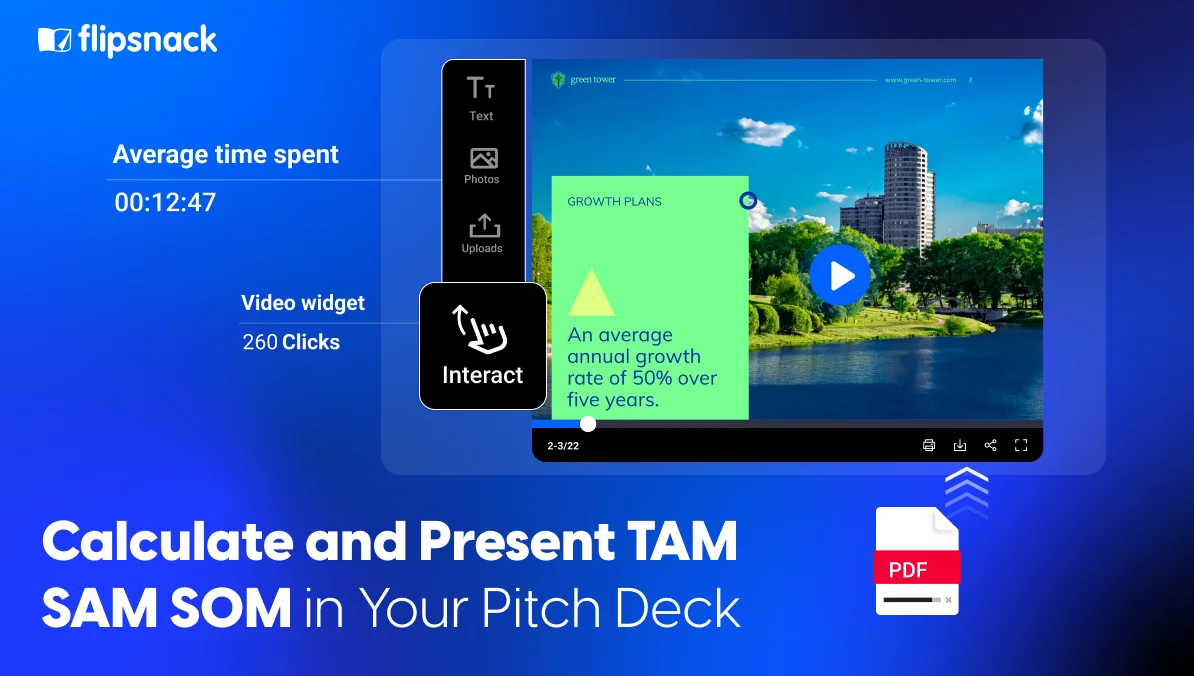
- Average time spent – shows how much attention your publication actually gets.
- Devices used – optimize design for desktop, tablet, or mobile.
- AI-driven insights – auto-generated reports that interpret results and suggest improvements.
- Heatmaps – visualize which buttons, links, or videos get the most clicks (Enterprise).
- Page-level performance – compare engagement across individual pages.
- Source & device tracking – see where readers come from (direct link, embed, social).
- Shopping list stats – track product views, orders, and revenue in digital catalogs.
- Lead capture & form responses – gather leads, quiz answers, or customer feedback directly from flipbooks.
Canva flipbook integrations and alternatives: How does Flipsnack compare?
If you’ve been searching for a way to get a page-turning effect directly inside Canva, you’ve probably come across a few options. Some tools, like Heyzine and FlippingBook, have apps listed in the Canva app directory, which means you can connect them without leaving Canva. That sounds convenient, but it’s worth understanding what you actually get before committing to a workflow.
Most of these integrations simply take your Canva design and convert it to a flipbook in their platform — the same workflow you’d follow by exporting a PDF and uploading it manually. The “native” connection saves one step, but it doesn’t change what the tool can do with your design once it gets there. That’s where the real differences show up: interactivity, analytics, sharing controls, and branding.
Flipsnack doesn’t have a Canva app directory listing, but it doesn’t need one. The PDF export and upload process takes under a minute, and what you get on the other side (a fully interactive flipbook with analytics, private sharing options, and complete branding control) goes further than what most Canva-native integrations offer. Here’s how the main options compare:
| Feature | Flipsnack | Heyzine | FlippingBook | Publuu | Simplebooklet |
| Design editor | Built-in Design Studio with templates, brand kits, and collaborative editing | None – upload PDFs only | None – PDF upload only | None – PDF upload only | Basic layouts + Canva/Adobe integrations |
| Flipbook creation | Design from scratch or upload PDFs | PDF → flipbook | PDF → flipbook | PDF → flipbook | PDF → flipbook |
| Interactive elements | Videos, links, slideshows, lead forms, maps, shopping lists | Basic (links, videos) | Videos, links, forms, quizzes | Links, videos, GIFs, lead forms | Basic animations, links, and forms |
| Analytics & tracking | Advanced analytics (views, clicks, time spent, device data) + Google Analytics | Basic views + simple stats | Engagement & geo analytics | Advanced stats + Google Analytics | Page-level reports (Business tier) |
| Sharing options | Public & private links, password protection, unlisted, SSO, embed, domain restriction | Public or password-protected links | Public and password-protected embeds | Public links, password protection | Public links, domain restriction |
| Branding control | Full white-label, custom domains, branded dashboards, bookshelves, locked templates, and brand kit | Basic white branding (Premium only) | Full white-label, custom domains, branded dashboards, and bookshelves | Custom domains on higher tiers | Custom domains (Pro+), limited white-label |
| Best for | Enterprise companies, secure, interactive publications with analytics and design flexibility | Simple flipbook conversion | Corporate reports & sales materials | Quick PDF sharing | Small teams using Canva or Adobe Express |
Final thoughts on Canva flipbooks
Canva is a genuinely powerful design tool, and if you’re already using it to create brochures, catalogs, presentations, or newsletters, you’re starting from a strong place. But design is only half the job. What happens after you export matters just as much — how your content is shared, whether people actually engage with it, and what you can learn from that engagement.
That’s the gap Flipsnack fills. Export your Canva design as a PDF, upload it to Flipsnack, and within a minute you have a fully interactive flipbook with a real page-turning effect, embeddable media, secure sharing options, and analytics that tell you exactly how your audience is reading. Whether you’re publishing a product catalog, sharing a Canva presentation as a book-like experience, or distributing internal communications to your team, the workflow is the same and the results are measurably better than a static PDF.
Try Flipsnack today and turn your Canva designs into flipbooks that actually perform.
Frequently asked questions about Canva flipbooks
Canva is an excellent design tool, but it doesn’t have a native flipbook feature. You can design brochures, catalogs, or presentations in Canva, but the result is a static PDF. To make a true flipbook with page-turning effects, interactivity, and analytics, you’ll need to export your Canva design and upload it to a flipbook maker like Flipsnack.
Creating a digital flipbook in Canva is simple, but it’s important to understand that Canva itself doesn’t offer a true flipbook experience — it only lets you design and export your pages. The interactive page-flip effect and analytics come when you upload your design to a flipbook platform like Flipsnack.
Start by finishing your Canva design, then download it as a PDF (standard quality). Then go to your Flipsnack account, upload the PDF, and it converts into a digital flipbook automatically. The whole process takes under a minute.
A “Canva flipbook” is usually just a Canva design saved as a PDF and presented in a page-flip viewer. It looks like a flipbook but has no interactivity, no analytics, and no advanced sharing options. A Flipsnack flipbook goes further: you can embed videos, links, slideshows, and lead forms, and track exactly how readers interact with your content. Flipsnack also gives you private sharing, password protection, and full branding control — things Canva alone doesn’t provide.
Not directly. Canva lets you add design elements, but once exported as a PDF those elements are static. With Flipsnack, you can upload your Canva PDF and add interactive features like videos, clickable links, navigation buttons, maps, and lead forms — turning your static design into a fully interactive experience.
Yes. Export your Canva presentation as a PDF (File > Download > PDF standard), then upload it to Flipsnack. The page-turning effect is applied automatically, and you can share it as a standalone link, embed it on a website, or distribute it privately to a specific audience. It’s the simplest way to share a Canva presentation in a book-like format without rebuilding it from scratch.